General
Back to News
GeneralJul 7, 2026
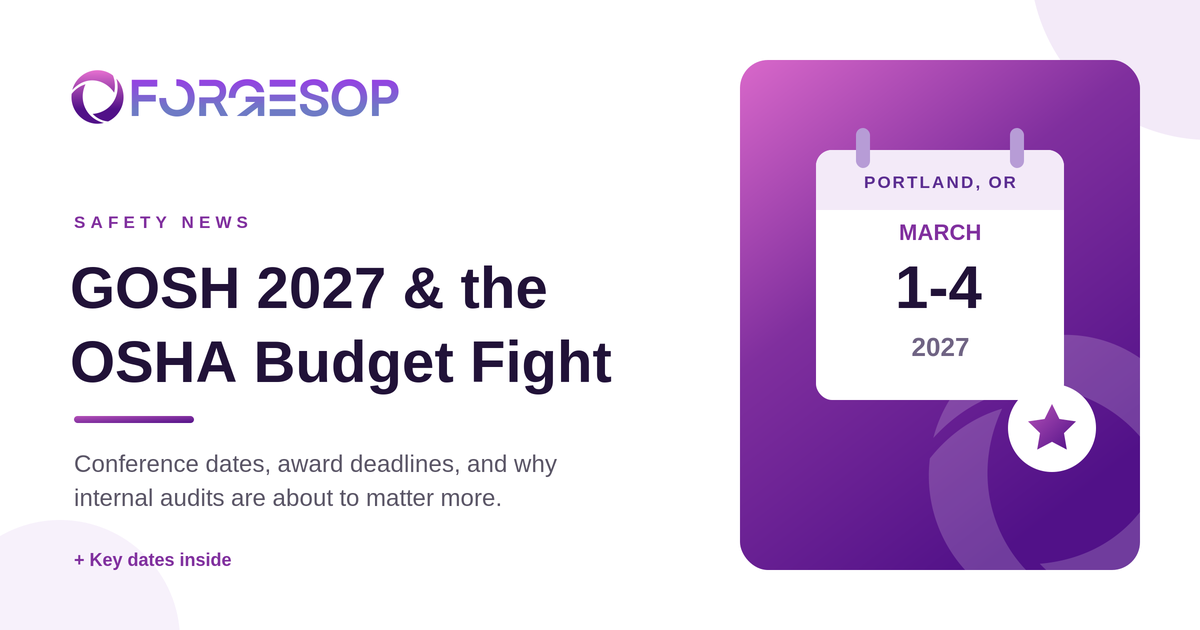
Oregon Sets Its 2027 Safety Conference. The Backdrop Is a Shrinking OSHA.
Two safety stories landed in the same week, and they are more connected than they look. Oregon OSHA announced the dates for the 2027 Governor’s Occupational Safety and Health (GOSH) Conference, the largest workplace safety event in the Pacific Northwest. Two days later, a national advocacy group urged the Senate to reject a proposed 7.5 percent cut to federal OSHA’s budget.
One story is about building safety capability. The other is about what happens to outside enforcement while you do. Both point the same direction for employers: the safety program you run internally is carrying more of the load.
Key takeaways
The 2027 GOSH Conference runs March 1 to 4 at the Oregon Convention Center in Portland, with more than 160 workshops and sessions across industries.
Registration opens in early 2027, but one deadline is live now: nominations for the conference’s safety awards close October 12, 2026.
GOSH is a collaboration among Oregon OSHA, the Columbia-Willamette ASSP chapter, and labor and business groups in Oregon and southwest Washington.
The administration’s FY 2027 budget proposes cutting OSHA funding by $46.9 million (7.5 percent), part of a 24.8 percent reduction across the Department of Labor.
Peer-reviewed research says inspections work: random OSHA inspections cut injury rates by 9.4 percent, and first-time scheduled inspections cut plant fatality rates by half. Fewer inspections shifts that job to your own audit program.
GOSH 2027: what was announced
On June 23, Oregon OSHA set the dates and headline details for the 2027 Oregon Governor’s Occupational Safety and Health Conference: March 1 to 4, 2027, at the Oregon Convention Center in Portland. The agency bills GOSH as the largest workplace health and safety conference in the Pacific Northwest and one of the largest in the country, built to give attendees practical knowledge, training, and tools for strengthening worker protection while reducing employer costs.
The program spans more than 160 workshops and sessions. The keynote comes from Hoan Do, an author and international speaker best known as a finalist on NBC’s “American Ninja Warrior.”
The conference is a joint effort: Oregon OSHA runs it with the Columbia-Willamette Chapter of the American Society of Safety Professionals and labor and business organizations from Oregon and southwest Washington.
The deadline that matters before registration opens
Registration is not expected to open until early 2027, so the date most safety leaders can act on now is October 12, 2026: the close of nominations for the conference awards, which honor people and organizations making exceptional contributions to workplace safety and health. If your team closed out a strong year, documented injury reductions, or built a program worth copying, the nomination is free visibility for work that usually stays invisible.
Worth remembering for out-of-state readers: Oregon OSHA is one of 22 state plans approved by federal OSHA, covering private sector as well as state and local government workers. State programs must be at least as effective as federal OSHA under the OSH Act of 1970, and several run conferences like GOSH. If Portland is far, your own state plan’s calendar is worth a check.
The other story: a 7.5 percent cut to federal OSHA
Two days after the GOSH announcement, Public Citizen, a nonprofit consumer and worker advocacy group, sent an open letter urging Senate committees to hold OSHA funding at no less than its FY 2026 level of $629.3 million.
The administration’s FY 2027 request would reduce OSHA’s budget by $46.9 million, to $582.4 million, within a proposed 24.8 percent cut to the Department of Labor’s discretionary budget overall. The department frames the request as a shift toward prioritizing compliance assistance over enforcement. Public Citizen’s letter argues enforcement capacity is “already dangerously thin,” citing a ratio of roughly one compliance officer for every 93,877 workers.
The group’s case leans on a stack of peer-reviewed evidence that inspections change outcomes. A study published in Science found random OSHA inspections reduced injury rates by 9.4 percent and injury costs by 26 percent at inspected facilities, with no detectable harm to employment, sales, or firm survival. Follow-up work in the American Economic Journal estimated each random inspection prevents about 9 percent of serious injuries over five years and generates roughly $125,000 in social benefit, about 35 times the inspection’s cost. A separate analysis found first-time scheduled inspections cut plant fatality rates by 52 to 57 percent.
What this means for employers
Read the two stories together and the message is not subtle. The training and networking infrastructure for safety is healthy and growing; the enforcement infrastructure may be about to shrink. Whatever happens in the Senate, the practical planning assumption for 2027 is fewer external eyes on your operation.
The research above explains why inspections work: they find hazards before incidents do, and they force findings to become fixes. Nothing stops an employer from running that same mechanism internally. A scheduled internal audit program with documented findings, owners, due dates, and verified closure is a private version of the thing the studies measured, and it is entirely in your control. Digital audit checklists tied to your procedures, with findings that flow into tracked corrective actions, make the discipline routine instead of heroic. That is the posture that pays off whether your next inspection comes from a regulator, a client, or nobody at all: [audit-ready operations](/blog/audit-ready-safety-operations) do not depend on who shows up.
And if you want a year’s worth of ideas for what to audit, train, and fix next, that is what four days in Portland next March is for.
Frequently asked questions
When and where is the 2027 GOSH Conference?
March 1 to 4, 2027, at the Oregon Convention Center in Portland. The conference includes more than 160 workshops and sessions, with a keynote from author and “American Ninja Warrior” finalist Hoan Do.
When does GOSH 2027 registration open?
Oregon OSHA expects registration to open in early 2027. Award nominations are open now and close October 12, 2026.
What is the GOSH Conference?
The Oregon Governor’s Occupational Safety and Health Conference is the largest workplace safety and health conference in the Pacific Northwest. It is run collaboratively by Oregon OSHA, the Columbia-Willamette ASSP chapter, and regional labor and business groups to help attendees build stronger safety programs.
What are the proposed OSHA budget cuts?
The administration’s FY 2027 budget request would cut OSHA funding by $46.9 million, or 7.5 percent, from $629.3 million to $582.4 million, as part of a 24.8 percent reduction in Department of Labor discretionary spending. Advocacy groups are urging the Senate to reject the cut.
Do OSHA inspections actually reduce injuries?
Peer-reviewed studies say yes. Random inspections were found to cut injury rates by 9.4 percent and injury costs by 26 percent with no negative business effects, and first-time scheduled inspections were associated with 52 to 57 percent lower plant fatality rates.
Sources
EHS Leaders: Oregon OSHA Unveils Plans for 2027 Governor’s Conference (July 6, 2026)
Public Citizen open letter: Senate Should Not Slash Funding for OSHA (June 25, 2026)
Science: randomized OSHA inspection study; AEJ Applied Economics follow-up; AEJ Economic Policy fatality analysis
Fewer outside inspections means your internal ones count double. Start with ForgeSOP for free and run audits, findings, and corrective actions in one audit-ready system.
General

Forge better processes
One platform. Always audit-ready.
Bring SOPs, checklists, audits, incidents, and CAPAs into one connected system for safer, clearer, and more consistent operations.
No credit card required · Built for teams that run on process