General
Back to News
GeneralNov 15, 2026
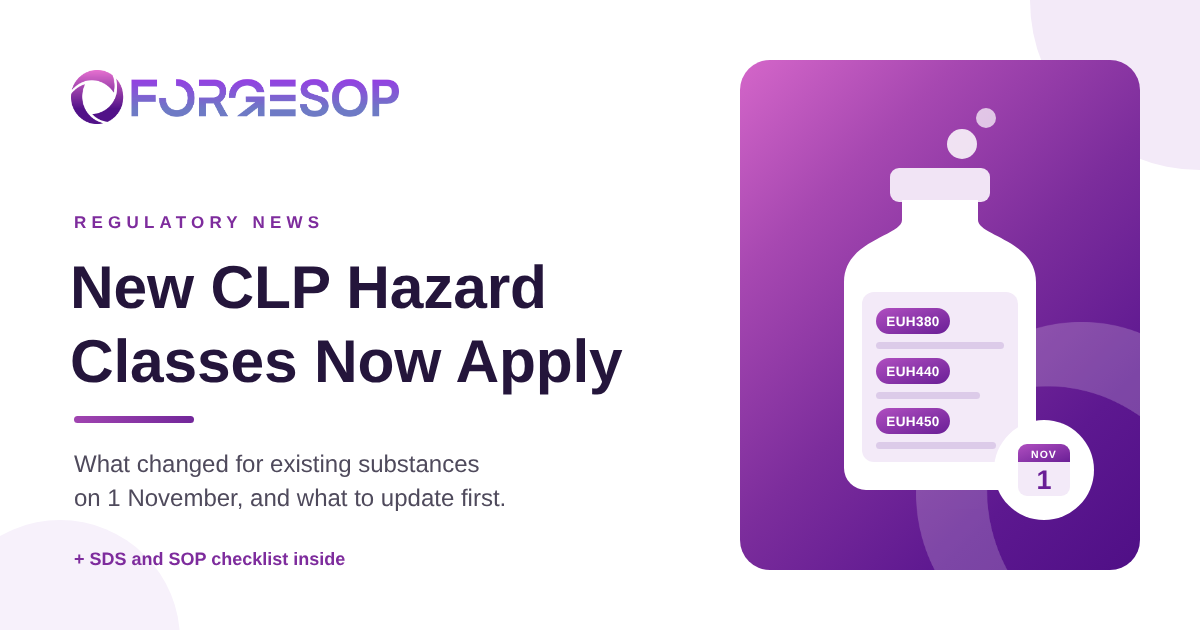
New EU CLP Hazard Classes Now Apply to Existing Substances. Your SDSs and SOPs Are Next
If you buy, store, or handle chemicals in the European Union (EU), a quiet deadline just passed. Since 1 November 2026, substances that were already on the EU market must be classified, labeled, and covered by safety data sheets (SDSs) under the new hazard classes in the Classification, Labelling and Packaging (CLP) Regulation.
Most organizations will file this under "supplier problem" and move on. The reality is different. Every revised SDS that reaches you changes the hazard information your risk assessments, training, and standard operating procedures (SOPs) are built on.
In this article, we break down what changed on 1 November, what did not change, and what you should update first.
Quick answer: Since 1 November 2026, substances placed on the EU market before 1 May 2025 must be classified and labeled under four new CLP hazard classes. They cover endocrine disruptors and substances that persist, accumulate, or spread through the environment. Suppliers must reflect the result on labels and SDSs. Mixtures already on the market have until 1 May 2028.
Key takeaways
The last transition period for substances has ended. Substances placed on the EU market before 1 May 2025 had until 1 November 2026 to meet the new classification and labeling rules.
There are four new hazard classes. They cover endocrine disruptors and substances that persist, build up, or spread through the environment and water.
There are no new pictograms. The hazards show up as new EU hazard statements, coded EUH380 to EUH451, which are easy to miss on a label.
Mixtures run on a later clock. New mixtures have been in scope since 1 May 2026. Mixtures already on the market have until 1 May 2028.
The "stop-the-clock" delay did not move this date. It postponed label formatting, advertising, and online sales rules to 1 January 2028. Hazard classification stayed on schedule.
The work now sits with you. Collect the revised SDSs, then review every risk assessment and SOP that depends on them.
What happened on 1 November 2026?
The new hazard classes come from Commission Delegated Regulation (EU) 2023/707, which amended the CLP Regulation, formally Regulation (EC) No 1272/2008. It was published on 31 March 2023 and entered into force on 20 April 2023.
Because reclassifying a whole portfolio takes time, the rules were phased in. Germany's Federal Institute for Occupational Safety and Health (BAuA) summarizes the timeline this way:
What is being supplied | New hazard classes apply from |
|---|---|
Substances first placed on the market from 1 May 2025 | 1 May 2025 |
Substances already on the market before 1 May 2025 | 1 November 2026 |
Mixtures first placed on the market from 1 May 2026 | 1 May 2026 |
Mixtures already on the market before 1 May 2026 | 1 May 2028 |
The 1 November date closed the last open window for substances. If you receive a solvent, an acid, a raw material, or a laboratory reagent as a single substance, its supplier should now have assessed it against the new classes.
What are the new CLP hazard classes?
The regulation added four hazard classes, which produce eight possible classifications. Each one has its own hazard statement.
Classification | Code | Hazard statement | Signal word |
|---|---|---|---|
Endocrine disruption for human health, Category 1 | EUH380 | May cause endocrine disruption in humans | Danger |
Endocrine disruption for human health, Category 2 | EUH381 | Suspected of causing endocrine disruption in humans | Warning |
Endocrine disruption for the environment, Category 1 | EUH430 | May cause endocrine disruption in the environment | Danger |
Endocrine disruption for the environment, Category 2 | EUH431 | Suspected of causing endocrine disruption in the environment | Warning |
Persistent, bioaccumulative and toxic (PBT) | EUH440 | Accumulates in the environment and living organisms including in humans | Danger |
Very persistent, very bioaccumulative (vPvB) | EUH441 | Strongly accumulates in the environment and living organisms including in humans | Danger |
Persistent, mobile and toxic (PMT) | EUH450 | Can cause long-lasting and diffuse contamination of water resources | Danger |
Very persistent, very mobile (vPvM) | EUH451 | Can cause very long-lasting and diffuse contamination of water resources | Danger |
Two details deserve your attention.
There is no pictogram. None of the new classes has its own hazard symbol. A worker who scans a label for the familiar red diamonds will see nothing new. The change is in the text.
The classes are specific to the EU. BAuA notes that they are not part of the United Nations Globally Harmonized System (GHS), which most national chemical rules are based on. If you import from outside the EU, an SDS written for another market may say nothing about these hazards.
"Stop the clock" did not stop this clock
Here is where many teams got the wrong message.
In November 2025, the Council of the EU signed off on a "stop-the-clock" measure, adopted as Regulation (EU) 2025/2439. It postponed parts of the 2024 CLP revision to 1 January 2028. According to the Council, the delay covers relabeling deadlines, mandatory formatting requirements, advertisements, online and distance sales, and fuel pump labeling.
It did not touch the new hazard classes or their transition dates.
If someone on your team heard that "CLP was delayed" and relaxed, that is the misreading to correct this month.
What changes on the safety data sheet?
In the EU, SDS content is set by Annex II of the Registration, Evaluation, Authorisation and Restriction of Chemicals (REACH) Regulation. When a substance is classified under a new hazard class, you should expect changes in these places:
Section 2.1 and 2.2: the classification and the label elements, including any new EUH statement and signal word.
Section 2.3: other hazards, including PBT, vPvB, and endocrine-disrupting properties.
Section 11: toxicological information, including endocrine-disrupting properties relevant to human health.
Section 12: ecological information, including the PBT and vPvB assessment and endocrine-disrupting properties relevant to the environment.
Under Article 31(9) of REACH, suppliers must update an SDS without delay when new hazard information becomes available. They must also send the dated revision, free of charge, to everyone they supplied in the preceding 12 months.
There is a second effect. An SDS is required when a substance meets the criteria for classification as hazardous. A substance that was unclassified until now could become hazardous under a new class, and come with an SDS for the first time.
Why is this your problem and not only your supplier's?
Classification, labeling, and SDS authoring are supplier duties. What you do with the information is yours.
Under the EU Chemical Agents Directive (98/24/EC), employers must assess the risks from hazardous chemical agents using the supplier's safety information, and the directive names the SDS as an example. It also says the assessment "shall be kept up-to-date, particularly if there have been significant changes."
A new hazard classification is a significant change.
This is where document drift starts. The revised SDS arrives, someone saves it to the shared drive, and the procedure on the shop floor still reflects the old revision. Nobody decided to ignore the change. Nobody owned the link between the two documents.
The new classes are most likely to touch procedures you may not think of first:
Waste and wastewater handling. PMT and vPvM are about contamination of water resources. Rinsing, draining, and disposal steps deserve a second look.
Spill response. Containment and drain protection matter more when a substance persists or spreads.
Storage and transfer. Secondary containment and transfer steps may need tightening.
Exposure controls. A new endocrine disruption classification can change the outcome of your risk assessment, and with it the controls and personal protective equipment (PPE) you specify.
What should you do this quarter?
Separate substances from mixtures in your chemical inventory. Substances are in scope now. Mixtures follow by 1 May 2028, and many will change sooner.
Ask each supplier for the current SDS revision. Ask whether the substance was assessed against the new classes. "Assessed, not classified" is a useful answer to keep on file.
Compare the new revision with the old one. Focus on Sections 2, 11, and 12, and log what changed and when you received it.
Update the risk assessment wherever the hazard picture changed.
Review every SOP that references an affected substance. Handling, storage, spill response, and waste disposal come first. This is where controlled, versioned SOPs earn their keep, because you can see which procedures cite which substance and who has read the current version.
Brief your people and record it. Explain that the new hazards appear as text, not symbols, and capture who was trained on the revised procedure.
Check containers already on site. Stock delivered before the deadline may carry the old label. Treat the SDS revision, not the label on the shelf, as your trigger.
If your safety SOPs are a living document with named owners and review dates, this is a routine update. If they are not, an SDS revision is an early warning that procedures and hazard data have started to drift. That drift carries a real cost, as we cover in the hidden cost of uncontrolled SOPs.
What comes next?
Three dates and trends are worth putting on your compliance calendar.
Mixture updates will arrive early. A mixture is classified from its components. Under the new rules, a component classified as PBT, vPvB, PMT, vPvM, or a Category 1 endocrine disruptor generally triggers classification of the mixture at 0.1% or more, and a Category 2 endocrine disruptor at 1% or more. Formulators now have the substance data they need, so expect revised mixture SDSs well before 1 May 2028.
1 January 2028 brings the postponed CLP formatting, advertising, and online sales rules.
Classifications will keep moving. Most classifications under the new classes are currently made by suppliers themselves. As the European Chemicals Agency (ECHA) and the EU agree harmonized classifications, some of those self-classifications will change again.
The bottom line
The 1 November deadline was a supplier deadline, but its effects land on your site. New hazard statements with no pictogram are easy to overlook, and a revised SDS that never reaches the procedure it supports is a finding waiting for an auditor.
The takeaway: treat every SDS revision as a trigger for change control. Get ahead of it now, while the list of affected substances is still short, and the mixture wave in 2028 becomes a routine update rather than a scramble.
Frequently asked questions
What changed under CLP on 1 November 2026?
The transition period ended for substances placed on the EU market before 1 May 2025. Since 1 November 2026, they must be classified and labeled under the new CLP hazard classes for endocrine disruption, PBT/vPvB, and PMT/vPvM, and their safety data sheets must reflect the result.
Do the new CLP hazard classes have pictograms?
No. None of the new hazard classes has its own pictogram. They are communicated through new EU hazard statements, EUH380 to EUH451, together with a signal word. Any pictogram on the label comes from the substance's other classifications.
Did the CLP "stop-the-clock" regulation delay the new hazard classes?
No. Regulation (EU) 2025/2439 postponed parts of the 2024 CLP revision to 1 January 2028, including label formatting, advertising, and online and distance sales rules. The transition dates for the new hazard classes were not changed.
When do mixtures have to comply with the new hazard classes?
Mixtures first placed on the EU market from 1 May 2026 must already comply. Mixtures placed on the market before that date have until 1 May 2028 to be classified and labeled under the new hazard classes.
Do you need to update SOPs when an SDS changes?
Yes, whenever the change affects how the work is done. EU rules require employers to keep chemical risk assessments up to date when there are significant changes. A new hazard classification is one, so review the handling, storage, spill response, and waste procedures that cite the substance.
Do the new hazard classes apply outside the EU?
They are specific to the EU CLP Regulation and are not part of the UN GHS. They matter if you manufacture in, import into, or supply chemicals to the EU market. Suppliers outside the EU may not address them on SDSs written for other markets.
Sources
EUR-Lex: Commission Delegated Regulation (EU) 2023/707 amending the CLP Regulation (published 31 March 2023)
Council of the EU: Council signs off postponing rules on classification, labelling, and packaging of chemicals to 2028 (17 November 2025)
REACH Regulation (EC) No 1907/2006, Article 31: Requirements for safety data sheets
EUR-Lex: Regulation (EU) 2025/2439 amending Regulation (EU) 2024/2865 as regards dates of application (26 November 2025)
The Acta Group: New CLP Hazard Classes: The Final Transition Deadline for Existing Substances Is Approaching (15 September 2026)
General
Forge better processes
One platform. Always audit-ready.
Bring SOPs, checklists, audits, incidents, and CAPAs into one connected system for safer, clearer, and more consistent operations.
No credit card required · Built for teams that run on process