
Education
Back to Blog
General16 min read
Quality SOPs: What They Are, Examples, and How to Write One
Hand the same lot of parts to two inspectors and watch what happens. The morning inspector measures three pieces, glances at the certificate, and releases the pallet. The evening inspector measures ten, frowns at one borderline reading, and quarantines the lot. Neither of them is careless. They are working to different standards, because the real standard lives in their heads instead of on paper.
That gap is what quality SOPs exist to close.
This guide covers what a quality SOP is which processes to document first, what the document must contain, and a seven-step method for writing quality procedures your team can follow at full production speed.
Quick answer: A quality SOP (standard operating procedure) is a written, step-by-step instruction for the tasks that keep products and services inside specification: inspection, sampling, testing, calibration, and the handling of anything that fails. It defines the acceptance criteria, the method, who has authority to accept or reject, and the records that prove the result.
Key takeaways
Quality SOPs are the subset of standard operating procedures that protect the product or service. They standardize inspection, sampling, testing, calibration, and the response when output fails to meet specification.
Their defining feature is the acceptance criterion. A procedure that lists steps but never states what passes and what fails is an operational SOP wearing a quality label.
Regulators look at quality documentation first. The most cited observation in FDA drug inspections, year after year, is quality unit procedures that are "not in writing or not fully followed."
Prioritize the control points where defects escape: incoming inspection, in-process checks, final release, calibration, and nonconformance handling.
Vague criteria are the enemy. "Check for damage" is an opinion; "no scratch longer than 3 mm on face A, viewed at 50 cm under normal light" is a standard.
Treat every quality SOP as a living document tied to specifications, test methods, and instruments. When any of those change and the procedure does not, "not fully followed" findings write themselves.
What is a quality SOP?
A quality SOP is a standard operating procedure that documents how your organization keeps its output inside specification. It takes one control point (an incoming inspection, a torque check, a lab test, a batch record review) and defines the one agreed way to perform it: the method, the sample, the acceptance criteria, the authority to decide, and the record that proves what happened.
Quality SOPs come in two flavors, and the distinction is worth learning because auditors use it constantly. Quality control (QC) procedures check the product itself: measuring, testing, inspecting, releasing. Quality assurance (QA) procedures run the system around those checks: document control, internal audits, supplier approval, training records, corrective action. QC asks "is this unit good?" QA asks "can we trust the process that says so?" Most organizations need both, and both live in the same library.
Within a quality management system (QMS), the formal framework standards like ISO 9001 describe, SOPs sit in the middle of the documentation stack. The quality manual and policies state intent at the top. Records prove what happened at the bottom. Procedures connect the two, which is why they are the layer an auditor actually reads. If the term SOP itself is new ground, start with our plain-language guide to what an SOP is and come back; this article assumes the basics and goes deep on one category.
How are quality SOPs different from operational and safety SOPs?
All SOP types share the same skeleton: numbered steps, named roles, a revision block. What changes is the risk each type exists to control. An operational SOP protects consistency and throughput. A safety SOP protects the person doing the work. A quality SOP protects the product, the customer, and the evidence, and that single difference reshapes the document.
Operational SOPs | Safety SOPs | Quality SOPs | |
|---|---|---|---|
Primary job | Consistent, repeatable routine work | Preventing injury and illness | Keeping output inside specification |
Typical trigger for writing one | Variation, handoffs, onboarding pain | Risk assessment, regulation, incidents | Defects, complaints, audit findings, customer specs |
Core content | Steps, settings, records | Hazards, controls, PPE, emergency actions | Method, sampling, acceptance criteria, failure path |
Cost of failure | Rework, downtime, scrap | Injury, enforcement, liability | Escapes, recalls, lost customers, audit findings |
Review cadence | Annual, or when the process changes | At least annual, plus after every incident | Annual, plus every spec, method, or instrument change |
Sign-off | Operations or process owner | Safety lead plus operations | Quality lead, often plus the customer or regulator's requirements |
In practice the boundaries blur, and that is fine. A filling-line changeover is operational at heart, but the moment step 9 requires a first-piece check against a fill-weight tolerance, that step carries quality content. The fix is never to write two overlapping documents. Write one SOP for the task and tag it into both categories, a point our types of SOPs guide covers across all ten types. The distinction that matters day to day is simpler: when the reason the document exists is to keep the product inside spec and prove it, the acceptance criteria lead, and the rules in this article apply.
Quality failure is a documentation failure before it is a production failure.
That claim sounds like consultant poetry, so here is the evidence.
Every fiscal year, the U.S. Food and Drug Administration (FDA) publishes the observations its investigators cite most often on Form 483, the inspection findings document. In the FY2025 drug inspection data, the most cited observation, for yet another year running, was 21 CFR 211.22(d): the responsibilities and procedures of the quality unit are "not in writing or not fully followed." It was cited 243 times, roughly one in every twelve drug citations. The runner-up, failure to properly investigate discrepancies, is a procedure failure too. Investigators rarely find processes that cannot be run correctly. They find processes nobody defined, or defined and then drifted away from.
The scale of the documentation habit tells the same story from the other direction. The ISO Survey counted more than 1.2 million sites worldwide holding ISO 9001 certification in 2023. Every one of them passed an audit that sampled controlled procedures, because the standard's authors concluded decades ago that consistent quality without documented process control does not survive contact with staff turnover.
Then there is the money. Philip Crosby, whose book Quality Is Free built the business case for prevention, put the cost of nonconformance at 20 to 25 percent of revenues for a typical company: scrap, rework, warranty claims, returns, and the hours spent arguing about all of it. Most leadership teams have never seen that number for their own operation. The American Society for Quality (ASQ) notes that only 31 percent of organizations say they fully understand the impact of quality costs on their financial performance.
The good news? A written procedure is the cheapest quality control you will ever deploy. It costs an afternoon to write, and it works every shift, including the ones you are not on.
Which processes need a quality SOP first?
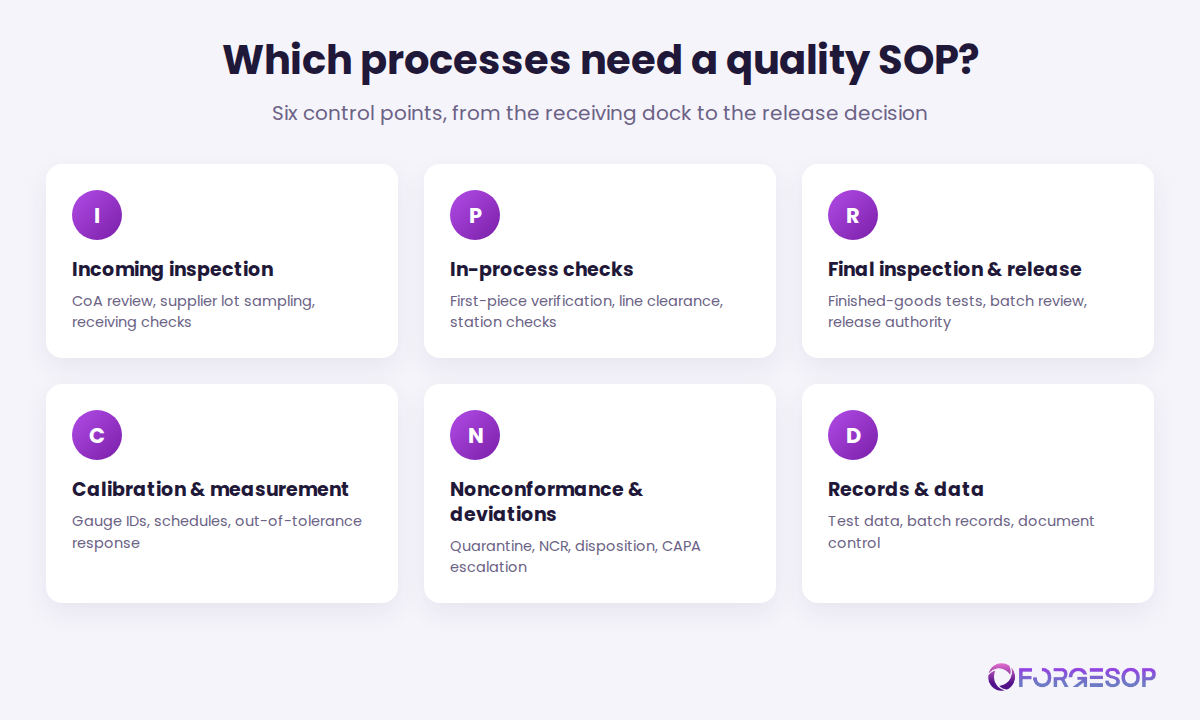
The tempting answer is "wherever the quality manual says." The useful answer is: wherever defects currently escape, and wherever two qualified people currently decide differently. Across industries, the highest-value candidates cluster into six families.
Incoming inspection. Receiving checks, certificate of analysis (CoA) review, sampling of supplier material. Defects accepted at the dock are the most expensive kind: everything you do afterward adds value to a part that was already bad.
In-process checks. First-piece verification after setup, line clearance between jobs, checks at defined stations. These procedures catch drift while it is still cheap to correct.
Final inspection and release. Finished-goods testing, batch record review, and the release decision itself, including who has the authority to make it. This is the last door a defect can walk through.
Calibration and measurement control. Which instruments are calibrated, on what schedule, and what happens when one is found out of tolerance. Every inspection SOP silently depends on this one; an uncalibrated gauge turns all your acceptance data into fiction.
Nonconformance and deviation handling. Quarantine, labeling, the nonconformance report (NCR), disposition authority, and when a problem escalates into a full CAPA investigation, the corrective and preventive action process. Without a written path, failed product has a way of drifting back into good stock.
Records and data. How results get recorded, corrected, and stored. Regulated industries call the principle ALCOA: records should be attributable, legible, contemporaneous, original, and accurate. Unregulated ones can simply remember the maxim, if it is not recorded, it did not happen.
Two rules set the order inside those families. Follow the escapes: any check that has already let a defect reach a customer goes to the top of the writing list, because your complaint log is a map of your weakest control points. And follow the disagreements: wherever two inspectors, two shifts, or two sites reach different verdicts on the same product, the criteria live in heads, not documents, and that is where the next escape starts.
What does a quality SOP include?
Format matters less than completeness, but strong quality SOPs share ten building blocks:
Title and unique ID, such as SOP-076, so versions, training records, and audits stay traceable
Purpose and scope: the product, process, or material covered, and what the document deliberately excludes
References: the specification, drawing revision, standard, or customer requirement the procedure enforces, cited precisely
Roles and authority: who performs the check, and, separately, who is authorized to accept, reject, or disposition product
Equipment and calibration status: the instruments used, by ID, with the requirement that they be in calibration
Sampling plan: how many units, drawn from where, at what frequency, and against which acceptance quality limit (AQL), the defect rate a sampling scheme is designed to catch
Numbered steps in sequence: one action per step, including how to prepare the sample and run the measurement or test
Acceptance criteria stated measurably: the numbers, tolerances, and defect definitions that separate pass from fail
The failure path: what happens the moment a result is out of spec, covering quarantine, labeling, the NCR, and who decides what happens next
Records and revision block: what gets logged, where, by whom, plus version, author, approver, effective date, and next review date
Two of these deserve special attention, because they are where weak quality procedures give themselves away.
Acceptance criteria are the whole game. "Inspect for defects" transfers the standard into the reader's imagination, which is exactly where you did not want it. "Measure outer diameter at two points 90 degrees apart: 25.00 mm ± 0.05 mm. No burrs detectable by fingernail on the sealing face. Compare surface finish to limit sample QL-12 at the bench" is a standard. Where words run out, use limit samples and defect photos; a laminated card showing the worst acceptable scratch settles arguments no adjective can.
The failure path earns its keep on a bad day. Most procedures describe the happy path and stop. But the moment that matters is the out-of-spec reading at 2 a.m.: does the operator know where the quarantine shelf is, which tag to apply, who to call, and whether the line keeps running? If the document does not say, the answer will be improvised, and improvised dispositions are how nonconforming product ships.
What does a quality SOP look like in practice?
Here is the skeleton of a real one, trimmed for space.
SOP-076: Incoming inspection, machined housings (v1.4, owner: Quality Technician, review due: August 2027). Purpose: verify supplier lots of part H-210 against drawing rev D before release to stock. References: drawing H-210 rev D, purchase spec PS-31, limit sample board QL-07. Authorized: trained receiving inspectors; disposition authority: Quality Engineer. Equipment: calipers CAL-014 and height gauge CAL-022, both in calibration. Sampling: 8 units per lot up to 500 pieces, per the AQL table in PS-31. Steps: verify the packing slip and CoA match the purchase order; pull 8 units across different layers of the crate; measure bore diameter (30.00 mm ± 0.08) and flange thickness (6.50 mm ± 0.10) on each; compare surface finish to QL-07; record results in the receiving log against the lot number. Accept: all 8 in spec, CoA complete. Reject: any unit out of spec, or CoA missing. On reject: move the lot to the quarantine rack, apply a red HOLD tag, raise an NCR, notify the Quality Engineer the same shift; the lot does not move until dispositioned. Records: receiving log entry, NCR if raised, retained CoA.
Nothing in it is exotic. Everything in it is checkable, and six months from now, when a customer asks why a bad housing reached their line, the answer is a signed log and a dispositioned NCR instead of a shrug.
How to write a quality SOP in 7 steps
The method matters more than the template, and for quality procedures the method starts one step earlier than most guides admit: before you can document the check, you have to pin down the standard it enforces.
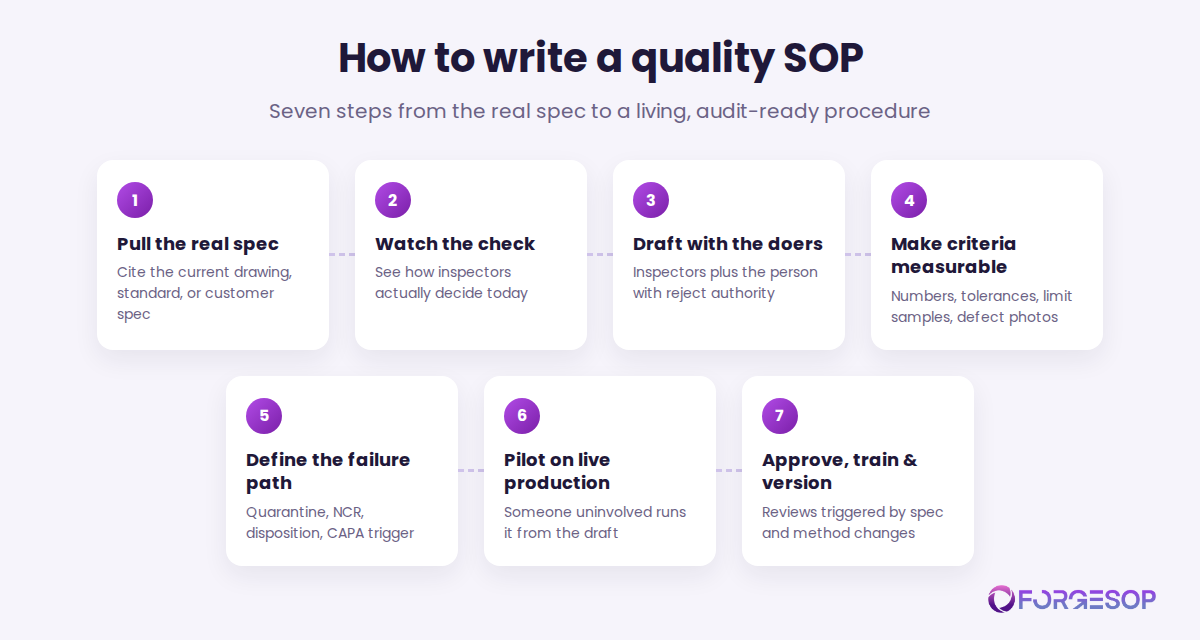
Pick one control point and pull the real spec. One check, one document. Find the current source of truth (the drawing revision, the customer specification, the standard, the regulatory limit) and cite it by name and revision in the references section. A surprising number of quality escapes trace back to procedures enforcing a spec that was superseded two revisions ago.
Watch the check as it is actually done. Observe different inspectors and different shifts run the same check. The differences you find (sample sizes, measurement points, how borderline calls get made) are not noise. They are the reason you are writing the document.
Draft with the people who perform it, and the person with reject authority. The inspector knows the method; the quality engineer knows the disposition rules; the document needs both. Procedures written by quality for quality read like audits. Procedures written with operators read like instructions.
Turn judgment into criteria. Every "looks OK" in the current practice becomes a number, a tolerance, a limit sample, or a defect photo in the draft. Ask each inspector for the borderline case they hate most, then write the rule that settles it. This step is slow and worth it, because it is the step that makes two inspectors interchangeable.
Define the failure path before anyone needs it. Name the quarantine location, the hold tag, the NCR form, the disposition authority, and the escalation trigger into your CAPA process. Decide now whether an out-of-spec result stops the line, because 2 a.m. is a bad time to invent policy.
Pilot it on live production. Hand the draft to a competent inspector who did not help write it and watch them run the check using only the document. Every hesitation, every question, every glance toward a colleague is a defect in the draft, not in the inspector.
Approve, version, train, and set the review triggers. Route it for signature, train every affected person against that version number, and record the training. Then tie reviews to events, not just the calendar: any change to the spec, the method, the instrument, or the supplier reopens the document automatically.
Your quality SOPs are the first thing an auditor reads.
Whether the visitor is an ISO 9001 registrar, a customer's supplier quality engineer, or an FDA investigator, the routine is the same. They pick a process, ask for the procedure, and then ask for the records that prove the procedure was followed. Three findings are available, and only one of them is rare: no procedure exists, the procedure exists but does not match reality, or the records contradict the procedure. The middle one is the workhorse of audit reports, and it is pure decay: the SOP was accurate the day it was approved, then the customer revised the drawing, the lab changed instruments, and nobody reopened the document.
ISO 9001:2015 is blunt about the duty. It requires documented information to be available, suitable, and controlled at the point of use, which means the version at the bench is the current one, every time. That is a version-control problem, and paper binders and shared drives fail at it quietly: three copies in three places, a stale printout taped inside a cabinet, and no way to say who was trained on which version. Purpose-built SOP management software solves it by keeping each procedure as one live version with its history, approvals, and training records attached, so the auditor's three questions take minutes instead of days. However you solve it, solve it before the library grows past a dozen documents. Retrofitting document control during an audit finding is the most expensive way to buy it.
The reality is that most quality teams do not have a writing problem. They have a decay problem, and decay is a system choice.
The bottom line
Quality SOPs are where "we care about quality" stops being a poster and becomes a set of instructions a new inspector can follow on their first Friday night shift. The regulators read them first, the auditors sample them first, and your customers experience the result of them with every lot you ship.
Start with five documents: the check where escapes have already happened, incoming inspection, final release, calibration control, and the nonconformance path. Pull the real spec before drafting, write the criteria so two strangers reach the same verdict, and give every document an owner, a version, and review triggers tied to change. Then keep them alive, because a quality SOP that matches today's spec is a control, and one that matches last year's spec is an audit finding with a date on it.
Get ahead of the defects while they are still borderline readings, and not yet a customer complaint.
Frequently asked questions
What is a quality SOP?
A quality SOP (standard operating procedure) is a written, task-level document explaining how to perform the checks and controls that keep products or services inside specification. It defines the method, the sampling plan, measurable acceptance criteria, who has authority to accept or reject, what happens to failed product, and the records that prove each result.
What is the difference between QA and QC SOPs?
Quality control (QC) SOPs check the product: inspection, measurement, testing, and release procedures. Quality assurance (QA) SOPs run the system around those checks: document control, internal audits, supplier approval, training, and corrective action. QC procedures answer "is this unit good?" while QA procedures answer "can we trust the process that says so?" A complete quality SOP library contains both.
What is the difference between a quality SOP and an operational SOP?
An operational SOP standardizes how routine work gets done, protecting consistency and throughput. A quality SOP standardizes how output is checked against specification, so it adds references to specs, sampling plans, measurable acceptance criteria, disposition authority, and a failure path for nonconforming product. One task can carry both kinds of content, and the best practice is a single document tagged into both categories.
Does ISO 9001 require quality SOPs?
ISO 9001:2015 no longer mandates a fixed set of documented procedures the way older editions did. It requires "documented information" wherever the organization needs it for the QMS to work, and requires that information to be controlled, current, and available at the point of use. In practice, certified organizations document their core quality procedures because auditors must sample objective evidence that processes are defined and followed.
What quality SOPs does FDA require?
For drug manufacturers, the GMP regulations in 21 CFR Part 211 require written procedures across production, testing, and the quality unit, and "procedures not in writing or not fully followed" is the most cited inspection observation year after year. For medical device manufacturers, the Quality Management System Regulation (QMSR), which took effect in February 2026, incorporates ISO 13485 and carries the same expectation: documented, controlled procedures with records to match.
Which quality SOPs should we write first?
Start where defects escape and where qualified people disagree. The usual first five: the check that has already let a defect reach a customer, incoming inspection, final inspection and release, calibration control, and nonconformance handling. Your complaint log and audit findings are the best prioritization tool you own.
How often should quality SOPs be reviewed?
Review each quality SOP at least annually, and immediately whenever its specification, test method, instrument, or supplier changes, and after any nonconformance or complaint that traces back to the check it governs. Record each review even when nothing changes, so the revision block proves the procedure is current rather than merely old.
Building your quality SOP library one control point at a time? ForgeSOP keeps every quality SOP versioned, approved, and tied to training records, so the version at the bench is always the current one.
General

Forge better processes
One platform. Always audit-ready.
Bring SOPs, checklists, audits, incidents, and CAPAs into one connected system for safer, clearer, and more consistent operations.
No credit card required · Built for teams that run on process