
Education
Back to Blog
General17 min read
HR and Training SOPs: What They Are, Examples, and How to Write One
The new hire arrived on Monday. Reception did not know her name, her laptop was still in an approval queue, and her manager was traveling, so a colleague improvised a tour and lent her a login. Her safety induction happened in week three, after she had already covered two shifts. Eight months later an auditor asked for evidence of her equipment training, and three people searched three systems and found a calendar invite.
Nothing in that story is a scandal. It is simply what happens when employee processes run on memory.
Most organizations are rich in HR policy and poor in HR procedure. The handbook says every new employee receives an induction, every review is documented, and every exit is handled properly. What the handbook never says is who books the induction, which checklist the review follows, and where the signed forms live. The policy is written. The process is folklore, and every manager retells it a little differently.
HR and training SOPs close that gap. This guide, covers what an HR and training SOP is, which employee processes to document first, what belongs inside each one, and a seven-step method for writing people procedures that every manager runs the same way.
Quick answer: An HR and training SOP (standard operating procedure) is a written, step-by-step instruction for a recurring employee process: hiring, onboarding, role training, performance reviews, policy acknowledgment, leave, discipline, and exits. Each one names who does each step, the checklists and forms used, and the record that proves the process happened.
Key takeaways
HR (human resources) and training SOPs document the processes every employee passes through: recruiting, onboarding, role training, performance management, policy acknowledgment, leave, discipline, and exits.
Their defining feature is consistency. The same process run differently by different managers is inefficient anywhere else in the business; in employee matters it is a fairness problem and, eventually, a legal one.
Onboarding is the natural starting point. Gallup finds only 12% of employees strongly agree their organization does a great job onboarding new employees.
The bill for improvised people processes arrives as turnover. Gallup estimates replacing one employee costs one-half to two times their annual salary, and that voluntary turnover costs U.S. businesses roughly $1 trillion a year.
Training you cannot prove might as well not have happened. Organizations spend an average of $1,054 per employee on direct learning (Association for Talent Development), yet in an audit or a dispute, the only training that counts is the training with a record.
HR and training SOPs decay with every policy update, reorganization, and system change. Treat each one as a living document with an owner, a version, and review triggers.
What is an HR and training SOP?
An HR and training SOP is a standard operating procedure for a recurring employee process. It takes a routine that currently lives in someone's head (how a new hire gets equipment, an induction, and their first assignments; how a resignation turns into a clean exit) and converts it into named steps with owners, timelines, checklists, and a record at the end.
A policy and a procedure are not the same document. The policy states what the organization commits to and why: every employee receives job-specific training before working unsupervised. The SOP states how that commitment is kept: who assigns the training, from which matrix, delivered by whom, signed off how, and filed where. Organizations that skip the second document end up with a handbook that reads beautifully while day one still improvises.
The category has two halves that belong together. HR SOPs cover the employee lifecycle: recruiting and hiring, onboarding, performance reviews, leave requests, policy acknowledgment, disciplinary and grievance handling, and offboarding. Training SOPs cover how learning is planned, delivered, and evidenced: induction, role-based training requirements, competency sign-off, refresher scheduling, and the training records themselves. What unites them is that every one of these processes touches a person directly and produces a sensitive record that someone, someday, will need to find.
If the term SOP itself is new ground, start with our plain-language guide to what an SOP is and come back; this article assumes the basics and goes deep on one category.
How are HR and training SOPs different from other SOP types?
Every SOP type shares the same skeleton: numbered steps, named roles, a revision block. What changes is the risk each type exists to control. An operational SOP protects the consistency of your core work. A safety SOP protects the person doing the work, a quality SOP protects the product, and a compliance SOP proves the rules were followed. An HR and training SOP protects the people and the proof: the employee's experience of your organization, and the records showing each step happened the way policy promised.
Operational SOPs | Administrative SOPs | HR and Training SOPs | |
|---|---|---|---|
Primary job | Keeping core work consistent and repeatable | Keeping business support flowing across desks | Giving every employee the same fair, documented experience |
Typical trigger for writing one | Variation, rework, a new line or shift | Stalled approvals, lost documents, repeated questions | Chaotic onboarding, a dispute, an audit asking for training proof |
Core content | Task steps, parameters, checkpoints | Workflow route, approval thresholds, templates | Lifecycle stages, checklists, training matrix, acknowledgments |
Cost of failure | Downtime, rework, inconsistent output | Delays, duplicate spend, fraud exposure | Turnover, disputes, unprovable training, compliance exposure |
Review cadence | Annual, plus process or equipment changes | Annual, plus reorgs and system changes | Annual, plus every policy, law, role, or system change |
Sign-off | Operations lead | Department head or office manager | HR lead, often with legal or department heads |
The column on the right has one property the others do not: universal reach. A machine changeover SOP matters to the people on that line. An onboarding SOP is experienced by literally every person who will ever work for you, in their most impressionable week, and a review or disciplinary SOP shapes whether they still trust you three years in.
In practice the categories overlap, and that is fine. A safety induction belongs to onboarding and to your safety procedures at the same time. Training records double as audit evidence, which puts them shoulder to shoulder with your compliance SOPs. Payroll setup and file handling lean on your administrative procedures. The fix is never to write two overlapping documents. Write one SOP for the process and tag it into both categories.
Improvised people processes send you the bill as turnover.
A bad first week teaches the new hire one lesson very quickly: this place runs on luck. Gallup research on onboarding finds that only 12% of employees strongly agree their organization does a great job onboarding new employees. That is not a training-budget problem. It is a process problem: the difference between an onboarding that was designed and one that gets reinvented per hire, per manager, per site.
The economics of getting it wrong are not subtle. Gallup estimates that replacing an individual employee costs one-half to two times that employee's annual salary, and that voluntary turnover costs U.S. businesses roughly $1 trillion a year. By its math, a 100-person organization with an average salary of $50,000 faces turnover and replacement costs of $660,000 to $2.6 million per year. The same research found 52% of voluntarily exiting employees saying their manager or organization could have done something to prevent them from leaving.
Turnover is also structural, not exceptional. The U.S. Bureau of Labor Statistics (BLS) puts median employee tenure at 3.9 years as of January 2024. At that tenure, a 60-person company runs roughly 15 onboardings and 15 exits a year. These are not rare events you can afford to hand-craft. They are a production line, and production lines get procedures.
Training happens either way. Proof does not.
Money is already being spent here. The Association for Talent Development (ATD) reports in its 2025 State of the Industry that organizations spent an average of $1,054 per employee on direct learning in 2024, with employees using an average of 13.7 formal learning hours. Without a delivery-and-records procedure, that investment evaporates into "we covered that in week one": no matrix saying who needed what, no sign-off saying they got it, no date saying when it expires.
Training is also a legal duty, not just a development perk. Many Occupational Safety and Health Administration (OSHA) standards include explicit employee information and training requirements. Hazard communication, one of them, was the second most cited OSHA standard of fiscal year 2025, with 2,546 citations. When an inspector or auditor asks whether your people were trained, the answer is a record or it is nothing.
Training without a record is a rumor.
Why does nobody write these processes down?
Because employee processes are learned by apprenticeship. Nobody hands the new supervisor an onboarding procedure; they hand them a memory of their own onboarding, and each manager quietly builds a private checklist version. Multiply that by every team and you get five onboardings wearing the same company's badge.
There is also a sensitivity excuse worth retiring. Discipline, grievances, and exits feel too situational to proceduralize, so they stay undocumented. The reality is the opposite: the more sensitive the process, the more it needs the same steps every time, because in employee matters, inconsistency is precisely what gets organizations in trouble. "We always follow these steps" is a defensible sentence only when the steps are written down.
And finally, HR teams are small and interrupt-driven. The people who own these processes are busy running them, which is exactly how a process ends up existing only in the heads of the people running it.
Which HR and training SOPs should you write first?
No HR team needs thirty procedures by Friday. Across industries, the highest-value HR and training SOPs cluster into six families. Start where every employee passes through, and where a mistake is hardest to defend.
Onboarding and induction: Preboarding (contract, accounts, equipment), day one, safety induction, policy acknowledgments, and 30/60/90-day check-ins. Start here: highest volume, first impressions, and the most cross-functional handoffs of any HR process.
Recruiting and hiring: Job requisitions and approvals, structured interview stages, reference checks, and offers. Consistency here is also legal protection: same stages, same questions, same records for every candidate.
Training delivery and records: The role-based training matrix, who delivers each item, competency sign-off, refresher intervals, and where records live. This is the family auditors ask about by name.
Performance management: Review cycles, goal setting, documentation standards, and the steps that follow when performance falls short. An improvised review process is unfair in both directions and indefensible in a dispute.
Leave and policy acknowledgment: Leave requests and approvals, absence reporting, and how handbook updates trigger re-acknowledgment. High frequency, so small ambiguities multiply fast.
Discipline, grievance, and exits: Investigation steps, warnings, appeal routes, resignation handling, access revocation, exit interviews, and final records. Lowest frequency, highest stakes per event: write these while nobody needs them.
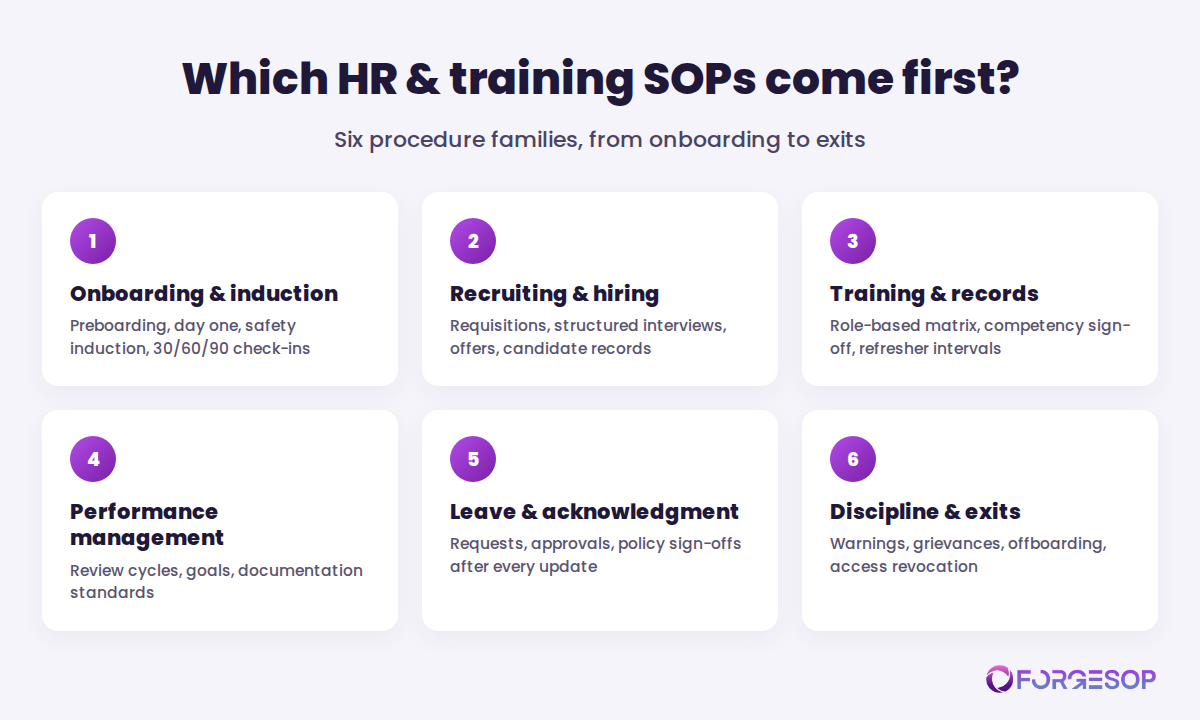
Two rules set the order inside the families. Follow the volume: onboarding and leave touch the most people the most often, so drift there compounds daily. And follow the exposure: any process that could end up examined by a lawyer, a regulator, or an auditor (hiring, discipline, exits, training records) gets documented before it is needed, because writing it during the crisis is too late.
What does an HR and training SOP include?
Format matters less than completeness, but strong HR and training SOPs share ten building blocks:
Title and unique ID, such as SOP-204, so versions, training, and cross-references stay traceable
Purpose and scope: which employee groups, locations, and employment types it covers, and which it deliberately excludes
Roles and responsibilities: HR, the hiring manager, IT, payroll, the safety lead, and the employee, each with a named backup
Definitions: acronyms and internal shorthand spelled out once, so the next reader does not have to guess
Triggers: what starts the process (a signed offer, a resignation letter, a review-cycle date, a policy change)
Staged, numbered steps with timelines: before day one, day one, week one, day 30/60/90, each step naming its owner
Named forms, checklists, and templates, one current version of each, linked from the procedure itself
The training matrix: required training by role, delivery method, refresher interval, and who signs off competency
Records and acknowledgments: what gets signed, where it is filed, who may access it, and how long it is retained
Revision block and review triggers: version, author, approver, effective date, next review date, and the changes that reopen the document early
Two of these blocks do the heavy lifting, and they are the two most often missing.
The training matrix turns "we train people" into a control. A training matrix is a simple grid: roles down one side, required training across the top, with the delivery method, refresher interval, and evidence type in each cell. With one, a new role slots into the system on day one and an auditor can sample compliance in minutes. Without one, training requirements live in managers' heads, which means they differ by manager.
The record makes the process defensible. Signed acknowledgments, competency sign-offs, dated review notes, exit checklists. Name where each record is filed, under what convention, who may access it (HR records are confidential, so say who sees what), and how long it is kept; payroll records, for instance, carry a three-year minimum under the Fair Labor Standards Act (FLSA). In employee matters, the record is not bureaucracy. It is the organization's memory of having been fair.
What does an HR and training SOP look like in practice?
Here is the skeleton of a real one, trimmed for space.
SOP-204: New employee onboarding (v2.1, owner: HR Manager, review due: August 2027). Purpose: give every new employee a consistent, documented first 90 days, from signed offer to confirmed competency. Scope: all permanent hires at all sites; contractors follow the short variant, SOP-209.
Roles: the HR coordinator opens the onboarding checklist on offer signature and requests accounts and equipment from IT within 2 business days; payroll setup follows the administrative payroll procedure; the hiring manager books the day-one induction before the start date and assigns role training from the training matrix in week one; the safety lead delivers the site safety induction before any floor work, no exceptions; the employee signs policy acknowledgments by the end of day one; the manager holds documented 30/60/90-day check-ins.
Records: the countersigned onboarding checklist and acknowledgments are filed in the personnel record, training entries go to the training log with dates and sign-offs, and access is limited to HR and the employee's own manager.
Exceptions: remote hires get shipped equipment and a virtual induction with the same sign-offs; internal transfers skip payroll setup but repeat role and safety training where the matrix requires it.
Nothing in it is inventive, and that is the point. The fortieth hire of the year gets the same first week the first one did, the safety induction cannot quietly slide to week three, and when someone asks for proof of training, the answer takes minutes, not a search party.
How to write an HR and training SOP in 7 steps
The method matters more than the template, and for people processes the method starts with a journey, not a task list.
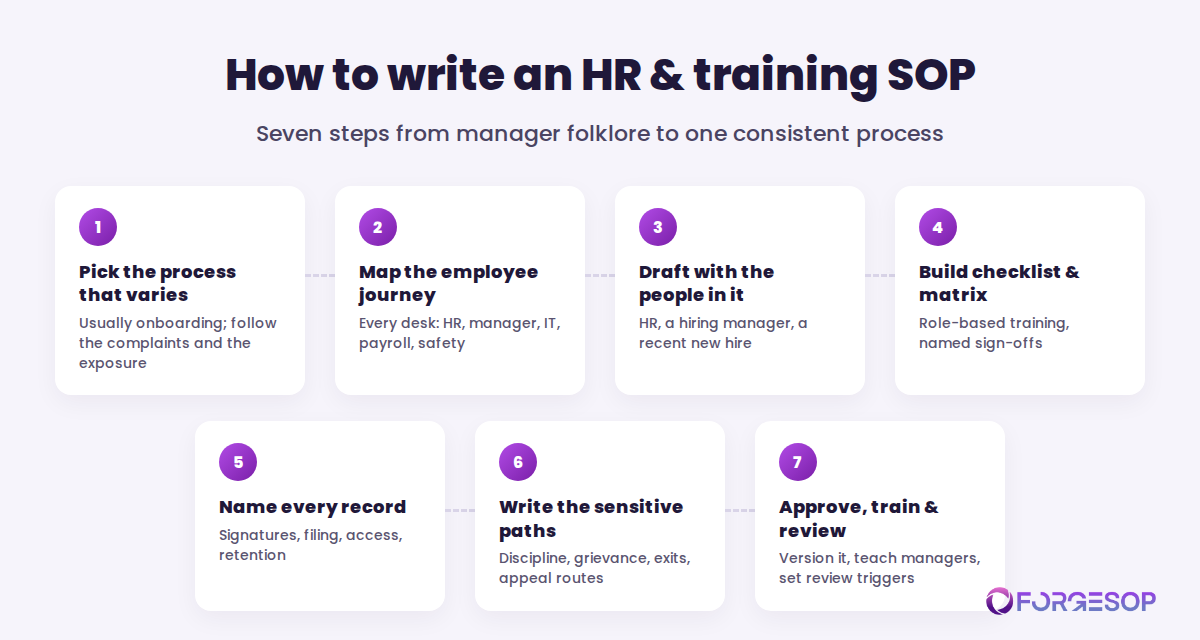
Pick the process that varies most between managers. For most organizations that is onboarding. Ask three managers to describe their version; the differences you hear are the SOP's table of contents. Follow the complaints, then the exposure.
Map one real employee's journey desk by desk. Follow an actual recent hire from signed offer to day 90. Note every handoff (HR, manager, IT, payroll, safety), every wait, and every step that happened late or not at all. The gaps are the material.
Draft with the people inside the process. That means HR, a hiring manager, and, crucially, a recent new hire, because only the newest person still remembers where the process felt confusing or silent. A procedure drafted by HR alone describes the process HR wishes existed.
Build the checklist and the training matrix into the text. One onboarding checklist, one matrix of role-based training requirements with refresher intervals and named sign-offs. These two artifacts carry the procedure; everything else is connective tissue.
Name the record at every stage. What is signed, where it is filed, who may access it, and how long it is kept. If a stage produces no record, decide whether it needs one; if it produces three in three systems, pick one home.
Write the sensitive paths with extra care. Discipline, grievance, and exit steps get named decision points, timelines, confidentiality rules, and appeal routes. These are the procedures you hope to use rarely and must follow exactly, so leave nothing to improvisation.
Approve, publish, train the managers, and set review triggers. Route sign-off through HR and legal where needed, publish where managers actually work, and walk every people manager through their part once. Then tie reviews to events as well as the calendar: an employment law change, a handbook update, a reorganization, a new HR system, or any dispute that exposes a gap.
One process, five manager versions is how HR SOPs actually fail.
HR and training procedures rarely fail loudly. They fail by fragmentation: each manager keeps a private onboarding checklist, the handbook gets updated but nobody re-runs acknowledgments, the review template forks into three versions, and the SOP still names an HR system you replaced last spring. A year of small drifts later, the written process describes a company that no longer exists, and every manager is once again improvising, just with more confidence.
The consequences are sharper here than in any other SOP family, because inconsistency between managers is not just inefficiency; it reads as favoritism to employees and as evidence to lawyers. We dissected what documentation drift costs in the hidden cost of uncontrolled SOPs, and people processes are a favorite victim, because they change with every policy revision and reorg.
The countermeasures are familiar, applied with more discipline. Every HR and training SOP gets one named owner and a deputy. Every procedure, checklist, and matrix lives in one place every manager can search, and superseded versions leave circulation the day a new one is approved.
Purpose-built SOP management software makes this structural rather than heroic: one current version of each procedure, acknowledgments tracked by name, and review dates that nag the owner instead of relying on memory. However you solve it, solve findability first. An onboarding procedure a manager cannot locate on the new hire's first morning does not exist.
In short, one current version visible to every manager beats five private ones, every time.
The bottom line
HR and training SOPs are where the employee experience stops depending on which manager you happened to get. They decide whether the promises in your handbook survive contact with a busy Monday: whether inductions happen before the work starts, whether training can be proven years later, and whether the sensitive moments (a warning, a grievance, an exit) follow the same fair steps every time.
Start with five documents: onboarding, training delivery and records, leave and policy acknowledgment, performance reviews, and exits. Build the onboarding checklist and the training matrix into the procedures themselves, name the record at every stage, and give each document an owner, a version, and review triggers tied to policy and law changes.
Your policies already promise consistency. Procedures are how the promise gets kept, hire after hire, long after the person who designed the process has moved on.
Frequently asked questions
What is an HR and training SOP?
An HR and training SOP (standard operating procedure) is a written, step-by-step document for a recurring employee process, such as hiring, onboarding, role training, performance reviews, policy acknowledgment, leave, discipline, or exits. It names who performs each step and by when, the checklists and forms used, the training requirements that apply, and the record that proves the process was completed.
What are examples of HR and training SOPs?
Common examples include employee onboarding, new hire safety induction, role-based training delivery and record keeping, competency sign-off, refresher training scheduling, recruiting and interviewing, performance review cycles, policy acknowledgment, leave request handling, disciplinary and grievance procedures, and employee exits with access revocation. Any employee process that should run the same way for every person is a candidate.
What is the difference between an HR policy and an HR SOP?
A policy states what the organization commits to and why, such as "every employee receives job-specific training before working unsupervised." An SOP states how that commitment is executed: who assigns the training, from which matrix, delivered and signed off by whom, and where the record is filed. Policies set the standard; SOPs make the standard happen the same way every time.
Are HR and training SOPs required by law?
The procedures themselves are rarely mandated, but much of what they govern is. Many OSHA standards require documented employee training, payroll records must be kept at least three years under the Fair Labor Standards Act, and consistent, documented handling of hiring, discipline, and termination is central to defending employment decisions. A written procedure is the practical way to meet those duties by design rather than by luck.
What is a training matrix?
A training matrix is a grid that maps each role to its required training, along with the delivery method, refresher interval, and the evidence that completion is signed off. It turns "we train our people" into a checkable control: a new hire's requirements are clear on day one, expiring certifications surface before they lapse, and an auditor can sample any role and see exactly what should exist.
How often should HR and training SOPs be reviewed?
Review each one at least annually, and immediately after the events that actually break them: an employment law change, a handbook or policy update, a reorganization, a new HR or training system, an audit finding, or a dispute that exposes a gap. Because people processes shift with every policy revision, event-based review triggers matter more than the calendar.
Who should write HR and training SOPs?
Draft them with the people inside the process: HR, a hiring manager, the trainers who deliver the content, and ideally a recent new hire who still remembers where the process felt confusing. HR owns the documents and sign-off, with legal review for sensitive paths like discipline and exits. Writing at a distance from the real process guarantees a procedure managers quietly replace with their own versions.
Trying to give every hire the same first week? ForgeSOP keeps every HR and training SOP versioned, acknowledged, and findable by every manager in seconds.
General
Forge better processes
One platform. Always audit-ready.
Bring SOPs, checklists, audits, incidents, and CAPAs into one connected system for safer, clearer, and more consistent operations.
No credit card required · Built for teams that run on process