
Education
Back to Blog
General10 min read
Audit-Ready Safety Operations: How to Manage SOPs, Contractors, Audits, and CAPAs in One Connected System
Work today does not always happen inside one team, one site, or one organization.
Many companies now depend on contractors, suppliers, temporary workers, and distributed teams to perform critical work. Some of that work happens offsite. Some of it happens inside high-risk environments. In both cases, organizations need visibility, control, and proof that safety processes are being followed.
That is where audit-ready safety operations become essential.
Audit-ready safety operations means your SOPs, digital checklists, audit records, incident reports, corrective actions, and supporting documents are always current, accessible, and connected. It means you can show that safety controls exist, workers understand the procedures, and corrective actions are being followed through.
In other words, audit readiness is no longer something teams prepare for once a year. It should be part of daily operations.
Key Takeaways
Audit-ready safety operations means your SOPs, checklists, audit records, incident reports, and CAPAs are current, connected, and easy to prove at any time.
As workforces become more distributed, organizations need better visibility across employees, contractors, suppliers, and site operations.
Compliance checklists alone do not prevent serious injuries and fatalities. Teams need clear procedures, real-time visibility, and closed-loop corrective actions.
SOPs should be living documents that are version-controlled, role-based, regularly reviewed, and connected to daily work.
A connected safety operations system helps teams move from last-minute audit preparation to everyday audit readiness.
What Are Audit-Ready Safety Operations?
Audit-ready safety operations refer to a safety management approach where SOPs, checklists, audits, incidents, investigations, and corrective and preventive actions are documented, controlled, and connected in one system.
Instead of searching through spreadsheets, shared drives, emails, and disconnected forms before an audit, teams can access the records they need when they need them.
An audit-ready safety system should help answer questions such as:
Which SOP is the current approved version?
Who has reviewed and acknowledged the procedure?
Which checklists were completed before the task?
What incidents or near misses were reported?
What corrective actions were assigned?
Which CAPAs are overdue?
What evidence can be shown during an audit or inspection?
The goal is simple: safety documentation should not only exist. It should be easy to access, easy to verify, and connected to the work being performed.
Why Audit Readiness Matters More for the Modern Workforce
The modern workforce is no longer limited to full-time employees working from one location. Many organizations now rely on contractors, suppliers, outsourced teams, and multi-site operations.
This creates a major safety challenge.
A contractor may be performing critical work on your site, using your equipment, following your procedures, or operating under your brand. Even if they are not on your payroll, their work can still create safety, legal, operational, and reputational risk for your organization.
This is especially important in high-risk industries such as construction, manufacturing, energy, logistics, chemical handling, facilities management, and industrial services.
Construction is a useful example because it often involves layers of contractors and specialty trade workers. According to CPWR data referenced in the original draft, U.S. construction fatalities increased by 39.8% from 2011 to 2022, rising from 781 to 1,092 deaths. The same data also notes that 60.8% of those fatalities occurred among specialty trade contractors.
For safety leaders, this points to a larger issue: risk often sits with the people who are furthest from direct control.
That is why safety operations need to be more connected. Host organizations need a practical way to manage procedures, training expectations, checklists, audits, incidents, and corrective actions across both employees and contractors.
Why Compliance Checklists Alone Are Not Enough
Most organizations already have some form of safety compliance process.
They collect contractor certificates. They store policies. They run prequalification checks. They complete inspection forms. They may also keep spreadsheets to track audits, training, and corrective actions.
These activities are important, but they are not enough on their own.
Compliance confirms that a requirement was checked at a specific point in time. It does not always prove that the right control was in place when the work happened. It also does not guarantee that the worker followed the correct SOP, understood the risk, or completed the required action after a finding.
This is where many safety programs become vulnerable.
A checklist may show that an inspection happened. But what happens if the finding is never assigned to anyone? What happens if the SOP was outdated? What happens if the contractor never acknowledged the updated procedure? What happens if the same issue appears again during the next audit?
Audit-ready safety operations require more than completed forms. They require a connected system where procedures, actions, evidence, and accountability work together.
The Real Problem: Safety Records Are Often Scattered
The biggest safety challenge is not always a lack of documentation. In many organizations, the documentation exists.
The problem is that it is scattered.
SOPs may live in shared drives. Checklists may be completed on paper. Incidents may be reported through email. CAPAs may be tracked in spreadsheets. Contractor records may sit in a separate folder. Audit evidence may only be gathered when someone asks for it.
This creates blind spots.
When safety information is disconnected, leaders struggle to see what is happening across sites, teams, and contractors. Workers may not know which procedure to follow. Supervisors may not know which actions are overdue. Auditors may ask for evidence that takes days to assemble.
A scattered system makes safety harder to manage and harder to prove.
Three Steps to Building Audit-Ready Safety Operations
Audit-ready safety operations are not built by storing more documents. They are built by making safety processes visible, consistent, and connected.
1. Build Line of Sight Across the Entire Workforce
Safety leaders need visibility beyond their direct employees. In a distributed workforce, risk may come from contractors, suppliers, field teams, site crews, or temporary workers.
Line of sight means being able to see what work is being done, which procedures are being followed, which checklists are completed, and what issues are being reported.
In practice, this means SOPs, checklists, incidents, audits, and CAPAs should be visible in one connected system. Without that visibility, contractor safety becomes harder to manage, and gaps may only appear after an incident, audit, or client review.
2. Standardize Work with Living SOPs
SOPs are only useful when they are current, clear, and easy to access.
In many organizations, SOPs are treated like static PDFs. They are written once, stored in folders, and updated only when something goes wrong. But processes, equipment, regulations, and teams change over time. If SOPs do not change with them, they become unreliable.
A better approach is to treat SOPs as living documents. They should be reviewed regularly, controlled through version history, connected to roles, and updated after incidents, audits, or process changes.
This is especially important for contractors, who may work across different sites with different expectations. Clear, role-based SOPs help everyone follow the right process from the start.
3. Close the Loop with Audits, Incidents, and CAPAs
Finding a problem is not enough. The real value comes from fixing it and preventing it from happening again.
When an audit, inspection, incident, or near miss identifies an issue, it should lead to a clear corrective action. That action should have an owner, a due date, and a way to verify completion.
This is where CAPA management matters. CAPA, or Corrective and Preventive Action, helps teams fix problems and reduce the chance of recurrence.
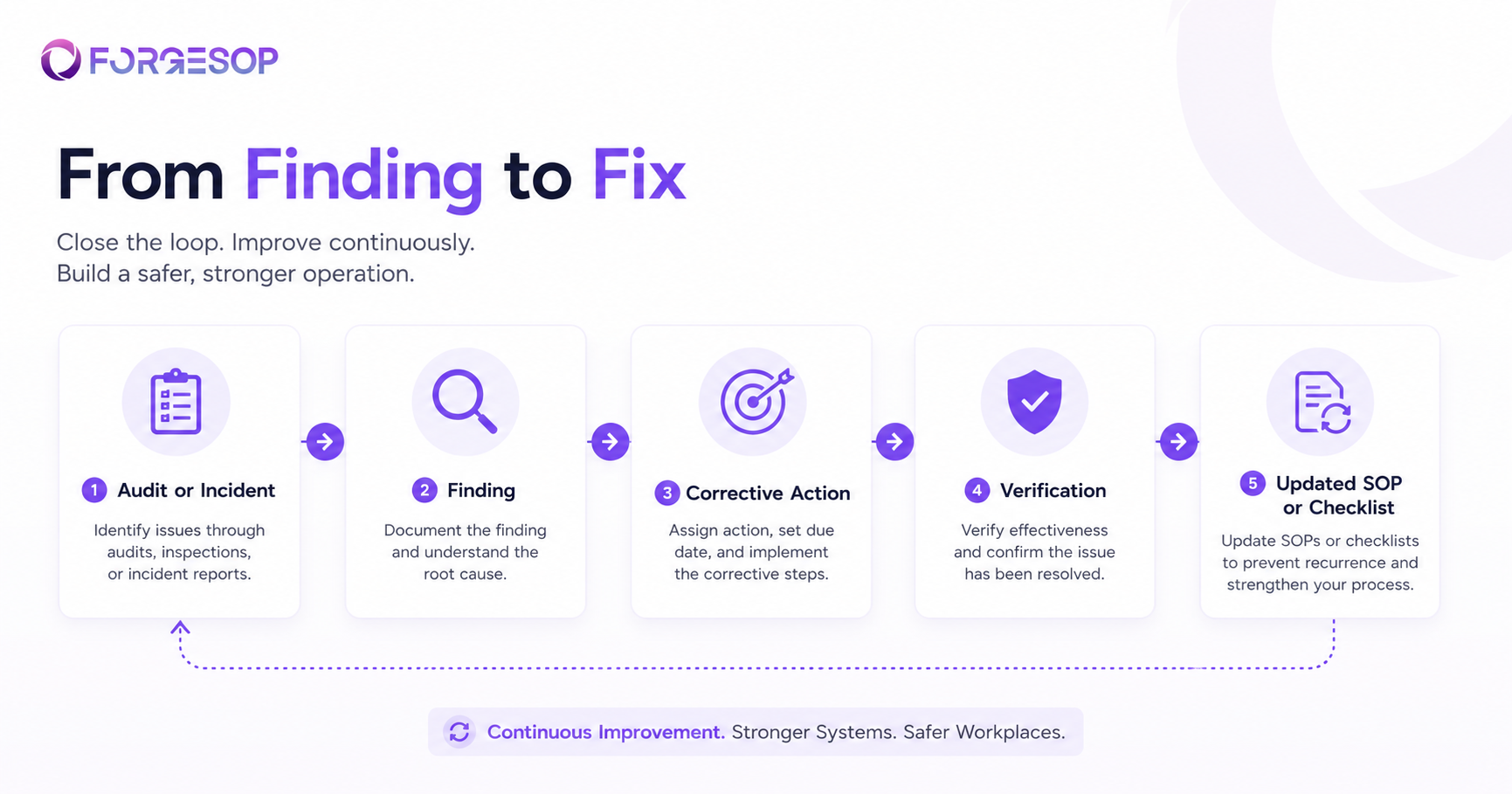
A strong audit-ready system connects the full chain:
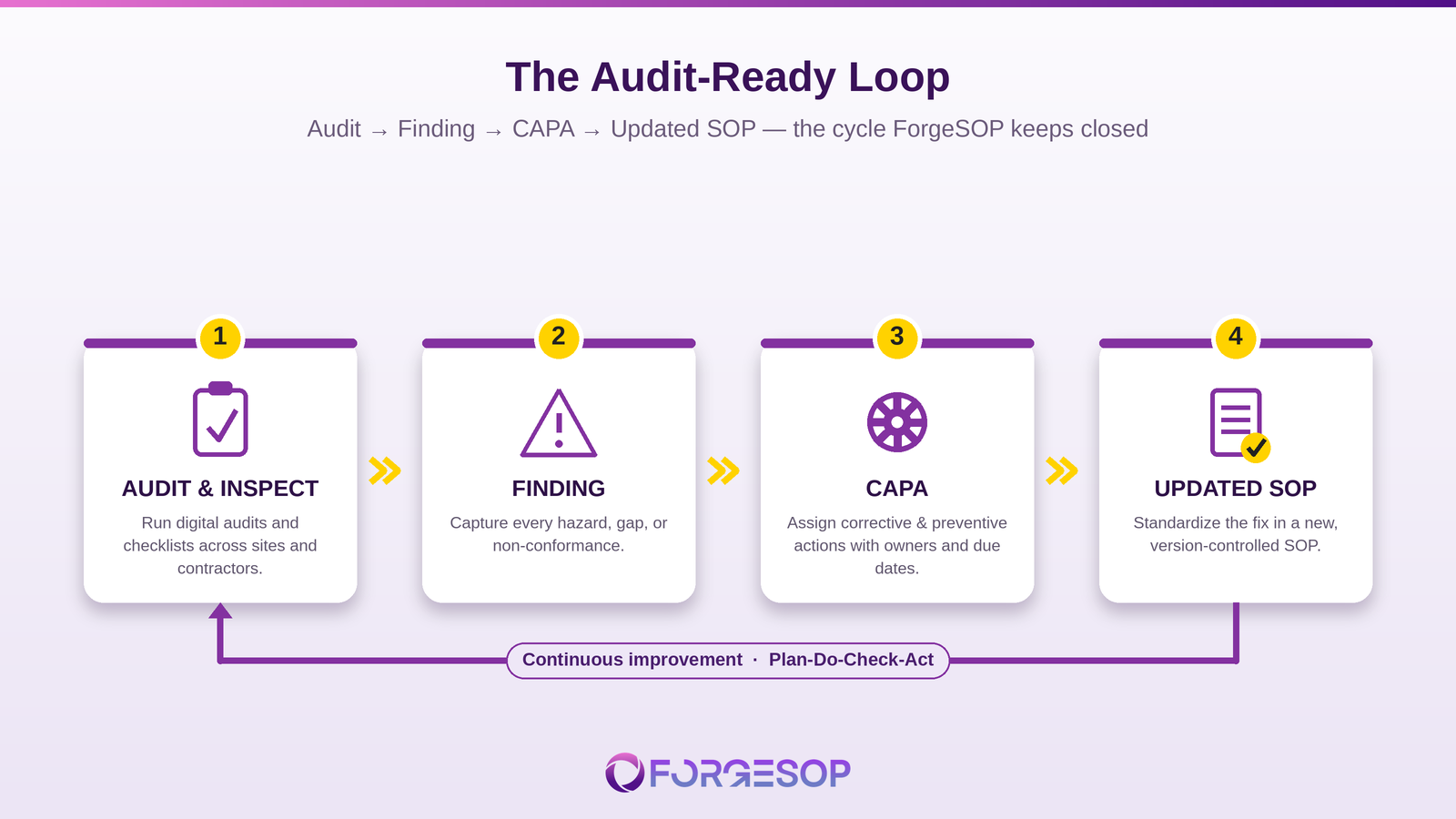
Audit or incident → finding → corrective action → verification → updated SOP or checklist
If the loop does not close, the risk remains. Audit-ready safety operations make sure findings turn into action, actions are tracked, and procedures improve over time.
What a Connected Safety Operations System Should Include
A strong audit-ready safety operations system should bring the most important safety and process workflows together.
At minimum, it should support:
Centralized SOP Management
Teams need one place to create, store, review, approve, and update SOPs. This reduces confusion around outdated files, duplicate procedures, and unclear ownership.
Digital Checklists
Procedures should be easy to turn into actionable checklists. This helps employees and contractors complete recurring tasks consistently and gives managers a record of what was done.
Audit and Inspection Management
Audits and inspections should produce structured findings, assigned actions, and organized evidence. This helps teams stay audit-ready without relying on last-minute document collection.
Incident Reporting and Investigations
Incidents, near misses, and operational issues should be reported in a consistent format. Investigation records should be easy to connect to actions, process changes, and future prevention.
CAPA Management
Corrective and preventive actions should be assigned, tracked, verified, and closed. This helps ensure findings do not disappear after an audit or incident review.
Contractor and Role-Based Access
Employees, contractors, supervisors, and managers should be able to access the procedures, checklists, and tasks relevant to their roles.
Audit-Ready Records
Records should show what happened, who was responsible, what changed, and whether corrective action was completed. This makes it easier to respond to audits, inspections, client reviews, and internal investigations.
Safety Challenges and What Better Systems Should Solve
Safety Challenge | What the System Should Provide | Operational Outcome |
|---|---|---|
SOPs are scattered across shared drives and inboxes | Centralized digital SOP management | One controlled source of truth |
Contractors work from different procedures | Role-based access and acknowledgment tracking | Employees and contractors follow the current version |
Inspection findings are not followed through | Digital audits connected to CAPAs | Every finding becomes a tracked action |
Safety leaders lack visibility across sites | Real-time dashboards and connected records | Better line of sight across operations |
Audit preparation takes too much time | Audit-ready documentation and exportable history | Records are easier to access and prove |
SOPs are not updated after incidents | Incident and CAPA workflows linked to SOP review | Procedures improve after findings |
How ForgeSOP Supports Audit-Ready Safety Operations
ForgeSOP is built for Safety, Processes, and Operations.
It brings SOPs, checklists, audits, incidents, investigations, CAPAs, resources, and operational records into one connected platform. Instead of managing procedures in one folder, audit findings in another spreadsheet, and corrective actions through email, teams can manage the full safety and process lifecycle in one place.
With ForgeSOP, organizations can create and control SOPs, run digital checklists, document audits and inspections, report incidents, manage investigations, assign CAPAs, and maintain audit-ready records.
This helps safety, operations, and quality teams improve visibility, reduce scattered documentation, and keep daily work aligned with approved procedures.
For organizations managing contractors or distributed teams, ForgeSOP also helps create a clearer standard: the right procedure, assigned to the right role, supported by the right record.
Final Thoughts
Safety operations are becoming more complex. Work is more distributed, contractor involvement is increasing, and organizations need stronger visibility across the people, processes, and controls that shape safety outcomes.
Compliance is still important, but compliance alone is not enough.
Audit-ready safety operations give teams a better way to manage risk. They connect SOPs, checklists, audits, incidents, investigations, and CAPAs so safety leaders can see what is happening, improve what is not working, and prove control when it matters.
For modern safety teams, this level of readiness cannot depend on paper forms, shared drives, or disconnected spreadsheets.
It requires a connected operating system for safety, processes, and operations.
Frequently Asked Questions
What does audit-ready mean in safety operations?
Audit-ready means your safety records, including SOPs, checklists, audit results, incident reports, investigations, and CAPAs, are current, complete, and easy to access. It means your team can prove that safety controls exist and are being followed without preparing everything at the last minute.
Why are SOPs important for audit-ready safety operations?
SOPs define how work should be performed safely and consistently. When SOPs are controlled, current, and linked to training, checklists, audits, and CAPAs, they help teams prove that workers are following approved procedures.
How can organizations manage contractor safety more effectively?
Organizations can manage contractor safety more effectively by giving contractors access to the right SOPs, requiring digital checklist completion, tracking acknowledgments, documenting incidents, and connecting contractor-related findings to corrective actions.
What is CAPA in EHS?
CAPA stands for Corrective and Preventive Action. In EHS, CAPAs are used to correct problems found during audits, inspections, incidents, or investigations and to prevent those problems from happening again.
How does digital SOP management improve audit readiness?
Digital SOP management improves audit readiness by keeping procedures centralized, version-controlled, searchable, approved, and connected to acknowledgment records, checklists, incidents, and CAPAs.
What is the difference between compliance and audit readiness?
Compliance means meeting required standards or regulations. Audit readiness means being able to prove, at any time, that those requirements are being followed through current procedures, records, actions, and evidence.
How does ForgeSOP support audit-ready safety operations?
ForgeSOP supports audit-ready safety operations by bringing SOPs, checklists, audits, incidents, investigations, CAPAs, and resources into one connected platform. It helps teams manage procedures, assign actions, track evidence, and maintain visibility across safety and operational workflows.
General
Forge better processes
One platform. Always audit-ready.
Bring SOPs, checklists, audits, incidents, and CAPAs into one connected system for safer, clearer, and more consistent operations.
No credit card required · Built for teams that run on process