
Education
Ask most quality leaders what their standard operating procedures (SOPs) cost, and they will point to the obvious: the hours spent writing them and the occasional audit finding. That number is real. It is also a fraction of the truth.
The expensive part of a broken SOP system never shows up on an invoice. It hides in rework, delays, and a slow erosion of trust that builds until an auditor, a deviation, or a departing expert forces it into the open.
This article maps the full cost of outdated and uncontrolled SOPs, above and below the waterline, and shows how disciplined document control turns a compliance expense into operational performance.
Key takeaways
|
What this article covers
1. Beyond the obvious: direct versus hidden SOP costs
Every SOP carries two kinds of cost. The first is the direct cost: the visible, budgeted spend that lands on a timesheet. Drafting hours, review cycles, training sessions, and pre-audit overtime all sit here. You can see these costs, so you manage them.
The second is the hidden cost: the indirect drag that never earns a line item. It is the productivity lost to confusion, the errors traced back to a stale instruction, and the risk that compounds every day a controlled document drifts out of date.
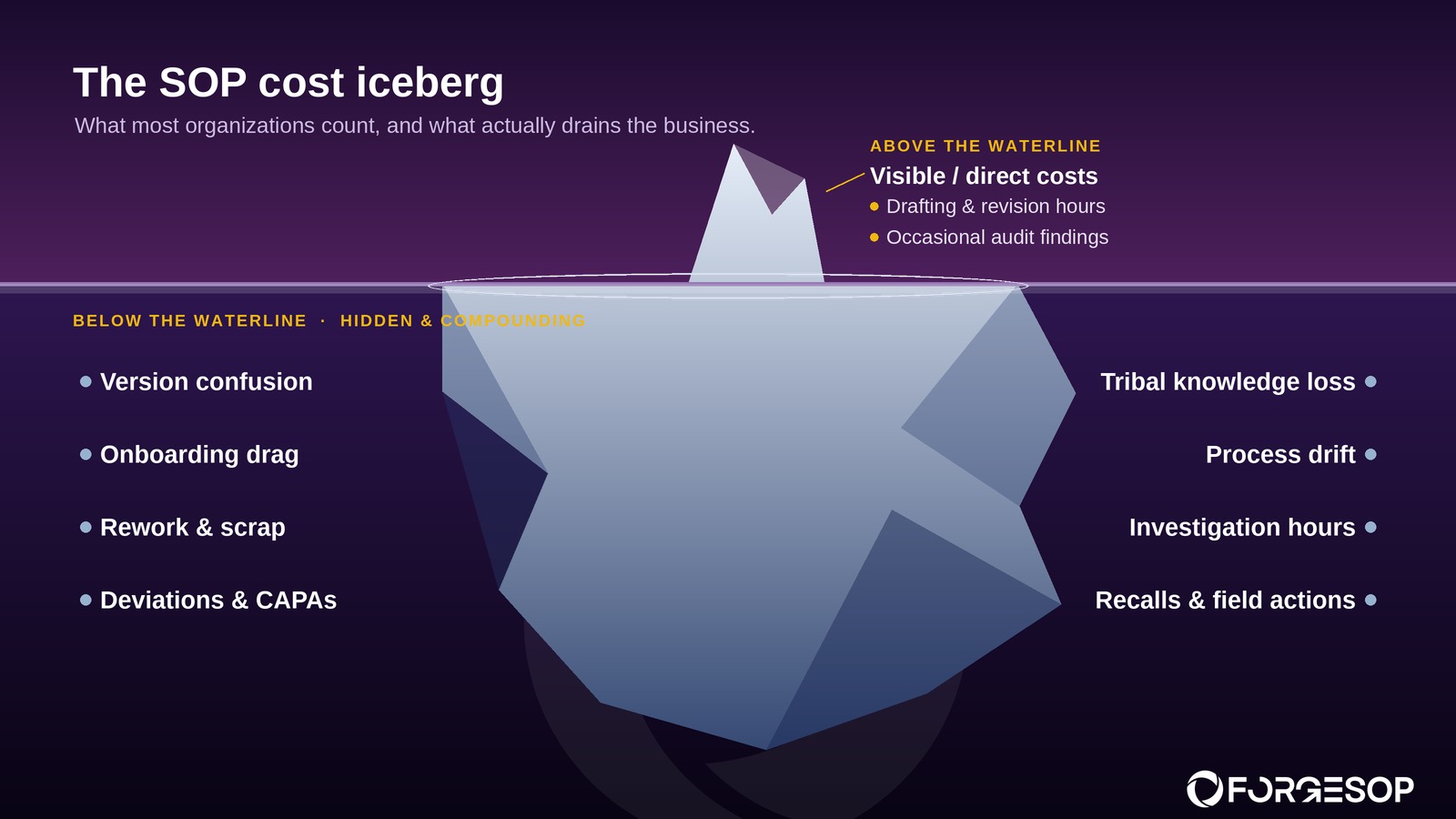
Picture an iceberg. The drafting and audit-prep hours sit above the waterline, easy to count and easy to defend in a budget review. Below the surface sits the larger mass: the rework, the deviations, the onboarding delays, and the slow loss of institutional knowledge.
Most organizations only budget for the part they can see. That is the mistake, because the hidden mass is where the real money goes.
2. The productivity drag of bad documentation
Bad documentation taxes your team long before it causes a compliance event. The tax is paid in time.
Start with the simplest loss: finding the right document. When SOPs live across shared drives, email threads, and local folders, operators cannot be sure they are reading the current version. The McKinsey Global Institute, in its report The Social Economy, found that the average knowledge worker spends about 1.8 hours a day, nearly a fifth of the workweek, searching for and gathering information. On a regulated line that is not just slow, it is a quality risk, because the wrong version is always one click away. Disciplined version control removes that doubt by keeping one current document in front of every operator.
The same drag shows up in onboarding and rework. A new technician learns from whatever document they are handed, so an outdated one teaches the wrong way to work and a senior operator has to fix it later. When a live procedure no longer matches reality, your team either follows it and produces a defect or ignores it and works from memory. Both outcomes erode consistency.
Working from memory has a name: tribal knowledge, the undocumented way work actually gets done, held in a few experienced heads. It feels efficient until that person takes leave, changes teams, or resigns. Then it walks out the door.
3. Ripple effects across quality and compliance
Productivity loss is the first ripple. Quality failures are the second, and they cost more.
When operators work from inconsistent instructions, variation creeps into the process. In regulated industries, that variation surfaces as deviations, which are documented departures from an approved procedure, and nonconformances, which are outputs that fail to meet specification. Each one triggers investigation, corrective and preventive action (CAPA), and often rework or scrap.
From there the cost cascades. A weak document trail turns a routine inspection into a finding, and one finding invites a closer look. The U.S. Food and Drug Administration (FDA) consistently lists missing or unfollowed written procedures among the most common observations in its published inspection data. Auditors read document control as a proxy for control of everything else.
The hidden costs stack up quickly:
Deviations and nonconformances from operators following inconsistent or outdated steps.
Rework and scrap when a stale instruction produces defective output or an unusable batch record.
Investigation and CAPA hours that pull your most experienced people off productive work.
Cascading audit findings, where a single document gap signals a systemic problem.
Eroded trust with regulators and customers, which is slow to rebuild and easy to lose.
That last cost is the quietest and the most dangerous. Trust never appears on a balance sheet, but losing it changes audit frequency, contract terms, and your standing with regulators. For the trail an inspector actually follows, see how connected audits and inspections keep that evidence ready.
4. Why poor document control hurts the bottom line
Hidden costs persist for a simple reason. The visible costs are easy to measure, and the hidden ones are not.
Direct costs slot neatly into a budget:
Drafting and revision hours spent creating and updating procedures.
Audit-prep overtime as teams scramble to assemble evidence before an inspection.
Fines and penalties when a regulator finds a violation.
Indirect costs resist measurement, which is exactly why they grow:
Process drift, the widening gap between what the SOP says and what the floor actually does.
Recalls and field actions that trace back to a single work-instruction failure.
Knowledge loss when an experienced operator leaves and their undocumented expertise leaves with them.
Here is the reframe most organizations miss. Document control is not a compliance cost. It is an operational performance lever. Every dollar spent keeping procedures current, controlled, and findable buys back throughput, reduces variation, and protects the trust that lets your site run without friction.
Compliance is the floor, not the ceiling. Meeting ISO 9001, the international standard for quality management systems, or 21 CFR Part 11, the FDA rule governing electronic records and signatures, keeps you in business. Disciplined document control is what makes the business run better.
5. How ForgeSOP reduces the hidden cost
ForgeSOP attacks the hidden cost directly, by removing the conditions that create it. Each capability maps to a specific cost named above.
AI-assisted authoring cuts drafting time and enforces a consistent structure, so procedures read the same way across every line and every site.
Version control ends the which-version question with one current, controlled document and a complete history of every change.
Structured approval workflows put governance behind every release, so no procedure reaches the floor without the right sign-offs.
Electronic signatures give you controlled, attributable sign-off that holds up to 21 CFR Part 11 scrutiny.
Audit trails record who did what and when, so audit-readiness is your default state, not a fire drill.
Role-based access keeps everyone working from a single source of truth, with the right permissions for each role.
None of this is about more paperwork. It is about turning document control into a system your team trusts and uses, so the hidden costs never accumulate in the first place.
The point is simple. The cost of an SOP system is not what you spend to maintain it. It is what you lose when you do not. If you want to see how ForgeSOP turns disciplined document control into throughput, quality, and audit-readiness, explore the plans or book a short demo.
Frequently Asked Questions:
How often should we update our SOPs?
There is no universal interval. Review each SOP on a fixed cycle (many regulated sites use annual or biennial reviews) and trigger an off-cycle update whenever the process, equipment, material, or regulation changes. The goal is a living document that matches the work on the floor, not a binder that is technically current but practically stale.
What is document control, in plain terms?
Document control is the system that makes sure everyone works from the correct, approved, and current version of a procedure. It covers how documents are authored, reviewed, approved, distributed, revised, and retired, with a record of each step. It is what separates "we have SOPs" from "we follow the right SOPs."
What is the real cost of an outdated SOP if it never causes a failed audit?
The cost shows up long before an audit. It appears as time lost hunting for the current version, slower onboarding, rework from stale steps, and growing reliance on a few people's memory. These losses compound quietly, which is exactly why they are easy to ignore and expensive to leave alone.
What is the difference between a deviation and a nonconformance?
A deviation is a documented departure from an approved procedure, so the process was not followed as written. A nonconformance is an output that fails to meet its specification, so the result is out of bounds. One describes the process and the other describes the product, and a single root cause often produces both.
Does better document control really improve throughput, or just compliance?
Both. Current, findable, consistent procedures cut search time, reduce rework, and shorten onboarding, which raises throughput. The same discipline produces the records an auditor expects. That is the core point: document control is an operational performance lever, not just a compliance task.
What is 21 CFR Part 11, and do our electronic SOPs need to meet it?
21 CFR Part 11 is the U.S. Food and Drug Administration (FDA) rule governing electronic records and electronic signatures. If you operate in an FDA-regulated industry and manage SOPs or sign-offs electronically, your system generally needs controls like secure, attributable e-signatures and a complete audit trail. Confirm your specific scope with your quality and regulatory team.
General
Forge better processes
One platform. Always audit-ready.
Bring SOPs, checklists, audits, incidents, and CAPAs into one connected system for safer, clearer, and more consistent operations.
No credit card required · Built for teams that run on process