
Education
Back to Blog
General14 min read
Safe Operating Procedures: Definition, Examples, and How to Write One
Ask ten supervisors how a job should be done safely and you will get ten slightly different answers. That gap between “how we think work happens” and “how work actually happens” is where most incidents start. A safe operating procedure closes that gap by putting the one correct, agreed way of doing a task in writing.
This guide covers what a safe operating procedure is, how it differs from a general SOP, what the document should contain, and how to write one your team will actually follow. You will also find worked examples for manufacturing, warehousing, and labs, plus a free template you can copy.
Quick answer: A safe operating procedure (SOP) is a written document that explains how to perform a task safely, step by step. It identifies the hazards involved, the controls and protective equipment required, and the exact sequence of actions a worker must follow to complete the job without injury.
Key takeaways
A safe operating procedure covers one hazardous task and spells out the hazards, required controls and PPE, numbered steps, and emergency response. One task, one document, one to three pages.
Written procedures are a legal expectation in many cases. OSHA requires them by name for lockout/tagout and process safety management, and ISO 45001 expects documented information wherever its absence could lead to harm.
Write with the operators who do the work, then test the draft by having someone uninvolved perform the task using only the document.
Vague instructions like “wear appropriate PPE” transfer risk to the reader. Name the specific control, setting, and equipment.
Review high-risk procedures at least annually, and immediately after any incident, equipment change, or process change.
Version control, named owners, and training records tied to the current version are what make procedures stand up in audits.
What is a safe operating procedure?
A safe operating procedure is a task-level safety document. It takes one specific job, such as operating a bench grinder, changing a blade, or decanting a solvent, and spells out how to do it from start to finish so the person doing it goes home in the same condition they arrived.
A good one answers five questions:
What task does this cover, and who is allowed to do it?
What can go wrong (the hazards)?
What controls, guards, and PPE are required before starting?
What are the steps, in order?
What do you do when something goes wrong?
You will hear different names for the same idea depending on where you work. Safe work procedure (SWP), safety operating procedures, safe system of work (common in the UK), safe work method statement (SWMS, used in Australian construction), and OHS SOP all describe roughly the same document: written instructions for doing hazardous work safely.
Safe operating procedures sit at the bottom of the safety documentation pyramid, and that is exactly why they matter. Policies say what the company intends. Programs say how the system works. Procedures tell a specific person how to do a specific task on a specific machine. When an auditor, an inspector, or a new hire wants to know how work really gets done at your site, this is the document they look at.
Safe operating procedure vs. standard operating procedure
The short version: every safe operating procedure is a standard operating procedure, but not every SOP is about safety. “SOP” is the umbrella term for any documented, repeatable process. Safety standard operating procedures are the subset written specifically to control hazards and prevent injury, and in SOP safety work the hazard section is the heart of the document, not an afterthought.
Standard operating procedure | Safe operating procedure | |
|---|---|---|
Purpose | Consistency and quality of any process | Preventing injury and illness during hazardous tasks |
Typical scope | Onboarding, invoicing, machine setup, customer service | Machine operation, chemical handling, work at height, energy isolation |
Core content | Steps, roles, standards | Hazards, controls, PPE, steps, emergency response |
Owner | Operations or quality | Safety, EHS, or operations with safety review |
Driven by | Process needs | Risk assessment and regulation |
In practice the line blurs. A machine setup SOP that ignores guarding is incomplete, and a safety procedure that ignores product quality creates workarounds. Mature teams write one document that covers both, then tag it by category (safety, quality, operations) so people can find it. If your SOP categories are a mess right now, start by separating anything involving a hazard. Those documents carry legal weight and deserve first attention.
Are safe operating procedures required by law?
Often, yes, though the wording varies. OSHA rarely uses the term “SOP,” but several standards require written procedures by name. Lockout/tagout (29 CFR 1910.147) requires documented energy control procedures for servicing machines. Process safety management (1910.119) requires written operating procedures for covered processes. Hazard communication (1910.1200) requires a written program. Respiratory protection, permit-required confined spaces, and bloodborne pathogens all have written-procedure requirements too.
Outside the US, the duty is usually framed as providing a safe system of work. UK HSE guidance expects documented safe systems for hazardous tasks. ISO 45001 requires organizations to keep documented information where its absence could lead to deviation from the OH&S policy or objectives, which in plain terms means: if skipping the document could get someone hurt, write the document.
Even where no rule names your specific task, written procedures are how you demonstrate due diligence after an incident. “We trained everyone verbally” is a hard position to defend in front of a regulator. A dated, signed, version-controlled procedure with training records attached is not.
What should a safe operating procedure include?
Format matters less than completeness, but a consistent SOP format makes procedures faster to write and easier to follow.
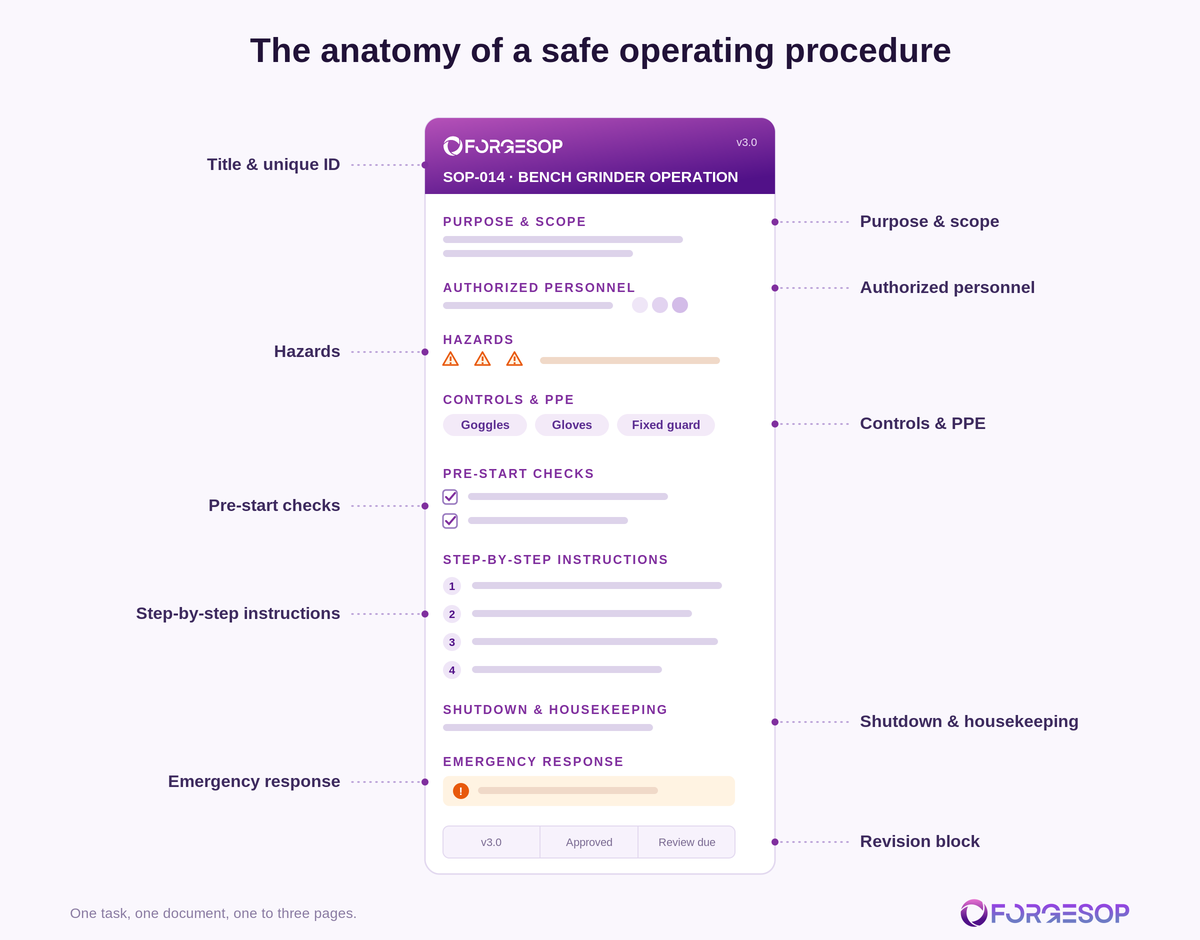
These are the sections that show up in nearly every good safety SOP:
Title and unique ID. “SOP-014: Bench Grinder Operation.” The ID makes version control and audits sane.
Purpose and scope. What task and equipment this covers, and what it does not.
Who may perform the task. Required training, licenses, or authorizations. A forklift SOP should say only certified operators may drive.
Hazards. The realistic ways this task hurts people: rotating parts, stored energy, corrosive splash, falling loads.
Required controls and PPE. Guards that must be in place, ventilation that must be running, and exactly what to wear. “Appropriate PPE” is not an instruction. “Cut-resistant gloves (level A4) and safety glasses” is.
Pre-start checks. What to inspect before beginning.
Step-by-step instructions. Numbered, in sequence, one action per step, written as commands. Add photos of the actual equipment wherever a step could be misread.
Shutdown and housekeeping. How to leave the equipment and area safe for the next person.
Emergency response. What to do if the job goes wrong: spill response, emergency stop location, first aid, who to call.
Revision block. Version number, author, approver, effective date, and next review date.
One page is a feature, not a limitation. If a procedure runs past three or four pages, it usually covers more than one task and should be split.
How to write a safe operating procedure in 7 steps
Writing the procedure is the easy part. The work that makes it accurate happens before you open the document, and the work that makes it followed happens after you save it.
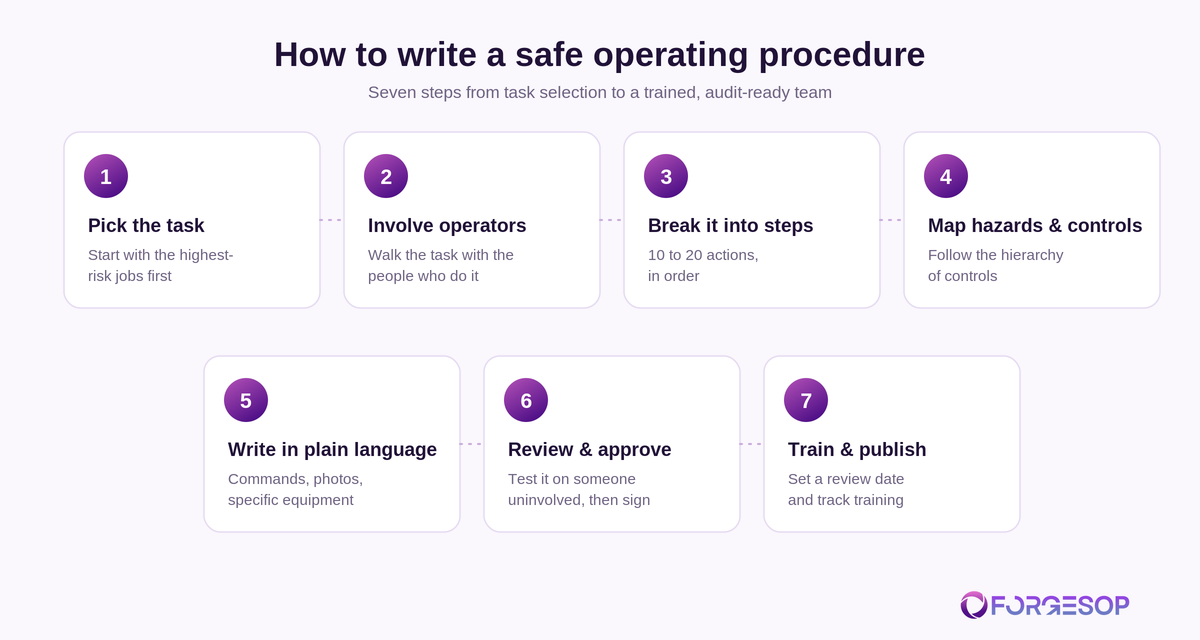
Step 1: Pick the task and justify the effort
Do not try to write procedures for everything at once. Build a task inventory, then rank it by risk. Start with tasks that involve machinery, hazardous energy, chemicals, heights, or vehicles, plus anything that has already produced an incident or near miss. A task that has hurt someone before goes to the top of the list.
Step 2: Involve the people who do the work
The operator who runs the saw every day knows where the procedure written from a desk will fail. Interview them. Better, have them walk you through the task while you take notes and photos. Procedures written without operators get workarounds. Procedures written with operators get followed, partly because the people who helped write them defend them on the floor.
Step 3: Break the task into steps
Watch the task performed and record each distinct action in order. Aim for the natural units of work: “Lower the guard until it locks” is one step. “Set up the machine” is ten steps hiding in a sentence. Most tasks break into 10 to 20 steps. More than that suggests you are documenting two tasks.
Step 4: Identify hazards and controls for each step
Go through the steps one at a time and ask what could go wrong at this exact moment. Pinch points, stored pressure, splash, dropped load, contact with a live edge. Then assign a control for each hazard, following the hierarchy of controls: eliminate or substitute where you can, guard and isolate next, and treat PPE as the last layer rather than the first answer. This step is a job safety analysis in miniature, and if you already run JSAs, pull them in here instead of starting over.
Step 5: Write it in plain language
Write for a reader who is standing at the machine, possibly on their third procedure of the day. Short sentences. Commands, not descriptions: “Lock the isolator” beats “the isolator should be locked by the operator.” Name specific things: the red e-stop on the left column, the level A4 gloves, the 15 amp breaker. Add a photo anywhere words could be misread. Skip the jargon unless every reader is trained on it, and define it once if you must use it.
Step 6: Review, test, and approve
Have someone who was not involved in writing perform the task using only the document. Every place they hesitate or improvise is a defect in the procedure, not in the person. Then route it for review by the supervisor and the safety lead, and have the approver sign and date it. An unsigned procedure is a draft, and drafts do not stand up in audits.
Step 7: Train, publish, and set a review date
A procedure nobody can find protects nobody. Publish it where the work happens: posted at the machine, linked by QR code, or one search away on a phone. Train every affected worker on it, record that training, and repeat the training when the procedure changes. Then set a review date, typically every one to three years depending on risk, and review immediately after any incident, equipment change, or process change. Following safety procedures is a habit your team builds only when the documents stay current enough to trust.
Safe operating procedure examples
Here is what the structure looks like applied to three common environments. Use these as skeletons, not finished procedures. Yours must reflect your actual equipment, your site, and your risk assessment.
Manufacturing: lockout/tagout for machine maintenance
The classic high-stakes procedure, and one where OSHA explicitly requires written steps for each machine.
Notify affected operators that the machine is coming down for service.
Identify every energy source: electrical, pneumatic, hydraulic, gravity, stored spring tension. The procedure should list them for this specific machine.
Shut the machine down using the normal stop sequence.
Isolate each energy source at its disconnect or valve.
Apply your personal lock and tag to each isolation point. One worker, one lock, one key.
Release or restrain stored energy: bleed pressure, block raised parts, let moving parts stop.
Verify zero energy by attempting a normal start. Return controls to off.
Complete the work, then remove locks in reverse order, confirm guards are back, clear the area, and notify operators before restart.
Warehouse: forklift pre-start inspection and operation
A workplace safety SOP that pays for itself daily, since forklift incidents cluster around skipped checks and pedestrian contact.
Pre-start walk-around: tires and wheels, forks (cracks, bends, heel wear), mast chains and hydraulic hoses, fluid leaks under the truck, horn, lights, seatbelt, and the data plate matching the load you plan to lift. Log the check. A truck that fails any item gets tagged out, not “driven carefully.”
Operating rules worth writing as numbered steps: seatbelt on before moving, travel with forks 10 to 15 cm off the floor and tilted back, sound the horn at every blind corner, keep three truck lengths behind other forklifts, never turn on a ramp, drive loads uphill on grades, and never lift a load above the rated capacity for the mast height. End the shift by parking in a designated zone, forks flat on the floor, brake set, key out.
Laboratory: handling corrosive chemicals
A health and safety SOP for labs starts before the container is opened.
Read the safety data sheet for the specific chemical before first use, and confirm the SDS on file matches the product in hand.
Put on splash goggles, a face shield for pours over one liter, a lab coat, and gloves rated for the specific corrosive. Nitrile is not universal.
Confirm the fume hood is running and the sash is at or below the marked working height.
Check the eyewash and safety shower are within reach and were flushed on schedule.
Transfer over a spill tray, adding acid to water, never the reverse.
Label the receiving container immediately: contents, concentration, date, your initials.
Close and wipe the source container before returning it to corrosives storage, segregated from incompatibles.
If skin or eye contact occurs, flush at the eyewash for 15 minutes and call for help. Report every splash, even the ones that “turned out fine.”
Get the free safe operating procedure template
You do not need to build the format from scratch. Our free template includes every section above (ID block, hazards, PPE, numbered steps, emergency response, revision table) in an editable document you can copy for each task.
[Download the free SOP template] and start with your highest-risk task this week.
Writing the procedure is step one. Keeping it alive is the real job.
Most sites do not have a writing problem. They have a decay problem. The procedure was accurate the day it was approved, and then the equipment changed, the reviewer left, and three different versions ended up in three different binders.
Keeping procedures trustworthy comes down to four habits:
One source of truth. Every procedure lives in one place, and everyone knows where. Printed copies point back to it.
Version history. When a procedure changes, the old version is archived, the change is noted, and the effective date is visible. Auditors ask for exactly this.
Ownership and review dates. Every SOP has a named owner and a next-review date, with reminders that fire before it lapses instead of after.
Training tied to versions. When version 3 replaces version 2, the system should tell you who still needs retraining.
You can run this on spreadsheets and shared drives for a while. Teams usually outgrow that around the point an auditor asks “how do you know operators are trained on the current version?” and the answer takes a week to assemble. That is the job ForgeSOP was built for: one place to write, approve, version, and assign safe operating procedures, with checklists, audits, and corrective actions connected to the same records.
Common mistakes to avoid
Writing from the office. Procedures that describe how the task should work instead of how it does work get ignored within a week. Walk the floor first.
Vague instructions. “Use caution,” “ensure proper ventilation,” and “wear appropriate PPE” transfer risk to the reader without telling them anything. Name the control, the setting, the equipment.
One giant document. A 30-page “safety SOP” covering a whole department is a policy wearing a procedure’s clothes. One task, one document.
No connection to incidents. When an investigation finds a procedure gap, the fix should flow back into a revision and retraining. If your corrective actions live in one system and your procedures in another, that loop quietly breaks.
Set and forget. An outdated procedure is worse than none, because it teaches people that the documents are wrong and their improvisation is right.
Frequently asked questions
What is a safety procedure?
A safety procedure is any documented set of steps designed to protect people from harm at work. Safe operating procedures for equipment and chemicals, emergency evacuation procedures, and incident reporting procedures are all safety procedures. They translate a company’s safety policy into specific actions employees can follow.
What does SOP mean in safety?
In a safety context, SOP stands for standard operating procedure or safe operating procedure. Both refer to a written document describing how to perform a task safely: the hazards, required controls and PPE, the steps in sequence, and what to do in an emergency.
What is the difference between an SOP and a safe work procedure?
Very little in practice. Safe work procedure (SWP), safe operating procedure, and safe system of work all describe task-level safety instructions. “Standard operating procedure” is broader and covers any documented process, including quality and administrative work. The document names vary by country and industry more than the content does.
What format should a safe operating procedure follow?
A common SOP format includes a title and ID number, purpose and scope, authorized personnel, hazards, required controls and PPE, pre-start checks, numbered step-by-step instructions, shutdown steps, emergency response, and a revision block with the version, approver, and review date. Keep it to one to three pages per task.
How often should safe operating procedures be reviewed?
Review high-risk procedures at least annually and lower-risk procedures every two to three years. Review immediately after any incident or near miss involving the task, any equipment or chemical change, or any regulation change. Record the review even when nothing changes, since auditors look for evidence the schedule is real.
Who should write safe operating procedures?
The people who perform the task should be directly involved, usually alongside a supervisor or safety professional who structures the document and checks it against the risk assessment. Procedures written without operator input tend to describe an idealized task and get bypassed on the floor.
Are safe operating procedures a legal requirement?
Frequently, yes. OSHA requires written procedures under specific standards such as lockout/tagout and process safety management, and regulators in the UK, Australia, and Canada expect documented safe systems of work for hazardous tasks. ISO 45001 also requires documented information where its absence could lead to harm.
Ready to stop chasing procedures across binders and shared drives? Start with ForgeSOP for free and put your SOPs, training, audits, and corrective actions in one audit-ready place.
General

Forge better processes
One platform. Always audit-ready.
Bring SOPs, checklists, audits, incidents, and CAPAs into one connected system for safer, clearer, and more consistent operations.
No credit card required · Built for teams that run on process