
Education
Back to Blog
General13 min read
The CAPA Investigation Process: Root Cause, Tools, and Records
Every safety and quality system produces findings. An audit flags a missing guard, an operator reports a near miss, a customer returns a batch. What separates strong operations from struggling ones is not how many findings they produce. It is what happens next. A CAPA investigation is the structured path from “something went wrong” to “it cannot happen again, and here is the proof.”
This guide walks through the full CAPA investigation process: what triggers one, how to find the real root cause, what a defensible CAPA record contains, and where spreadsheets stop being enough. There is a free CAPA report template at the end.
Quick answer: A CAPA investigation is the documented process of examining a problem, finding its root cause, and implementing corrective and preventive actions so it does not recur. A complete CAPA record shows what happened, why, what was done about it, who did it, and evidence that the fix worked.
Key takeaways
CAPA stands for corrective and preventive action. Corrective actions fix a problem that already happened. Preventive actions stop the same failure appearing anywhere else.
A CAPA is only as good as its root cause analysis. If your root cause is a person (“operator error”), you have not found it yet. Keep digging until you hit a system.
Every CAPA needs an owner, a due date, and a verification step. A closed CAPA without evidence the fix worked is a finding waiting to reopen.
The record is the point. Auditors and regulators do not grade your intentions. They trace the chain: finding, investigation, root cause, action, verification, and the SOP that changed.
Spreadsheets can run CAPAs at low volume. They break the moment you need to link a CAPA to its incident, its audit finding, and the procedure it changed.
What is a CAPA?
CAPA is short for corrective and preventive action. It is the formal mechanism quality and safety systems use to respond to problems: nonconformities, incidents, near misses, audit findings, customer complaints, and failed inspections.
The idea predates the acronym. Every mature management system standard requires some version of it. ISO 9001 requires organizations to react to nonconformities, evaluate the need for action to eliminate the root cause, and review the effectiveness of that action. ISO 45001 applies the same logic to incidents and safety nonconformities. For medical device companies, ISO 13485 and FDA quality system requirements make CAPA one of the most heavily inspected parts of the entire operation.
Strip away the standards language and a CAPA answers five questions. What happened? How bad is it, and is it contained? Why did it really happen? What are we changing so it stops happening? How do we know the change worked?
A CAPA is not a punishment record, and the fastest way to kill a reporting culture is to treat it like one. People stop raising problems when raising problems creates blame. The investigation targets the system that allowed the failure, not the person nearest to it when it surfaced.
Corrective action vs. preventive action
The two halves of CAPA get merged in conversation, but they answer different questions, and auditors check for both.
Corrective action | Preventive action | |
|---|---|---|
Question | How do we fix what happened? | Where else could this happen? |
Trigger | An actual problem: incident, defect, finding | A potential problem: trend, near miss, lookalike risk |
Example | Refit the guard and retrain the crew on Line 2 | Add guard checks to pre-start checklists on all lines |
Timing | Immediate to short term | After the corrective action, deliberately |
Proof | The specific problem is resolved | The failure mode is controlled everywhere it exists |
Worth knowing when someone quotes standards at you: ISO 9001 dropped the separate “preventive action” clause in its 2015 revision and folded the concept into risk-based thinking. The practical work has not changed. When you fix a failure in one place, you are still expected to ask where else the same weakness lives. Companies regulated by the FDA still use the full CAPA term, and most safety teams keep it because the distinction is useful on the floor.
What triggers a CAPA investigation?
Not every hiccup deserves a full investigation. Opening a CAPA for a typo on a label wastes the attention you need for real risks, and a system flooded with trivial CAPAs is a system nobody takes seriously. Most teams use a risk threshold: the higher the actual or potential harm, the deeper the investigation.
Common triggers that should reliably open a CAPA:
Incidents and near misses. Anything that hurt someone, or credibly could have. Near misses are the cheapest lessons you will ever get.
Internal audit findings. A nonconformity found by your own audit program, especially repeat findings.
External audit and inspection findings. Regulator citations, client audit findings, certification body nonconformities. These carry deadlines.
Customer complaints and returns. Particularly patterns: three complaints about the same failure is a trend, not bad luck.
Process and trend data. A metric drifting out of range, scrap rates climbing, repeat equipment failures.
Failed verification of an earlier CAPA. If a fix did not hold, the reopened investigation goes deeper than the first one did.
Whatever the trigger, log it in one register. A CAPA that starts life in an email thread has a short life expectancy.
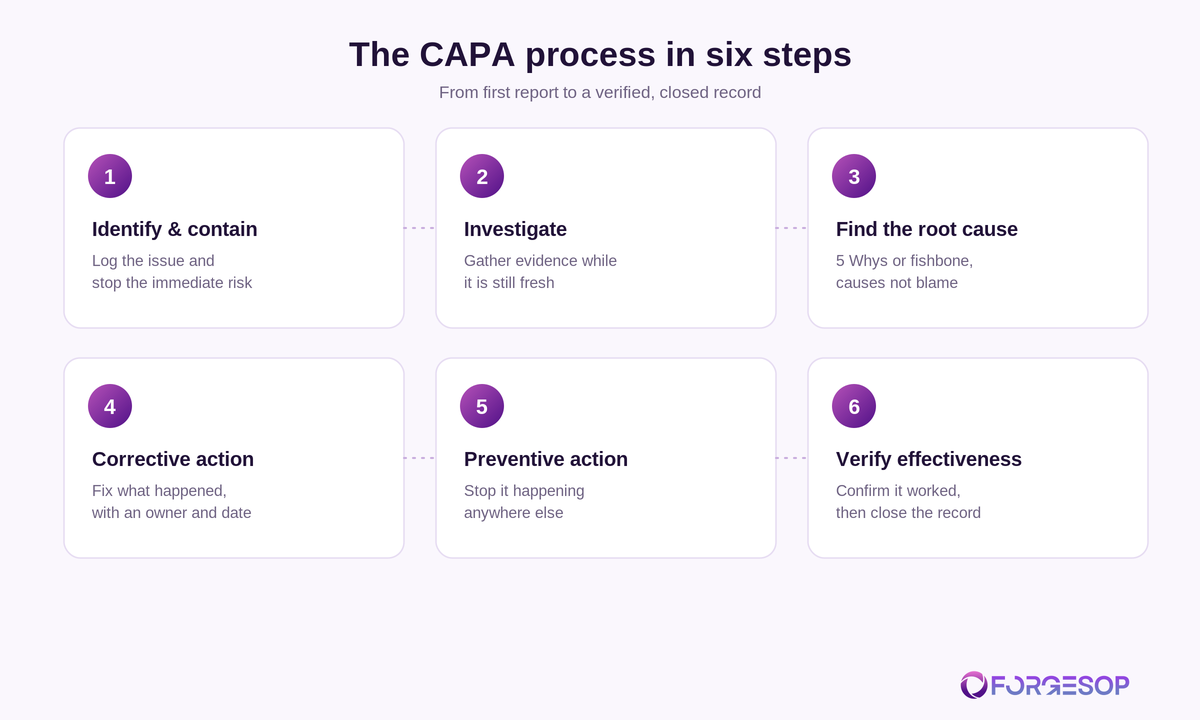
The CAPA process in six steps
The mechanics are the same whether the trigger was a safety incident or a quality defect. What varies is depth: match the effort to the risk.
Step 1: Identify and contain
Record the problem factually: what was observed, where, when, by whom, and what was affected. Then contain it. Containment is the immediate action that stops the bleeding: tag out the machine, quarantine the batch, cordon the area, pull the defective SOP from circulation. Containment is not the corrective action, and writing “machine tagged out” in the corrective action field is one of the most common CAPA record failures. It treats the symptom pause as the cure.
Step 2: Investigate while the evidence is fresh
Evidence decays fast. Interview the people involved within a day or two, while memory is specific. Photograph the scene and the equipment state. Pull the relevant records: the SOP version in force, training records, maintenance logs, inspection history. The goal at this stage is an accurate timeline of what actually happened, in sequence, without interpretation. Facts first, theories later.
Step 3: Find the root cause
This is the step that determines whether the whole exercise means anything, so it gets its own section below. The short version: keep asking why until the answer is a system, a process, or a missing control. If your investigation ends at “the operator did not follow the procedure,” you are one why short. Why did they not follow it? Was it findable? Current? Trained? Physically possible under time pressure? The honest answer is usually less comfortable and more fixable than blame.
Step 4: Define and assign the corrective action
Write the action specifically enough that a stranger could verify it: not “improve guard awareness” but “refit fixed guard to grinder G-12, update SOP-014 to add a guard check to pre-start, retrain all Line 2 operators on the new version.” Every action gets one owner and one due date. Actions without owners are wishes. Set the due date by risk, not convenience: a missing machine guard does not get a 90-day timeline.
Step 5: Extend to preventive action
Now widen the lens. The guard was missing on G-12. How many other grinders are there? Do their pre-start checklists include guard checks? Does the maintenance procedure that removed the guard include a refit verification anywhere in the plant? This is the step most spreadsheet-run CAPA systems silently skip, because nothing in a spreadsheet prompts you to look sideways. Skipping it means fixing the same failure one machine at a time, one incident at a time.
Step 6: Verify effectiveness, then close
A CAPA closes on evidence, not on completed tasks. Verification answers a different question than completion: not “did we do the actions?” but “did the actions work?” Check after a defined interval: the guard is still fitted, the checklist is actually being completed, no repeat events in 90 days, the retrained operators can demonstrate the procedure. Record who verified, what they checked, and what they found. Only then does the record close. If verification fails, the CAPA reopens and the investigation goes deeper.
Root cause analysis: methods that work on the floor
You do not need a six sigma black belt to find root causes. You need discipline about not stopping early.
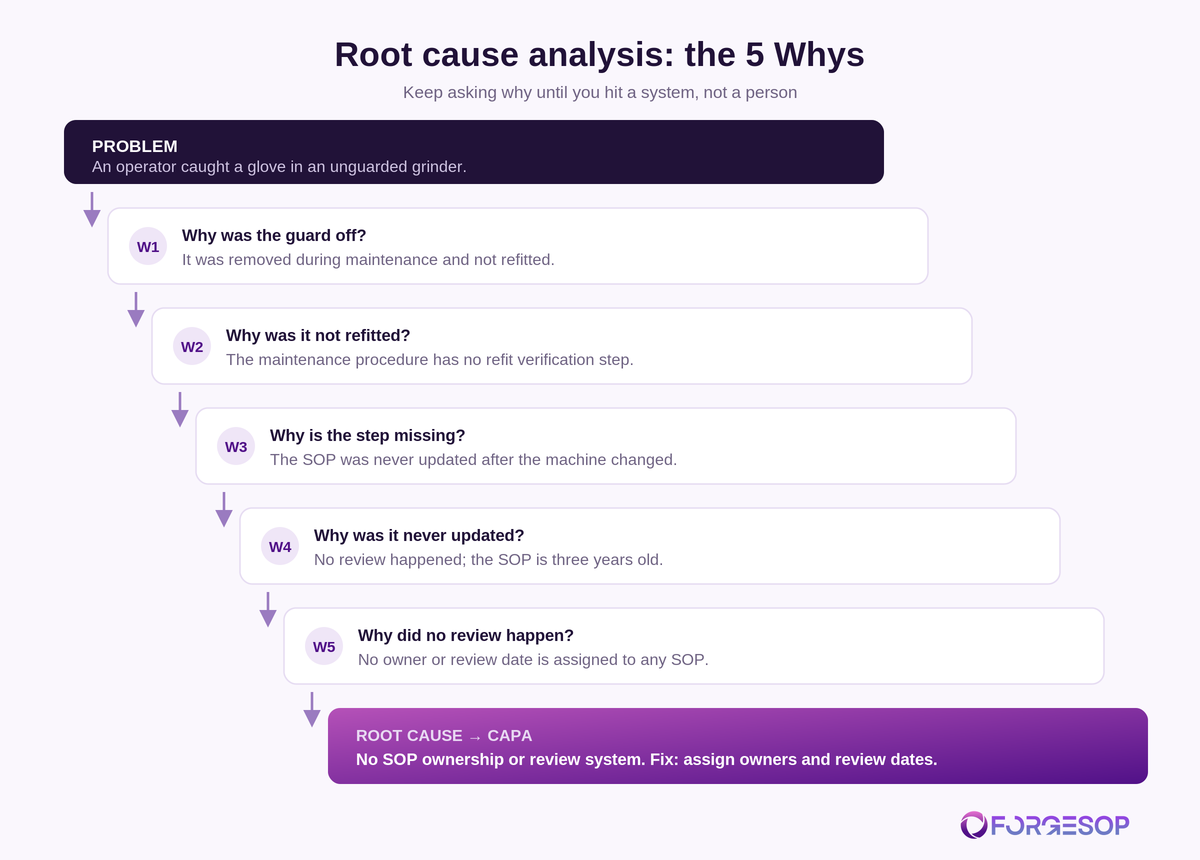
The 5 Whys is the workhorse. State the problem, then ask why it happened. Take that answer and ask why again. Five is a guideline, not a rule; the signal to stop is reaching something the organization controls. A worked example: an operator caught a glove in an unguarded grinder. Why was the guard off? Removed during maintenance and not refitted. Why not refitted? The maintenance procedure has no refit verification step. Why is the step missing? The SOP was never updated after the machine changed. Why never updated? No review happened in three years. Why no review? No owner or review date is assigned to any SOP. The root cause is not the missing guard, and it is certainly not the maintenance tech. It is the absence of an SOP ownership and review system. Fix that, and you fix failures you have not had yet.
Fishbone diagrams (Ishikawa) help when the problem has multiple contributing causes. Branch the problem across categories such as people, method, machine, material, measurement, and environment, and fill in candidate causes under each before deciding which to chase with evidence. Useful for investigation teams, because it stops the loudest theory in the room from winning by default.
Fault tree analysis works top-down from the failure event through the logical combinations of conditions that had to be true for it to occur. It is heavier, and worth the weight for serious incidents and complex systems.
Whichever method you use, the test is the same: would fixing your stated root cause have prevented the event? If not, it is a contributing factor, not the root.
What a CAPA record must contain
The investigation only counts if the record proves it happened. Auditors read CAPA records the way accountants read ledgers, and gaps read as failures. A defensible record contains:
A unique ID and the date opened
The trigger and source reference: the incident report, audit finding, or complaint it came from
A factual problem description, with severity or risk rating
Containment actions taken, with dates
The investigation summary and evidence collected
The root cause, stated as a system condition, with the method used
Corrective actions with owners and due dates
Preventive actions with owners and due dates
Documents changed as a result: SOP versions, checklist updates, training completed
Verification of effectiveness: what was checked, when, by whom, result
Closure sign-off, with name and date
Read that list again and notice how much of it is links: to an incident, an audit, an SOP version, a training record. That connectedness is exactly what breaks down when the pieces live in different places.
CAPA tools: when a spreadsheet stops being enough
Plenty of small operations run CAPAs in a spreadsheet, and at low volume it works. A shared register with columns for ID, description, root cause, owner, due date, and status is far better than email threads and memory.
The failure points are predictable. Nothing chases an overdue action, so the register is only as current as the last person who remembered to update it. Nothing links the CAPA to the incident that triggered it or the SOP it changed, so an auditor asking to trace the chain sends you into three systems and a shared drive. Version chaos arrives the first time two people edit the file. And leadership has no view of what is open, overdue, or repeating, so the same root cause resurfaces under a new ID every year. If your CAPA register has rows marked closed with empty verification columns, you already know the failure mode.
Dedicated CAPA software earns its keep on exactly those points. The requirements worth insisting on: every CAPA links to its source (incident, audit finding, complaint) and its outputs (SOP revisions, training records); every action has an owner, a due date, and automatic reminders; verification is a required step, not an optional column; the full history is timestamped and exportable for auditors; and dashboards show open, overdue, and repeat items without anyone compiling a report. That end-to-end chain, from a reported incident through investigation and root cause to a tracked, verified action and an updated procedure, is exactly what ForgeSOP’s CAPA module was built to hold in one place.
CAPA metrics worth tracking
A CAPA system generates management data as a byproduct, and reviewing a handful of numbers monthly keeps the whole loop honest.
Open CAPAs by age. A healthy distribution skews young. A pile of six-month-old open actions means owners are overloaded, due dates are decorative, or both.
Overdue percentage. The single best indicator of whether your due dates mean anything. Track it by department, not just in total, because averages hide the one area quietly ignoring the system.
Time to containment and time to closure. Containment should be measured in hours; closure in weeks, scaled by risk. If closure times cluster right before audit season, your system runs on fear of inspection rather than routine.
Repeat findings rate. The percentage of new CAPAs whose root cause matches a previously closed one. This is the effectiveness meter for the entire program: repeats mean your root causes were shallow or your verifications were rubber stamps.
Verification failure rate. How often fixes fail their effectiveness check. A rate of zero is not good news; it usually means verification is a formality. A modest failure rate with reopened investigations means the check is real.
Review these in your monthly safety and quality meeting, and let them pick where the next process improvement goes. The numbers are dull, and that is the point: a boring CAPA dashboard is what operational control looks like.
Common CAPA mistakes
“Operator error” as a root cause. It is a symptom. Something about training, procedure, workload, or equipment made the error likely. Name that.
Containment recorded as correction. Tagging out the machine stopped today’s risk. It did nothing about tomorrow’s.
Corrective without preventive. Fixing one machine while its five twins run with the same weakness is scheduling the next incident.
Closing on completion instead of effectiveness. “All actions done” is not the finish line. “Actions verified working, 90 days clean” is.
No connection to documents and training. If the fix changed how a task is done, the SOP version and the retraining record are part of the CAPA. A fix that lives only in the CAPA record changed nothing on the floor.
A register nobody reviews. CAPAs are management data. Open, overdue, and repeat counts belong in your monthly safety and quality review, not in a file that gets opened before audits.
Frequently asked questions
What does CAPA stand for?
CAPA stands for corrective and preventive action. It is the documented process of investigating a problem, finding its root cause, fixing it, preventing recurrence elsewhere, and verifying the fix worked. CAPAs are required in some form by ISO 9001, ISO 45001, ISO 13485, and FDA quality system regulations.
What is the difference between corrective and preventive action?
Corrective action eliminates the root cause of a problem that has already occurred. Preventive action addresses the same weakness everywhere else it exists before it fails there too. Refitting a missing guard is corrective. Adding guard checks to every machine’s pre-start checklist is preventive.
What triggers a CAPA?
Typical triggers are incidents and near misses, internal and external audit findings, customer complaints, adverse trends in process data, and failed verification of a previous fix. Most organizations set a risk threshold so trivial issues are fixed on the spot and investigation effort goes to high-consequence problems.
How long should a CAPA take?
Containment should be immediate, and investigation should start within days while evidence is fresh. Action timelines scale with risk: a serious safety gap warrants days or weeks, not quarters. Verification typically happens 30 to 90 days after implementation, and the CAPA closes only when effectiveness is confirmed.
What is a CAPA record?
A CAPA record is the documented file of the whole investigation: problem description, containment, evidence, root cause, corrective and preventive actions with owners and dates, related SOP and training updates, verification results, and closure sign-off. It is the artifact auditors trace to judge whether your system actually works.
What should I look for in CAPA software?
Linkage and enforcement. Every CAPA should connect to its triggering incident or audit finding and to the SOPs and training it changed. Owners, due dates, and reminders should be built in, verification should be a required step before closure, and the full audit trail should be exportable.
Is a CAPA required by OSHA?
OSHA standards do not use the term CAPA, but they require hazard correction in many contexts, and incident investigations that produce no corrective action are a red flag in any inspection. ISO 45001 explicitly requires investigating incidents and taking corrective action, so certified organizations need the full loop with records.
Stop losing findings between systems. Start with ForgeSOP for free and run incidents, investigations, CAPAs, and the SOPs they change in one audit-ready place.
General
Forge better processes
One platform. Always audit-ready.
Bring SOPs, checklists, audits, incidents, and CAPAs into one connected system for safer, clearer, and more consistent operations.
No credit card required · Built for teams that run on process