
Education
Back to Blog
General13 min read
What Is an SOP? Meaning, Format, and Categories (With Examples)
Ask three managers what an SOP is and you will get a policy, a training manual, and a checklist. All three are wrong in a useful way: an SOP borrows from each but does a job none of them do. Since procedures sit underneath training, audits, compliance, and most arguments about “how we do things here,” it pays to get the definition straight.
This guide covers what an SOP actually is, what the document contains, the four formats that cover nearly every use case, the main categories, and how an SOP differs from the documents it gets confused with. Examples included throughout.
Quick answer: An SOP (standard operating procedure) is a documented set of step-by-step instructions that describes how to perform a routine task correctly and consistently. A complete SOP document states its purpose and scope, who is authorized to do the task, the steps in order, and how the procedure is approved, versioned, and reviewed.
Key takeaways
SOP stands for standard operating procedure: the one agreed, documented way to perform a specific task, written so a qualified person can follow it without guesswork.
An SOP is not a policy. Policies say what the organization intends and why. SOPs say exactly how, step by step, at the level of a single task.
Four formats cover almost everything: simple step-by-step lists, hierarchical procedures, flowcharts for tasks with decision points, and checklists for recurring verification.
Match the format to the task, not to a template you already have. A linear task in a flowchart is clutter. A branching task in a flat list is a trap.
SOPs earn their value in the boring follow-through: a named owner, a version history, a review date, and training records tied to the current version.
SOP meaning: what the term actually covers
A standard operating procedure is the written answer to a narrow question: how do we do this specific task, here, correctly, every time? “Standard” is the operative word. The point is not that the document exists. The point is that everyone performs the task the same way, and that the way is the approved one, not whichever version a shift inherited from whoever trained them.
An SOP document is task-level by design. “Run the warehouse” is not an SOP. “Complete the forklift pre-start inspection” is. That narrowness is what makes SOPs teachable, auditable, and improvable one at a time.
Organizations lean on SOPs for four jobs at once. Consistency: the task produces the same result regardless of who performs it. Training: new people learn the approved method instead of a folk version. Compliance: regulators and certification bodies from OSHA to ISO expect documented procedures for hazardous or quality-relevant work, and in safety-heavy contexts the same document often goes by safe operating procedure. Knowledge retention: when your most experienced operator retires, the procedure stays.
What does an SOP document include?
Formats vary, but strong SOP documents share a recognizable skeleton:
Title and unique ID (for example, SOP-014), so versions and audits stay sane
Purpose and scope: what the procedure covers and what it deliberately does not
Roles and authorization: who may perform the task and what training they need
Materials, equipment, and references: what is needed before starting, including related documents
The procedure itself: numbered steps in sequence, one action per step, written as instructions
Safety and quality callouts where a step carries risk: hazards, required PPE, hold points
Records: what gets logged when the task is done
Revision block: version number, author, approver, effective date, and next review date
Keep it to one task and one to three pages. If the document sprawls past that, it is usually two procedures stapled together, or a policy in disguise. For a deeper treatment of safety-specific content (hazards, controls, emergency response), see our guide to [safe operating procedures](/blog/safe-operating-procedures).
The four SOP formats (and when to use each)
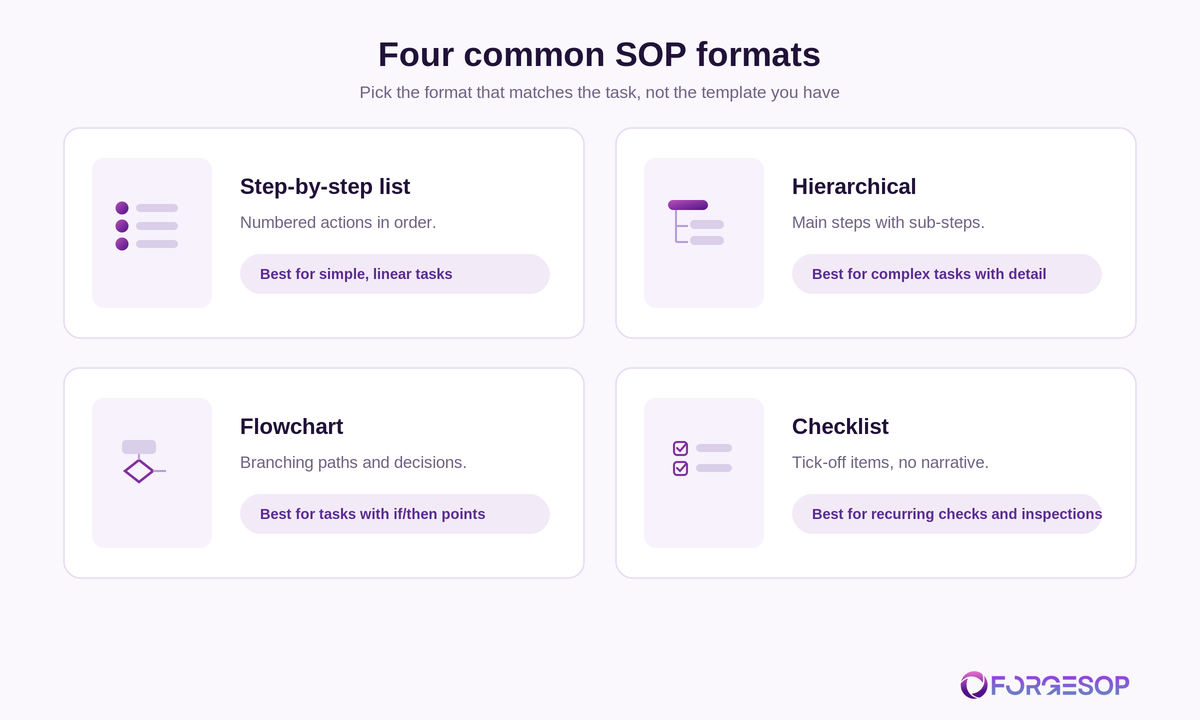
Nearly every SOP fits one of four formats. Choosing well matters more than people expect: the format decides whether the document gets used at the point of work or ignored in a drawer.
1. Simple step-by-step list
Numbered actions in order, one action per step. This is the default format and the right one for linear tasks with no branching: locking out a machine, decanting a chemical, closing out a shift. If a competent person can complete the task by reading top to bottom, stop here. Most procedures never need anything fancier.
2. Hierarchical SOP
Main steps with lettered or indented sub-steps beneath them. Use it when steps contain real detail that some readers need and others do not: step 4 might read “prepare the sampling port,” while 4a through 4d spell out exactly how for the newer technician. Hierarchical structure keeps the experienced reader fast and the new reader safe, in the same document.
3. Flowchart SOP
A diagram of boxes and decision diamonds. This is the format for tasks with genuine branching: if the pressure reading is in range do X, otherwise do Y and escalate. Troubleshooting guides, triage procedures, and escalation paths belong here. A useful flowchart SOP must include a clearly marked start and end point, a single question at each decision diamond with every branch labeled, the role responsible for each action, and references to the detailed procedure or document behind any step that needs one. A flowchart that leaves a branch hanging, or that nobody can tell where to enter, fails exactly when it is needed most.
4. Checklist SOP
Tick-off items with no narrative, built for recurring verification where the reader already knows how to do each item and the risk is skipping one: pre-start inspections, opening and closing routines, audit preparation, changeover verification. Checklists assume competence and protect against omission. They pair naturally with a fuller SOP: the procedure teaches the task, the checklist confirms it happened.
A good test when choosing: does the task branch? Use a flowchart. Does it repeat daily with known steps? Checklist. Does one audience need depth another does not? Hierarchical. Otherwise, a plain numbered list wins.
SOP categories: organizing the library
Once you pass a dozen procedures, findability becomes the problem, and tagging by category is the fix. Most organizations converge on six:
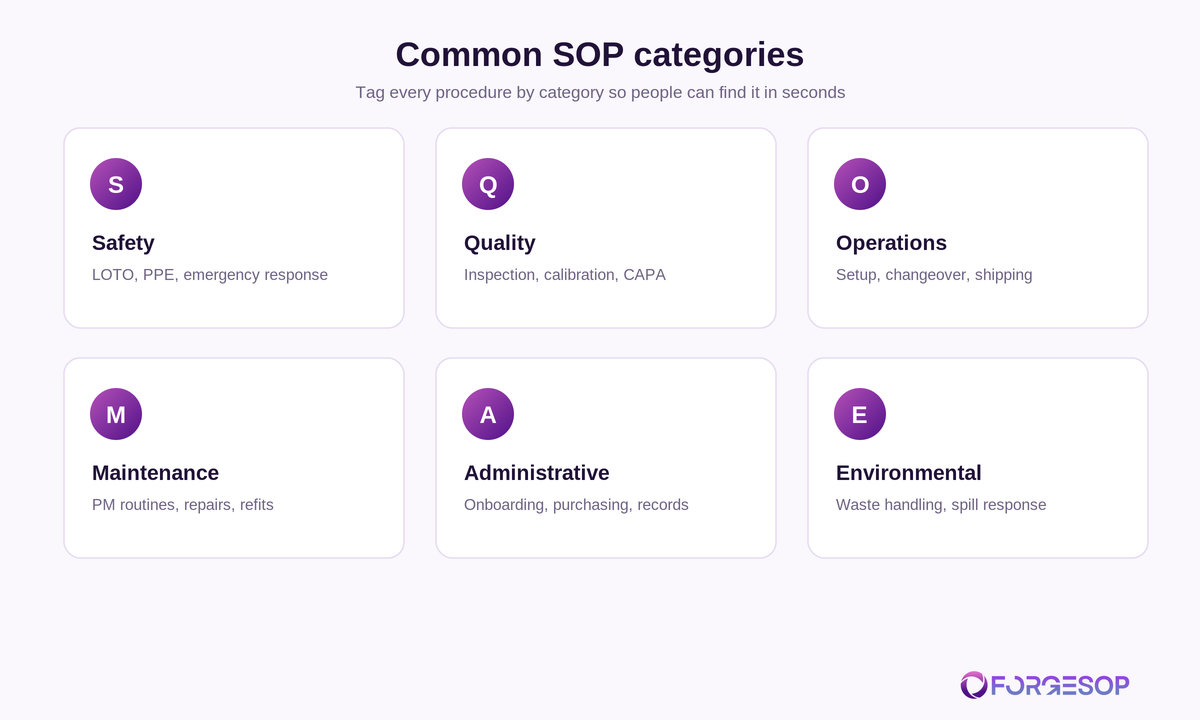
Safety SOPs cover hazardous work: lockout/tagout, confined space entry, PPE requirements, emergency response. These carry legal weight and get reviewed hardest in audits.
Quality SOPs govern inspection, calibration, sampling, nonconformity handling, and [CAPA investigations](/blog/capa-investigation-process). Certification bodies live in this category.
Operations SOPs are the daily production work: machine setup, changeovers, packing, shipping, receiving.
Maintenance SOPs cover preventive maintenance routines, repairs, and the handback steps that return equipment to service safely (the step that, when missing, puts guards back on the floor instead of on machines).
Administrative SOPs handle onboarding, purchasing approvals, document control, and record retention. Unglamorous, and the first place new office staff look.
Environmental SOPs cover waste segregation and disposal, spill response, emissions checks, and permit-driven monitoring.
The category tag is not bureaucracy. It is how a supervisor finds every safety procedure for their area in one search, and how an auditor gets the quality set without touching the rest.
A worked example
Here is the skeleton of a real checklist-format SOP, trimmed for space:
SOP-031: Forklift pre-start inspection (v2.1, owner: Warehouse Manager, review due: March 2027). Purpose: confirm the truck is safe to operate before each shift. Authorized: certified forklift operators only. Steps: check tires and wheels for damage; inspect forks for cracks and heel wear; check mast chains and hydraulic hoses; look under the truck for leaks; test horn, lights, and seatbelt; confirm the data plate matches the planned load; log the inspection; tag out the truck and report to the supervisor if any item fails. Records: inspection log entry per shift.
Notice what makes it work: one task, one page, named owner, version number, a clear failure path, and a record at the end. The content is ordinary. The discipline is the value.
SOP examples by industry
The structure stays constant; the content shifts with the work. A few sketches of what the library looks like in different settings:
Manufacturing. Machine setup and changeover procedures, lockout/tagout per machine, first-piece inspection, tool calibration, and nonconformity handling. The safety and quality categories dominate, and version control matters most here because equipment changes constantly outrun paper documents.
Warehousing and logistics. Forklift pre-start inspections, racking damage checks, loading dock procedures, manual handling techniques, and receiving inspection. Checklist-format SOPs earn their keep in this environment because so much of the work is recurring verification.
Laboratories. Sample handling and chain of custody, reagent preparation, instrument calibration, chemical storage and segregation, spill response, and waste disposal. Labs often maintain the tightest revision discipline because methods must be reproducible and inspectors read revision blocks first.
Food service and food manufacturing. Handwashing and hygiene procedures, allergen changeover cleaning, temperature checks and logging, and supplier receiving checks. HACCP plans lean on SOPs as their prerequisite programs, so the two systems should reference each other.
Offices and administration. Invoice approval, employee onboarding, records retention, and system access requests. Nobody gets hurt when these fail, but money leaks and audits drag, which is why finance teams are often the second-biggest SOP users after operations.
Common SOP mistakes
The same failures show up in every industry’s library. Written from the office: the documented steps describe how the task should work, not how it does, and the floor quietly ignores them. One giant document: a 30-page departmental SOP is a policy wearing the wrong costume; split it into tasks. No version discipline: three conflicting copies in three binders teaches people that no copy can be trusted. Format mismatch: a branching diagnostic task crammed into a flat numbered list, or a two-minute daily check buried in a narrative document. No owner: documents without a named owner and review date decay silently until an incident or an auditor finds the gap. Jargon without definition: the newest reader is the one who needs the SOP most and the one your abbreviations exclude.
SOP vs. policy vs. work instruction vs. process
These four terms get swapped around constantly, and the confusion produces documents that do no job well.
A policy states intent and rules at the organizational level: “all elevated work above two meters requires fall protection.” It says what and why, never how.
A process describes how work flows across roles and departments at a high level: order intake to fulfillment, incident report to closed CAPA. Processes span many tasks and usually many teams.
An SOP documents one task within a process, start to finish, for the person performing it.
A work instruction sits below the SOP where more granularity is needed: the torque spec and bit size for step 6, the exact screen sequence in the ERP. Not every SOP needs work instructions underneath it; many small organizations combine the two levels, which is fine as long as the document stays usable.
If a document tells you why, it is a policy. If it tells you who then what across teams, it is a process. If it tells you how, step by step, for one task, it is an SOP. If it zooms into one step’s fine detail, it is a work instruction.
Paper, shared drives, or SOP software?
Where the documents live shapes whether the discipline survives. Paper binders fail quietly: the copy at the machine drifts out of date, and nobody can say who has read what. Shared drives improve findability but multiply versions; the moment “SOP-014-final-v2-JB-edits.docx” exists, trust in every document drops. Both can work for a very small operation with one diligent owner, and both stop working at exactly the moment you grow or get audited.
Purpose-built SOP software changes three things. There is one live version of each document, with the history archived behind it instead of beside it. Approvals, review reminders, and read-and-acknowledge tracking happen in the workflow instead of in someone’s calendar. And procedures connect to the rest of the system: the checklist generated from the SOP, the training record tied to its version, the corrective action that triggered its last revision. The point is not the software itself; it is that the version and training questions auditors ask become answerable in seconds.
SOP version control in one paragraph
Every revision gets a new version number, a note on what changed and why, an approver, and an effective date. The old version is archived, never deleted, because investigations need to know what the procedure said on the day of the event. Anyone affected by the change is retrained, and the training record names the version. That is the whole discipline. It fits in a paragraph and fails in a hundred small ways when tracked by hand, which is why version control is usually the first feature teams outgrow spreadsheets over.
What makes people actually follow SOPs
A library nobody uses is decoration, and usage comes down to a few unglamorous conditions. The document has to be findable at the point of work: posted at the machine, one search away on a phone, or behind a QR code, because a procedure that lives in a binder in an office competes with memory and loses. It has to be accurate, because the first time a worker finds a step that no longer matches the equipment, the whole library loses credibility, not just that page. The people doing the task need a hand in writing and revising it, since procedures feel like instructions when you wrote them and like accusations when they are done to you. Training has to reference the current version by number, so “trained” means something specific. And supervisors have to use the documents themselves: coaching from the SOP, auditing against the SOP, and updating the SOP when the floor finds a better way. Following procedures is a culture outcome, and the culture takes its cues from what leadership treats as real.
Where to start if you have none (or a mess)
Do not attempt the full library in one quarter. Inventory the tasks that are hazardous, compliance-relevant, or error-prone, and write those ten first, with the people who do the work in the room. Pick the format per task using the tests above. Give every document an ID, an owner, a version number, and a review date on day one; retrofitting discipline later is far more painful than starting with it.
Then decide where procedures will live. A shared drive works until the first audit question about who is trained on which version. Purpose-built SOP software keeps one approved version of each document with its history, routes approvals, tracks who has read and acknowledged what, and reminds owners before reviews lapse. That is the job ForgeSOP does, with checklists, audits, and corrective actions connected to the same records, so the library stays alive after the writing sprint ends.
Frequently asked questions
What does SOP stand for?
SOP stands for standard operating procedure: a documented, step-by-step description of how to perform a routine task correctly and consistently. The term is used across manufacturing, healthcare, laboratories, logistics, food service, and office operations.
What is an SOP in safety?
In safety contexts, an SOP (often called a safe operating procedure or safe work procedure) documents how to perform a hazardous task without injury. It adds hazard identification, required controls and PPE, and emergency response steps to the standard structure of purpose, authorization, and numbered instructions.
What is the standard SOP format?
There is no single mandated format. The common baseline is a title and document ID, purpose and scope, roles and authorization, numbered step-by-step instructions, safety or quality callouts where relevant, records to complete, and a revision block with version, approver, and review date. Keep one task per document.
What are the main types of SOP?
By structure, four types cover most needs: simple step-by-step lists, hierarchical SOPs with sub-steps, flowchart SOPs for tasks with decision points, and checklist SOPs for recurring verification. By subject, most libraries organize into safety, quality, operations, maintenance, administrative, and environmental categories.
What is the difference between an SOP and a work instruction?
An SOP describes one complete task from start to finish for the person performing it. A work instruction zooms into a single step of that task in fine detail, such as exact settings, torque values, or software screens. Smaller organizations often merge the two into one document.
Who should write SOPs?
The people who perform the task, working with a supervisor or safety and quality professional who structures the document and checks it against requirements. Procedures written without operator input describe an imaginary version of the task and get bypassed on the floor.
How often should SOPs be reviewed?
High-risk and compliance-relevant SOPs at least annually; lower-risk procedures every two to three years. Review immediately after any incident involving the task, any equipment or process change, or any regulation change, and record the review even when nothing changes.
Building your SOP library from scratch, or rescuing one from a shared drive? Start with ForgeSOP for free and keep every procedure versioned, owned, and audit-ready.
General

Forge better processes
One platform. Always audit-ready.
Bring SOPs, checklists, audits, incidents, and CAPAs into one connected system for safer, clearer, and more consistent operations.
No credit card required · Built for teams that run on process