
General
The types of workplace hazards covered in this guide are safety, electrical, fire and explosion, physical, chemical, biological, ergonomic, and psychosocial hazards. They give teams a practical way to inspect work, describe concerns clearly, and decide what needs to change.
A hazard is a source or situation with the potential to cause harm. It might be a forklift crossing a pedestrian route, solvent vapor at a cleaning station, or repeated lifting from floor level. Finding it is the starting point. The next step is to control exposure and check that the change works.
Use the examples below to strengthen inspections, improve standard operating procedures (SOPs), and give every reported concern a clear path to resolution.
Key takeaways
Use the eight categories as inspection prompts. They overlap and are not a universal OSHA classification.
Inspect routine work, maintenance, changeovers, and emergencies; the same area can present different hazards during each task.
Choose controls in this order: elimination, substitution, engineering controls, administrative controls, then personal protective equipment (PPE).
Make reports actionable with a location, task, responsible owner, interim protection, and a completion check.
Connect findings to the relevant SOP and confirm that workers can carry out the revised task safely.
What is the difference between a hazard and a risk?
A hazard is what could cause harm. Risk describes the likelihood and severity of that harm in the actual working conditions. A moving conveyor is a hazard; the risk depends on factors such as access to moving parts, the task being performed, and the safeguards in place.
For example, a conveyor may be guarded during production but expose a pinch point during cleaning. Assess both situations. A general label such as “machinery hazard” cannot tell a cleaner which energy sources must be isolated or how safe access will be verified.
What are the eight types of workplace hazards?
This guide separates electrical and fire hazards to make them easier to check. Other frameworks group them under safety hazards. OSHA’s hazard-identification guidance covers multiple safety and health concerns; it does not prescribe one definitive six-type or eight-type list. Adapt your checklist to the work, equipment, people, and exposures at your site. OSHA hazard identification
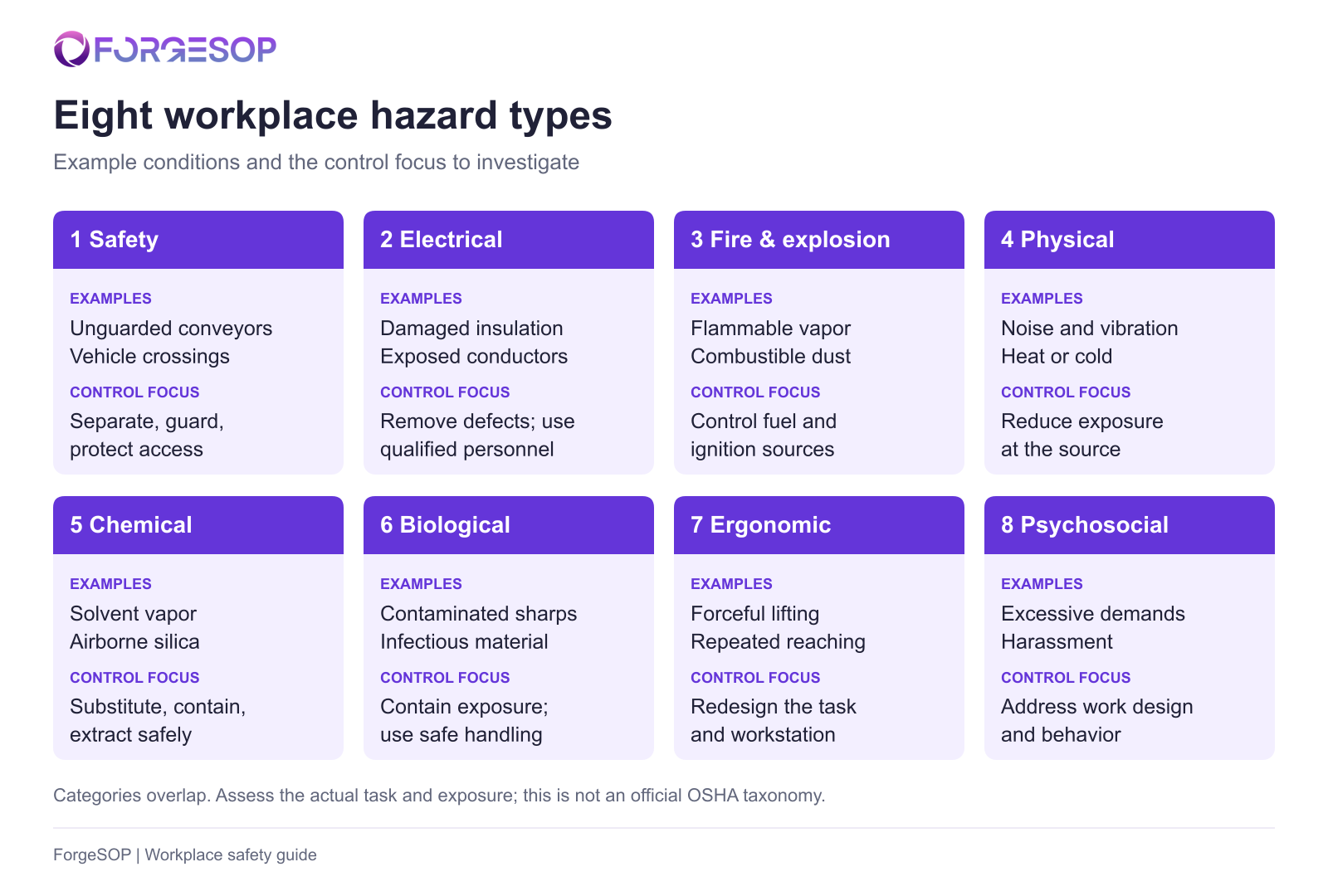
Use the categories as prompts, then assess the specific task. A solvent, for example, can create both chemical and fire hazards.
1. Safety hazards
Safety hazards include conditions that can cause injuries through falls, impact, crushing, cutting, or contact with moving equipment. Examples include unsecured loads, an unprotected platform edge, and pedestrians sharing an active forklift route.
Control focus: remove obstructions, separate people from moving vehicles, and provide suitable guarding and access protection. A warning sign alone does not prevent someone reaching a moving machine part. OSHA’s machine-guarding guidance addresses protection from dangerous machinery. Machine guarding
SOP checkpoint: define the pre-use inspection and what makes equipment unavailable for service.
2. Electrical hazards
Electrical hazards include damaged insulation, exposed conductors, unsuitable equipment in wet areas, and contact with overhead lines. Consequences can include shock, burns, fire, or fatal injury. Office appliances and extension leads deserve attention alongside industrial installations. Electrical safety
Control focus: remove defective equipment from use and refer electrical work to appropriately qualified people. Servicing can also release stored mechanical, pneumatic, hydraulic, or thermal energy. A stop button is not energy isolation; authorized personnel need the equipment-specific hazardous-energy procedure and verification steps. Hazardous energy control
SOP checkpoint: identify isolation responsibilities and the conditions for a controlled return to service.
3. Fire and explosion hazards
Fire hazards arise when an ignition source can reach combustible material. Flammable vapor, hot work near packaging, and accumulated combustible dust are examples. An explosion can also involve pressure or rapidly burning gases and dusts. Blocked escape routes make an emergency more dangerous even when they do not ignite the fire.
Control focus: manage ignition sources, assess flammable storage and dust accumulation, and keep evacuation routes usable. Employees should follow the site emergency plan and attempt firefighting only when their role, training, and conditions allow it. Fire safety
SOP checkpoint: state hot-work authorization, housekeeping, and evacuation responsibilities.
4. Physical hazards
Physical hazards include harmful exposure to noise, heat, cold, vibration, radiation, and pressure. They can occur without a visible broken part or obvious spill. Repeated noise exposure can permanently damage hearing. Occupational hearing loss
Control focus: reduce exposure at the source through measures such as quieter equipment, enclosure, insulation, or shielding. Assess heat conditions and provide appropriate cooling, water, rest, and acclimatization arrangements. Exposure assessment may require a competent safety or occupational health specialist. Heat exposure
SOP checkpoint: define exposure-related checks, protective measures, and escalation triggers for the task.
5. Chemical hazards
Chemical hazards can come from gases, vapors, liquids, dusts, fumes, and mists. Consider degreasing chemicals, airborne silica during cutting, welding fumes, and exhaust in enclosed areas. Skin and eye contact can matter as much as inhalation.
Control focus: evaluate safer substances or processes, containment, and suitable local exhaust. Use product labels and safety data sheets (SDSs) to inform handling, storage, and protection. Select gloves and other PPE for the actual chemical and exposure; one glove material does not suit every product. Hazard communication
SOP checkpoint: identify the approved substance, handling limits, SDS access, and spill-response escalation.
6. Biological hazards
Biological hazards involve infectious organisms or biological materials that can cause illness or allergic reactions. Examples include contaminated sharps, blood or other potentially infectious material, wastewater, and mold-affected materials. The exposure route and the task determine the controls.
Control focus: use appropriate containment, safer devices, hygiene, cleaning, waste handling, and task-specific protection. Where occupational blood exposure applies, OSHA requires an exposure control plan and associated protective measures. Workers need to know how to report a needlestick or other exposure promptly. Bloodborne pathogens
SOP checkpoint: define safe handling and disposal, exposure reporting, and the designated response contact.
7. Ergonomic hazards
Ergonomic hazards arise when work places excessive strain on the body. Repeated reaching across a packing bench, forceful gripping, awkward lifting, and poorly positioned screens are examples. Injury can develop gradually, so discomfort reports help reveal problems before a task becomes intolerable.
Control focus: redesign the work around the person. Adjust working height, reduce reach distances, use lifting aids, and change load presentation. Task rotation can help only when the alternative work reduces the same exposure. OSHA describes ergonomics as fitting work to workers. Ergonomics
SOP checkpoint: specify handling aids and workstation adjustments needed before the task begins.
8. Psychosocial hazards
Psychosocial hazards come from how work is designed, managed, and experienced. They can include excessive demands, limited control, unclear responsibilities, harassment, violence, and inadequate support. A worker struggling with an unrealistic production target may also rush a physical task.
Control focus: address staffing, scheduling, role clarity, harmful behavior, and reporting channels. Individual stress-management advice cannot resolve an unsafe workload on its own. The World Health Organization recommends organizational interventions that assess and reduce workplace mental health risks. Mental health at work
SOP checkpoint: provide a clear escalation route for unsafe demands and threatening behavior.
Why vehicle and fall hazards deserve close attention
In 2024, the US Bureau of Labor Statistics recorded 5,070 fatal occupational injuries. Transportation incidents accounted for 1,937, while falls, slips, and trips accounted for 844. Together, those two event categories represented approximately 54.9% of the total. BLS fatal injuries
These are national fatal-injury counts, not a forecast for an individual workplace. They support looking carefully at routes, loading areas, access equipment, and work at height while still assessing less visible health exposures.
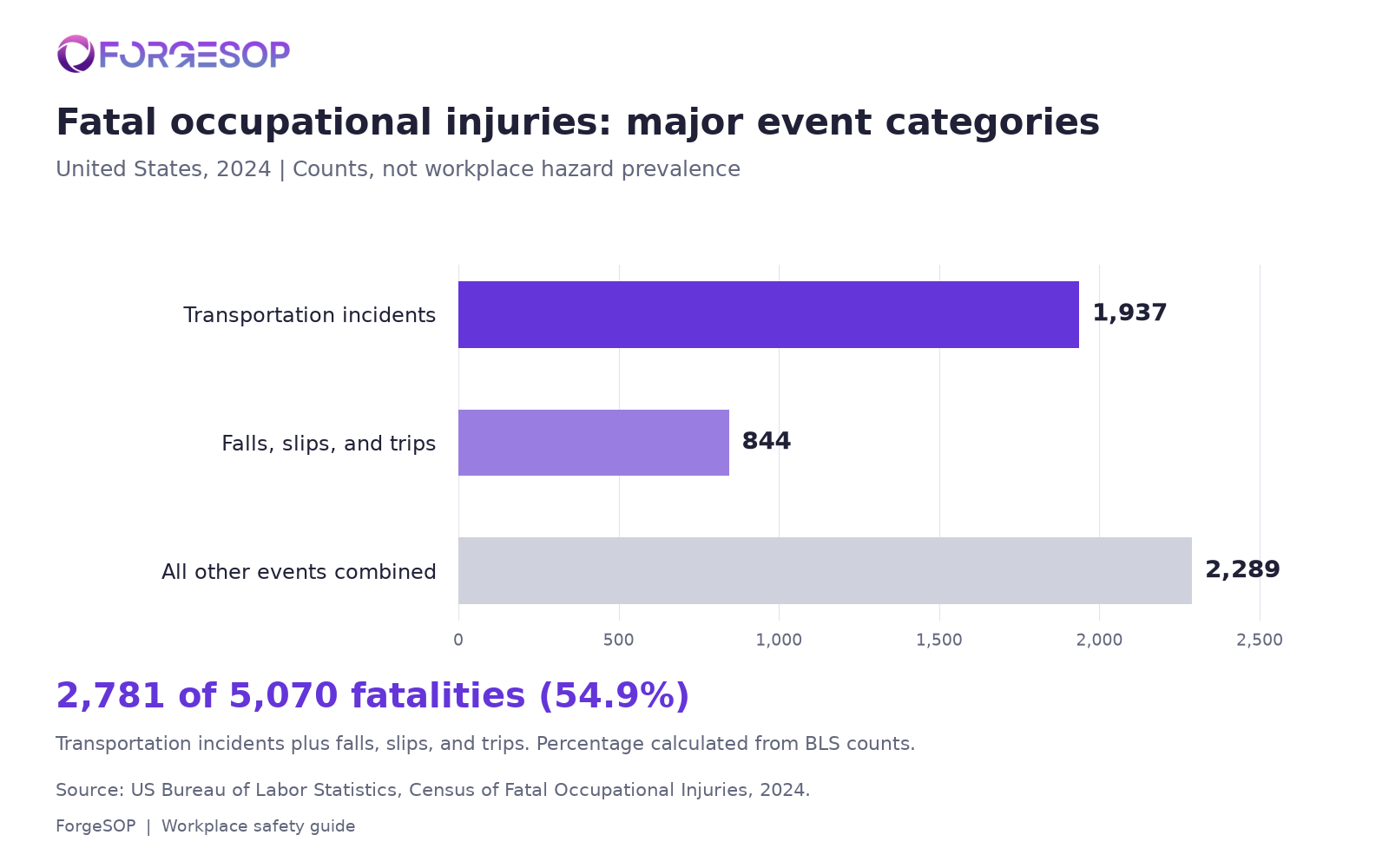
Source: US Bureau of Labor Statistics, Census of Fatal Occupational Injuries, 2024. The two highlighted event categories together account for 54.9% of the total.
Workplace hazard examples by setting
A workplace label helps you begin an inspection, but the task determines what you need to assess. These examples illustrate possible hazards; they are not prevalence ratings or a complete site assessment.
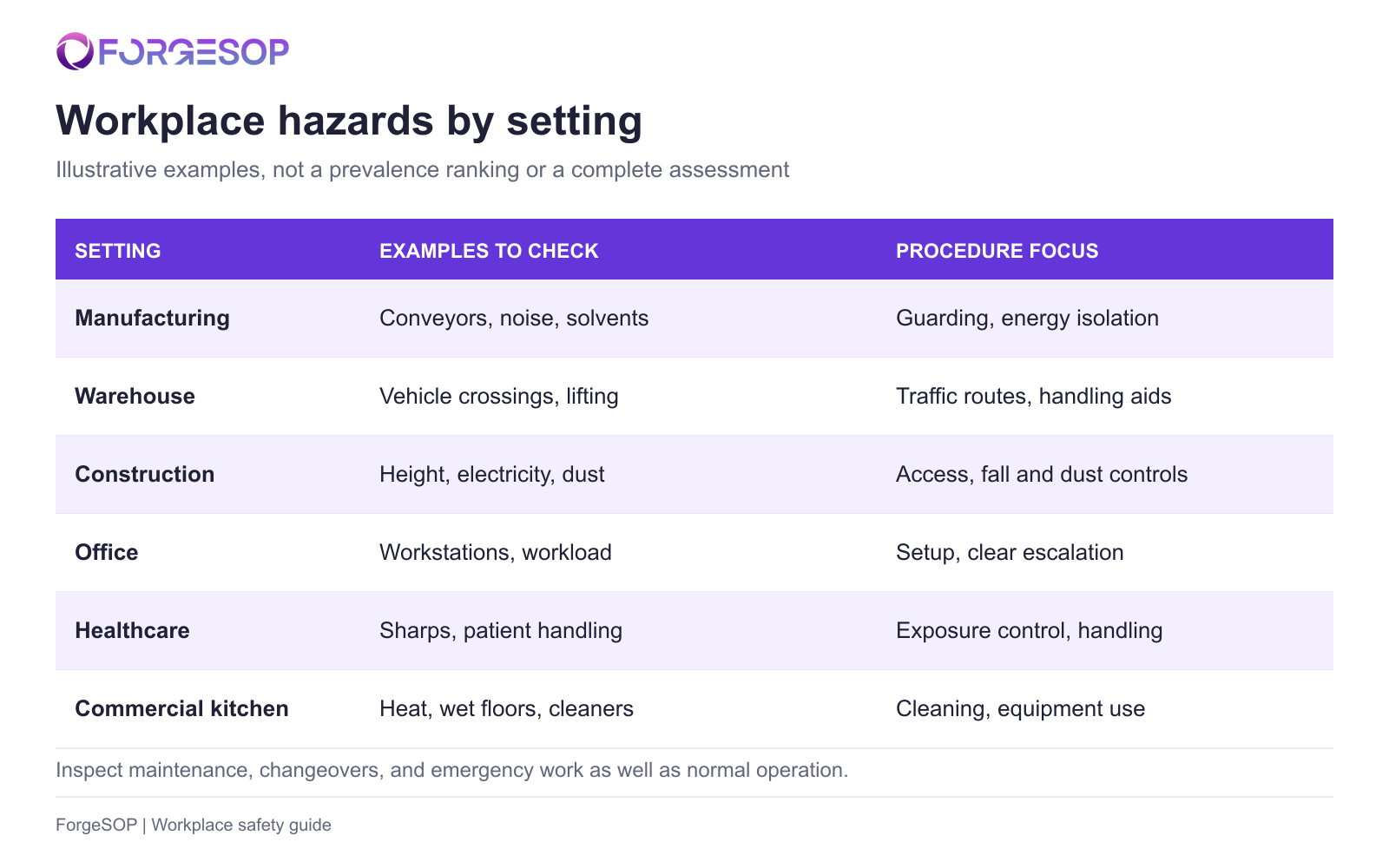
Illustrative examples only. Every setting can contain additional hazard types, including during maintenance or emergency work.
Setting | Example to investigate | Procedure to review |
Manufacturing | Access to a conveyor during cleaning | Guarding and energy isolation |
Warehouse | Pedestrians crossing a loading route | Traffic and loading-bay controls |
Construction | Cutting materials at an elevated work area | Access, fall protection, and dust controls |
Office | Repeated reaching and excessive workload | Workstation setup and workload escalation |
Healthcare | Sharps disposal and patient movement | Exposure control and safe handling |
Commercial kitchen | Hot equipment beside a wet walkway | Cleaning, equipment use, and emergency response |
How to identify workplace hazards before work starts
Use a repeatable inspection process and ask the people doing the job what changes across shifts. OSHA’s job hazard analysis guide connects the worker, task, tools, and environment. Break work into steps and examine where harm could occur. Job hazard analysis
Walk the task from preparation to shutdown. Include cleaning, replenishment, fault clearing, and maintenance.
Check the interfaces: people entering a vehicle route, contractors using a shared access point, or another crew starting nearby work.
Compare conditions with the current SOP. Look for missing equipment, unclear instructions, or steps that workers cannot realistically follow.
Record a precise observation. “Oil leak across the west packing-line walkway” is more useful than “unsafe floor.”
Arrange specialist assessment where observation is insufficient, such as airborne contaminants or noise exposure.
Revisit the assessment when equipment, materials, staffing, layout, or operating conditions change. A checklist that never changes can keep confirming yesterday’s assumptions.
How to control workplace hazards
Use the NIOSH hierarchy of controls to compare options. It favors removing or controlling a hazard at its source before depending on instructions and personal protection. Several levels may be needed together. NIOSH hierarchy of controls
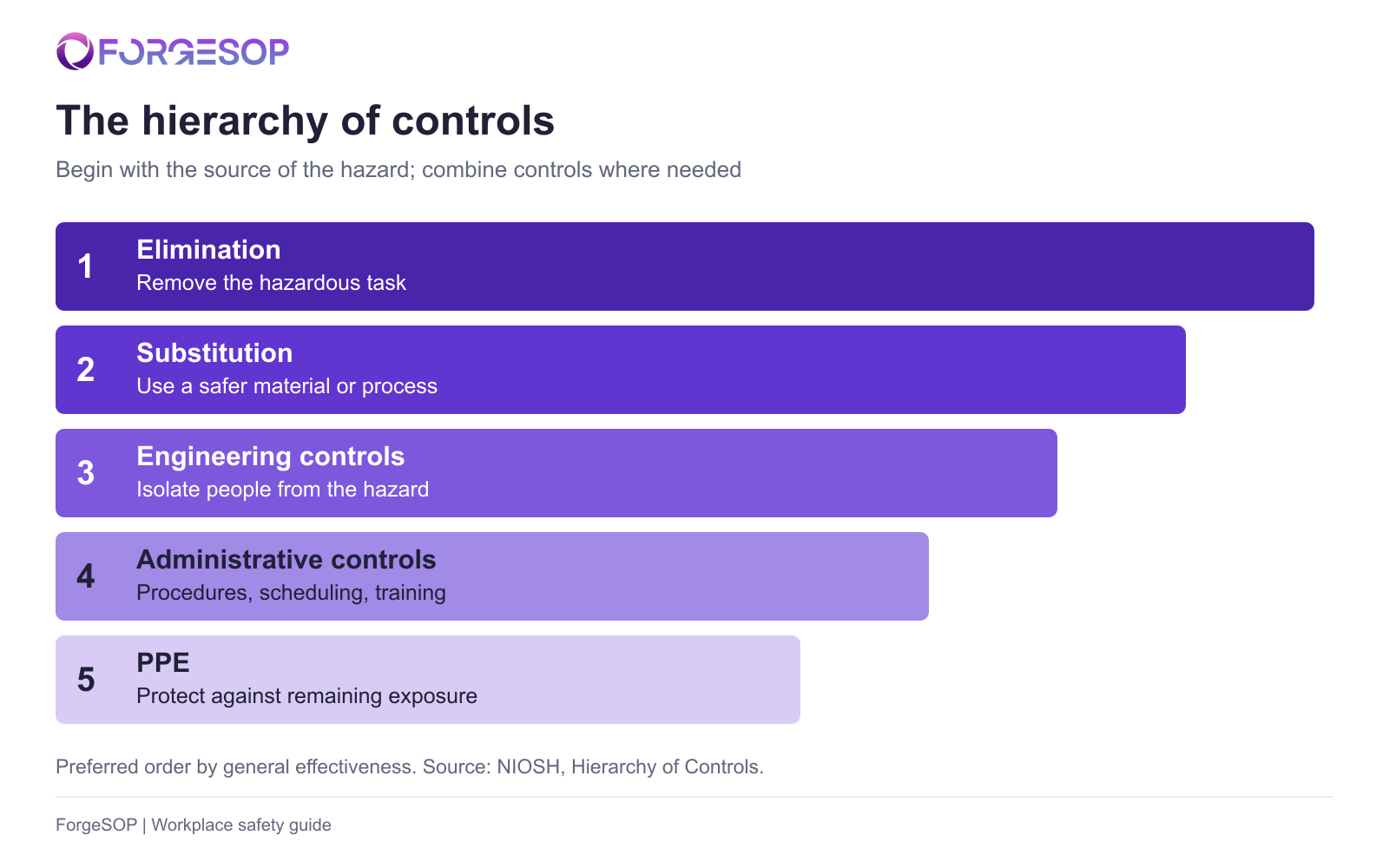
Begin at the source. SOPs and PPE support a control system; their effectiveness depends on the task and implementation.
Elimination: redesign the task so the hazardous activity is no longer needed.
Substitution: use a safer material or process, checking that it does not introduce a different risk.
Engineering controls: isolate people from the hazard with measures such as guards, enclosure, or extraction.
Administrative controls: use suitable procedures, scheduling, access rules, and training.
PPE: select, fit, maintain, and use protection appropriate to the remaining exposure.
For example, a packing team repeatedly lifts stock from floor level. Raising the supply position and using a suitable handling aid changes the work. An updated SOP then explains the setup, inspections, and exceptions. Training supports those changes, and observation confirms that the method can be followed during a busy shift.
Turn every hazard report into a verified fix
A useful reporting process connects the observation with immediate protection, a decision, and follow-through. OSHA recommends a hazard-control plan, clear responsibility, and checks that controls remain effective. Hazard prevention and control
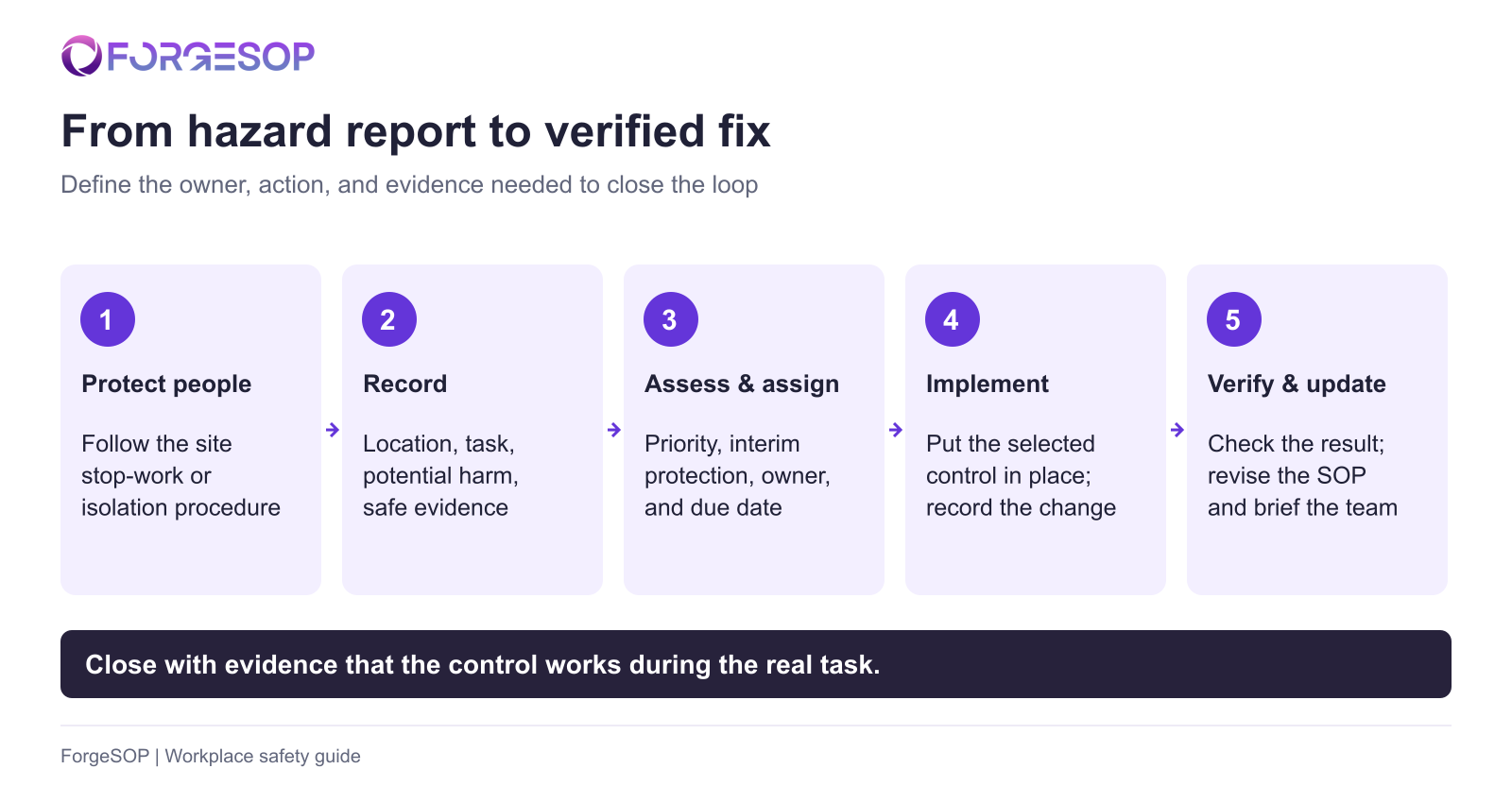
An assigned action is progress. Closure should show that the control was implemented and checked in the real task.
Protect people. Follow the site procedure for stopping or isolating unsafe work and getting help. Do not attempt an unfamiliar repair or enter a dangerous area to take a photo.
Record the observation. Capture the location, task, equipment, time, potential harm, and who may be exposed. Add evidence only when it is safe.
Assess and assign. Decide urgency, record interim protection, and give the action an owner and due date.
Implement the control. Record what changed, who completed it, and any associated maintenance or procedure revision.
Verify and learn. Check the task after the change, confirm workers can follow it, and communicate the outcome to the reporting team.
For a recurring spill, closing a report after mopping may leave the leak unresolved. The lasting action could include repairing the source, checking adjacent equipment, and changing the inspection procedure. Define the closure evidence before the action is marked complete.
Connect hazard management with safer SOPs in ForgeSOP
ForgeSOP’s workplace safety tools support recording hazards, incidents, and near misses. Inspection checklists help teams capture findings consistently, while CAPA workflows connect corrective actions with ownership, evidence, and effectiveness checks. ForgeSOP workplace safety ForgeSOP inspections ForgeSOP CAPA
SOP management adds the instructions behind the control: review and approve the revised method, retain its version history, and make the current procedure available to the team. That connection helps a finding improve the way work is done, rather than remaining an isolated report. ForgeSOP SOP management
Start with one recurring task: identify its hazards, review the strongest feasible controls, and connect the inspection, action, and procedure. Explore ForgeSOP to bring that workflow into one place. Start with ForgeSOP
Frequently asked questions
What are the main types of workplace hazards?
A practical eight-category checklist covers safety, electrical, fire and explosion, physical, chemical, biological, ergonomic, and psychosocial hazards. Categories overlap: a flammable cleaning solvent can create both chemical exposure and fire hazards. Use the categories to prompt questions, then assess the actual work.
Does OSHA define exactly six or eight hazard types?
OSHA’s recommended practices discuss multiple safety and health hazards and give examples for inspection and assessment. They do not establish one universal six-type or eight-type classification. A site-specific checklist should cover the hazards relevant to its tasks, including unusual work and emergencies. OSHA hazard identification
Who is responsible for identifying and controlling workplace hazards?
In the United States, employers must provide a workplace free from serious recognized hazards and comply with applicable OSHA requirements. Workers contribute essential information through inspections, reports, and task experience. Encourage participation without making the reporting employee responsible for funding or approving the fix. Employer responsibilities
Is an SOP enough to control a workplace hazard?
An SOP is an administrative control. It can define a safe method, but it does not physically remove a hazard. Assess whether elimination, substitution, or engineering measures are feasible, then use procedures, training, and suitable PPE to support the remaining controls. NIOSH hierarchy of controls
When should a workplace hazard assessment be reviewed?
Review it when a change could affect exposure or the effectiveness of controls, after incidents or relevant near misses, and through the site’s planned review process. A different material, shift pattern, machine, contractor activity, or maintenance method can change how the task needs to be controlled.
What information belongs in a hazard report?
Include the exact location, task, observation, equipment involved, people potentially exposed, and possible consequence. Record immediate protection and safe supporting evidence. The follow-up record should identify an owner, priority, due date, chosen control, and evidence that the completed action works.
General


Forge better processes
One platform. Always audit-ready.
Bring SOPs, checklists, audits, incidents, and CAPAs into one connected system for safer, clearer, and more consistent operations.
No credit card required · Built for teams that run on process