
Education
Back to Blog
General15 min read
Safety SOPs: What They Are, Examples, and Which Tasks Need One
Somewhere on your site right now there is a laminated procedure hanging beside a machine it no longer describes. The guard it references was replaced last year. The isolator moved. The person who wrote it left. And the newest operator on that line is learning the task from whoever happens to be standing nearby.
For most documents, that kind of drift costs money. For safety documents, it costs fingers, lungs, and lives.
This guide covers what a safety SOP is, how it differs from its operational and quality cousins, which tasks need one first, what the document must contain, and how to build a safety SOP library that stands up to inspectors, auditors, and real work.
Quick answer: A safety SOP (standard operating procedure) is a written, step-by-step instruction for performing hazardous work without injury. It names the task's hazards, the controls and personal protective equipment (PPE) required, the safe sequence of steps, and the emergency actions to take when something goes wrong, before, during, and after the task.
Key takeaways
Safety SOPs are the subset of standard operating procedures written to control hazards. They document how work involving machinery, chemicals, hazardous energy, height, or vehicles gets done without anyone getting hurt.
They carry legal weight the other SOP types do not. OSHA (the Occupational Safety and Health Administration) requires written procedures by name for hazardous energy control, hazard communication, confined spaces, and respiratory protection, among others.
Four of OSHA's ten most-cited standards in fiscal year 2025 sit squarely in safety SOP territory, led by hazard communication and lockout/tagout.
Prioritize by consequence, not convenience. Tasks that can kill or maim get documented before tasks that merely cause rework, whatever the current binder says.
A safety SOP only works when it names specifics: the hazard, the exact control, the PPE rating, the stop-work condition. "Use caution" is not a control.
Treat every safety SOP as a living document. Incidents, near misses, equipment changes, and regulation changes should each flow back into a revision, retraining, and a new version number.
What is a safety SOP?
A safety SOP is a standard operating procedure written to control hazards. It takes one hazardous task (changing a saw blade, decanting a solvent, entering a storage tank) and documents the one agreed way to perform it, so the person doing the work goes home in the same condition they arrived.
You will meet the same document under different names depending on where you work: safe operating procedure, safe work procedure (SWP), safe system of work in the UK, safe work method statement (SWMS) on Australian construction sites. The label changes. The job does not.
Within the documentation hierarchy, safety SOPs sit at the bottom, which is exactly why they matter. Policies state what the company intends. Programs describe how the safety management system works. Procedures tell one person how to do one task on one machine, and that makes them the document an inspector, an incident investigator, or a brand-new hire actually reads.
How are safety SOPs different from operational and quality SOPs?
All SOP types share the same skeleton: numbered steps, named roles, a revision block. What changes is the risk the document exists to control. An operational SOP protects consistency and throughput. A quality SOP protects the product. A safety SOP protects the person performing the task, and that single difference reshapes everything from content to sign-off.
Operational SOPs | Safety SOPs | |
|---|---|---|
Primary job | Consistent, repeatable routine work | Preventing injury and illness |
Typical trigger for writing one | Variation, handoffs, onboarding pain | Risk assessment, regulation, incidents |
Core content | Steps, settings, records | Hazards, controls, PPE, steps, emergency actions |
Cost of failure | Rework, downtime, scrap | Injury, enforcement, liability |
Review cadence | Annual, or when the process changes | At least annual, plus after every incident or change |
Sign-off | Operations or process owner | Safety lead plus operations, usually both |
In practice, the boundary blurs, and that is fine. A machine setup procedure is operational at heart, but the moment step 4 requires isolating energy, that step carries safety content and the header will list PPE. The fix is never to write two overlapping documents. Write one SOP for the task and tag it into both categories, a point our types of SOPs guide covers across all ten types. The distinction that matters day to day is simpler: when hazard control is the reason the document exists, the hazard section leads, and the rules in this article apply.
The case for safety SOPs is written in the injury data.
Safety leads sometimes struggle to justify documentation time to management. The numbers make the argument for them.
The U.S. Bureau of Labor Statistics recorded 5,070 fatal work injuries in the United States in 2024. That figure is 4 percent lower than the year before, and it still works out to roughly 14 workers who did not come home from an ordinary shift, every single day. Alongside the fatalities, private industry employers reported 2.5 million nonfatal workplace injuries and illnesses in 2024.
The financial ledger is no gentler. The National Safety Council puts the total cost of work injuries in 2024 at 181.4 billion dollars, with an average of 48,000 dollars per medically consulted injury. One preventable incident can quietly erase the margin on a very good quarter.
Now look at where enforcement actually lands. In OSHA's preliminary top 10 most-cited standards for fiscal year 2025, hazard communication ranked second with 2,546 citations, lockout/tagout fourth with 2,177, respiratory protection fifth with 1,953, and machine guarding tenth. Three of those four standards require written programs or procedures by name. When an employer is cited under them, the finding is often not that the work was impossible to do safely. It is that nobody had defined, in writing, what doing it safely meant.
The good news? The injury rate is at its lowest point since the BLS began the current data series, 2.3 cases per 100 full-time workers, which says systematic prevention works. And among prevention tools, a written procedure is close to the cheapest control you will ever deploy. It costs an afternoon to write and nothing to follow.
Which tasks need a safety SOP?
The honest answer: any task where a credible failure puts a person in a hospital. But "document everything" is how safety libraries die of their own weight, so sequence the work in two passes.
Start where the law has already decided for you. OSHA rarely uses the term "SOP," but several standards demand written procedures or programs by name:
Hazardous energy control, better known as lockout/tagout or LOTO (29 CFR 1910.147), requires documented energy control procedures for servicing machines, specific to each machine.
Hazard communication (1910.1200) requires a written program covering labels, training, and access to safety data sheets (SDS), the standardized documents describing each chemical's hazards.
Permit-required confined spaces (1910.146) requires a written permit program before anyone enters a tank, pit, or vessel.
Respiratory protection (1910.134) requires a written program with worksite-specific procedures.
Process safety management (1910.119) requires written operating procedures for every covered process.
Bloodborne pathogens (1910.1030) requires a written exposure control plan.
If a task on your site falls under one of these and the procedure is not written down, you are not deciding whether to create a safety SOP. You are deciding how long to remain citable.
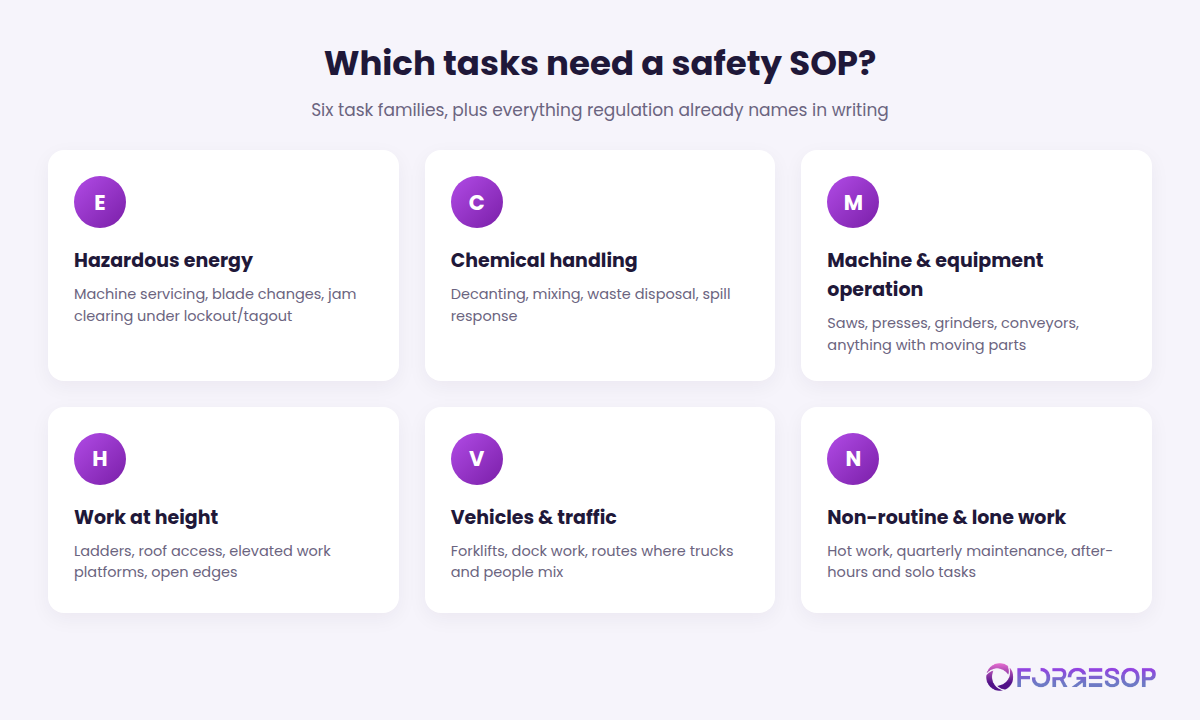
Then let risk, not habit, set the rest of the queue. Across industries, the tasks that justify a safety SOP cluster into six families:
Machine and equipment operation. Saws, presses, grinders, conveyors: anything with moving parts, stored energy, or a history of taking fingers.
Chemical handling. Decanting, diluting, mixing, waste disposal, and spill response, in labs, plants, and cleaning cupboards alike.
Work at height. Ladder work, roof access, mobile elevated work platforms, and anything within reach of an unprotected edge.
Vehicles and pedestrian traffic. Forklift operation, dock work, yard movements, and every place trucks and people share a floor.
Hot work and non-routine maintenance. Welding, cutting, and the quarterly jobs nobody quite remembers how to do safely. Infrequent tasks punch far above their weight in incident reports.
Lone and after-hours work. Tasks performed with nobody nearby to notice when something goes wrong.
Within those families, two rules set the order. Severity beats frequency: a task that could kill one person outranks a task that inconveniences twenty. And history jumps the queue: any task already linked to an incident or a near miss (an event that could have caused harm but happened not to) goes to the top of the writing list.
If a task can put someone in a hospital, it needs a safety SOP before it needs anything else.
What does a safety SOP include?
Format matters less than completeness, but the strong safety SOPs share ten building blocks:
Title and unique ID, such as SOP-042, so versions, training records, and audits stay traceable
Purpose and scope: the task and equipment covered, and what the document deliberately excludes
Authorized personnel: the training, certification, or authorization required before anyone attempts the task
Hazards: the realistic ways this task hurts people, named plainly (stored energy, corrosive splash, pinch points, falling loads)
Controls and PPE: what must be in place and what must be worn, stated exactly
Pre-start checks: what to inspect before beginning, and what failing the check means
Numbered steps in sequence: one action per step, with the stop-work conditions spelled out ("if the blade coasts longer than 10 seconds, stop and tag the machine out")
Shutdown and housekeeping: how to leave the equipment and area safe for the next person
Emergency actions: spill response, emergency stop locations, first aid, and who to call
Revision block: version, author, approver, effective date, and next review date
Two of these deserve special attention, because they are where weak procedures give themselves away.
The controls section should follow the hierarchy of controls, the ranking safety professionals use for protection: eliminate the hazard first, substitute something less dangerous, apply engineering controls like guards and ventilation, then administrative controls like procedures and training, and only then rely on PPE. A safety SOP is itself an administrative control, which is a polite way of saying it is not the strongest one. A good procedure records the stronger controls it depends on. If the SOP compensates for a missing guard, the fix is the guard.
And specificity is the whole game. "Wear appropriate PPE" transfers risk to the reader without telling them anything. "Cut-resistant gloves, level A4, and sealed safety glasses" is an instruction. Vague words in a safety SOP are not a style problem. They are the audit finding and the lawsuit, waiting.
For a section-by-section walkthrough of drafting each block, with a free template, see the safe operating procedure guide.
What does a safety SOP look like in practice?
Here is the skeleton of a real one, trimmed for space.
SOP-042: Blade change, vertical bandsaw 3 (v2.1, owner: Maintenance Lead, review due: August 2027).
Purpose: replace or tension the blade without contact or release of stored energy. Authorized: maintenance staff trained on this SOP and on the site lockout/tagout procedure. Hazards: blade laceration, unexpected startup, pinch between wheel and frame.
Controls and PPE: LOTO applied per SOP-007, cut-resistant gloves level A4, safety glasses.
Steps: run the down sequence, isolate and lock out at the disconnect, verify zero energy with a start attempt, open both wheel covers, release tension fully before touching the blade, fold and bin the old blade sharp edge inward, seat and tension the new blade to the gauge mark, spin by hand for tracking, close covers, remove locks, run a supervised test cut. Emergency: e-stop on the left column, first aid kit at the shop door, report every cut, including the ones that "turned out fine."
Records: signed LOTO log entry and the maintenance module entry for the blade change.
Nothing in it is clever. Everything in it is checkable, and the day an investigator asks how blade changes are done on that saw, the answer is a document with a version number instead of a shrug.
How to build a safety SOP library in 7 steps
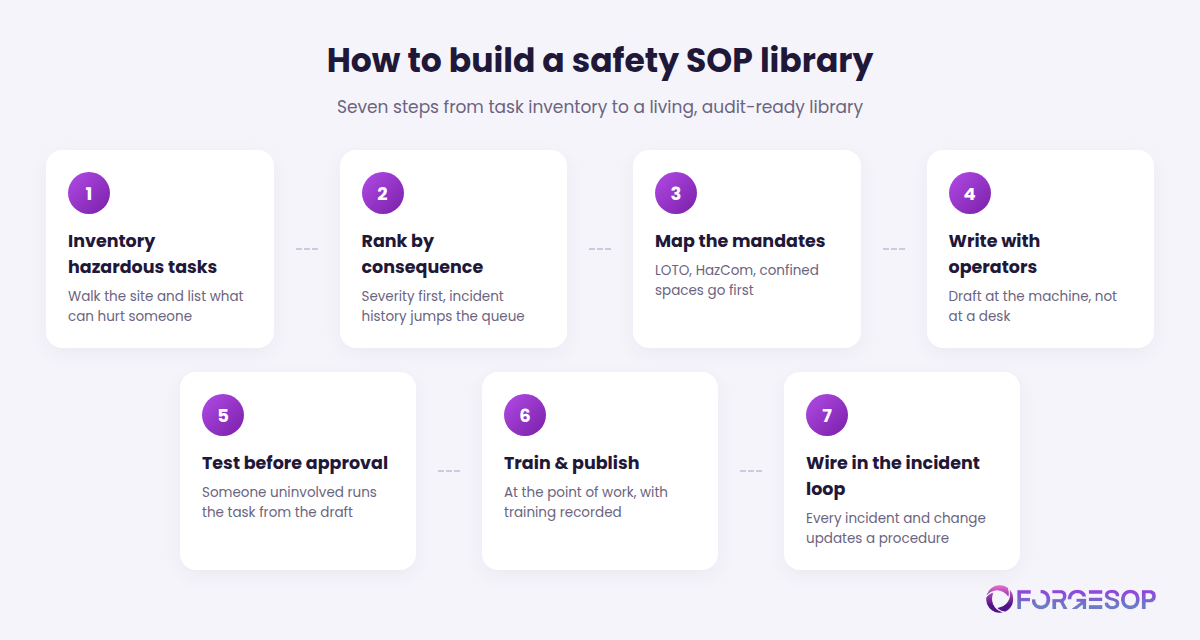
Writing one good procedure is a craft. Building a library that covers your real risks is a project, and it runs best in this order:
Inventory the hazardous tasks. Walk the site area by area and list every task involving machinery, chemicals, energy, height, vehicles, or non-routine maintenance. Ask supervisors what they would never let a new hire do alone; that question surfaces the list faster than any form. Include the jobs that happen quarterly, because rare tasks are where memory fails first.
Rank by consequence and history. Score each task on severity and likelihood, then move anything with an incident or near miss on record to the top regardless of score. The past is data.
Map the regulatory mandates. Cross-check the inventory against the standards above that require written procedures by name. Those tasks are both your highest legal exposure and, usually, your highest physical risk. They go first.
Write the top tasks with the operators. Draft at the machine, not at a desk, with the people who do the work. If you have job safety analyses (JSAs), the step-by-step hazard breakdowns many sites already keep, pull them in rather than starting over. The full drafting method lives in our safe operating procedure guide; the short version is one action per step, hazards and controls named exactly, emergency actions included.
Test each draft before approving it. Have a competent person who did not help write the procedure perform the task using only the document. Every hesitation is a defect in the draft, not in the person. Then route it for approval and signature. An unsigned safety SOP is an opinion.
Publish at the point of work and train against the version. A procedure nobody can find protects nobody. Post it at the machine, link it by QR code, make it one search away on a phone. Train every affected worker, record the training against that version number, and retrain when the version changes.
Wire the library into your incident loop. Every incident and near-miss investigation should ask three questions: did a procedure exist, was it followed, and was it right? Each answer feeds a revision, a retraining, or a new SOP. If your incident reporting, audits, and corrective actions run in one connected loop, this happens by default. Set review dates too: at least annually for high-risk procedures, and immediately after any incident, equipment change, chemical change, or regulation change.
An out-of-date safety SOP is worse than no SOP at all.
That sounds backwards, so it deserves a defense.
A missing procedure is a visible gap. People know there is no document, and the careful ones ask questions, check with a supervisor, slow down. An outdated procedure is camouflage. It looks like a control, satisfies the checklist, and describes a machine that no longer exists. The first time an operator notices the document contradicts the equipment in front of them, the entire library loses authority, not just that page. From then on, improvisation feels justified.
The reality is that most sites do not have a writing problem. They have a decay problem. Procedures were accurate the day they were approved, and then the equipment changed, the approver left, and three versions ended up in three binders.
After an incident, the questions arrive in a fixed order: show me the procedure, show me the version in force that day, show me who was trained on it. Paper binders and shared drives answer those questions in days, sometimes never. Purpose-built SOP management software answers them in minutes, because each procedure lives as one current version with its history, approvals, and training records attached. However you solve it, solve it before the library grows past a dozen documents. Retrofitting version control after an incident is the most expensive way to buy it.
The bottom line
Safety SOPs are where your safety program stops being a statement of intent and becomes a set of instructions someone can actually follow at 2 a.m. on a short-staffed shift. The regulations name some of them, the risk assessment names the rest, and the injury data explains why both lists matter.
Start with five tasks: the ones that could kill, the ones the law already requires in writing, and the ones that have hurt someone before. Write them at the machine with the people who do the work, test them on someone uninvolved, and give every document an owner, a version, and a review date. Then keep them alive, because a safety SOP that matches reality is a control, and one that used to match reality is a liability.
Get ahead of the risk while it is still a list of tasks, and not yet an incident report.
Frequently asked questions
What is a safety SOP?
A safety SOP (standard operating procedure) is a written, task-level document explaining how to perform hazardous work without injury. It identifies the hazards of one specific task, the required controls and PPE, the safe sequence of steps, and the emergency actions to take if something goes wrong. Safe operating procedure and safe work procedure describe the same document.
What is the difference between a safety SOP and an operational SOP?
An operational SOP standardizes routine work to protect consistency and throughput. A safety SOP controls hazardous work to protect people, so it adds hazard identification, controls, PPE requirements, stop-work conditions, and emergency actions. One task can need both kinds of content, and the best practice is a single document tagged into both categories.
What is the difference between a safety SOP and a JSA?
A JSA (job safety analysis) breaks a task into steps and lists the hazards and controls for each step. It is an analysis tool. A safety SOP is the instruction that results: the approved, versioned document workers are trained on and follow. Mature programs use the JSA as the input and the safety SOP as the output.
Are safety SOPs required by OSHA?
Often, yes. OSHA requires written procedures or programs by name under several standards, including lockout/tagout (29 CFR 1910.147), hazard communication (1910.1200), permit-required confined spaces (1910.146), respiratory protection (1910.134), and process safety management (1910.119). Even where no standard names your task, written procedures are the accepted way to demonstrate due diligence after an incident.
How many safety SOPs does a workplace need?
As many as there are hazardous tasks, and no more. Inventory every task involving machinery, chemicals, energy, height, vehicles, or non-routine maintenance, then write procedures in order of consequence. A small workshop might need ten. A chemical plant might need hundreds. The number that matters is coverage of your actual hazards, not the count in the binder.
How long should a safety SOP be?
One task, one to three pages, typically 10 to 20 numbered steps. A 30-page safety SOP is almost always a program or policy wearing a procedure's clothes, and it should be split into task-level documents. Length should come from necessary detail (exact controls, settings, PPE ratings, stop-work conditions), never from narrative padding.
How often should safety SOPs be reviewed?
Review high-risk safety SOPs at least annually, and every procedure immediately after an incident or near miss involving the task, an equipment or chemical change, or a regulation change. Record each review even when nothing changes, so the revision block proves the procedure is current rather than merely old.
General

Forge better processes
One platform. Always audit-ready.
Bring SOPs, checklists, audits, incidents, and CAPAs into one connected system for safer, clearer, and more consistent operations.
No credit card required · Built for teams that run on process