

General
Back to Blog
General14 min read
Permit to Work vs JSA vs SOP: What Each One Does and How They Fit Together
A safety lead asks a supervisor to show the paperwork for a welding job on a tank. The supervisor hands over three documents: the site's hot work procedure, a job safety analysis and a hot work permit. All three mention fire watches. Two of them mention gas testing. One of them is out of date.
Which one actually governs the job?
The supervisor isn't sure, and neither is the crew. That confusion is common, and it matters. When the roles of these documents blur, teams either duplicate effort, or each assumes another document covered the risk. Investigators then find three pieces of paper and no clear owner for the control that failed.
In this article, we break down what a permit to work, a job safety analysis (JSA) and a standard operating procedure (SOP) each do, where they overlap, which jobs need which documents, and how to link them so they never contradict each other. All three sit at the heart of any permit to work system.
Quick answer: An SOP explains how a task is done correctly every time. A JSA breaks one job into steps and identifies the hazards and controls for each step. A permit to work confirms those controls are actually in place for a specific job, place and time, and authorizes the work to start. High-risk, non-routine work usually needs all three, linked rather than duplicated.
Key takeaways
An SOP answers "how is this task done?", a JSA answers "what could go wrong on this job?", and a permit answers "is it safe to start now?"
The three documents differ in scope, lifespan and who signs them. An SOP lasts until it is revised; a permit usually lasts one shift.
The JSA is the bridge: it applies the SOP to today's job and feeds the permit's list of precautions.
Routine, low-risk tasks may need only an SOP. High-risk, non-routine work such as hot work, confined space entry and complex isolation needs all three.
The biggest risk is not missing paperwork. It is three documents that say different things.
Link the documents by reference, not by copying, so a change in one triggers a review of the others.
What is an SOP?
A standard operating procedure is a written, approved set of steps for doing a task the same way every time. It sets the method, the equipment, the quality and safety requirements, and who is responsible for what. Our guide to what an SOP is covers the basics, and our breakdown of what an SOP should include covers the structure.
A typical safety-related SOP includes:
purpose and scope, so readers know when it applies
roles and responsibilities, such as who may perform the task and who must be informed
required equipment and protective gear
the steps, in order, with the standard safety precautions built in
references to related procedures, regulations and forms
revision history and approval, so everyone knows which version is current
SOPs are written once, approved by the process owner and reused. They describe the task in general, not one particular day, location or crew. That is their strength and their limit. An SOP for hot work tells you that combustibles must be cleared and gas tested. It cannot tell you that the tank next to today's job still holds a layer of sludge giving off vapor.
An SOP is a living document. It stays valid until the method, the equipment or the regulations change, and then it is revised and reissued.
What is a JSA?
A job safety analysis, also called a job hazard analysis (JHA), is a structured look at one job before it starts. It breaks the job into steps, identifies the hazards at each step and sets the controls that will deal with them. The two names mean the same thing in practice, and many sites use them interchangeably.
The Occupational Safety and Health Administration (OSHA) describes the job hazard analysis as a technique that focuses on job tasks as a way to identify hazards before they occur, in its guidance booklet OSHA 3071. It looks at the relationship between the worker, the task, the tools and the work environment.
A JSA usually has three columns:
Job steps: what is done, in the order it is done, in a few words each.
Hazards: what could go wrong at each step, and how.
Controls: what will prevent it, working down from eliminating the hazard to engineering controls, then administrative controls, then protective equipment.
Which jobs need a JSA?
OSHA's booklet suggests giving priority to:
jobs with the highest injury or illness rates
jobs that could cause severe or disabling injuries, even if nothing has happened yet
jobs where one simple human error could lead to a severe incident
jobs that are new to your operation or have changed
jobs complex enough to need written instructions
A JSA can be generic, written once for a recurring job, or specific to one job in one place. For permit work, a generic JSA should always be reviewed at the work point for the conditions on the day. That review is where the job-specific hazards show up.
JSA example
Here is part of a JSA for the welding job in our opening scenario.
JSA-0412: Pipe support repair, Tank Farm B (reviewed at the work point on the day)
Step | Hazard | Control
|
|---|---|---|
1. Isolate the transfer line | Product released when the line is disturbed | Isolate and lock under an isolation permit; verify before work |
2. Prepare the work area | Combustibles near the work; vapor from Tank 3 | Clear combustibles to 35 ft; cover drains; test for flammable vapor |
3. Cut out the damaged bracket | Sparks falling to grade; hot metal | Fire-resistant blanket below; fire watch in place; gloves and face shield |
4. Weld the new bracket | Ignition of vapor; welding fume; burns | Retest gas every 2 hours; local exhaust; welding protective gear |
5. Finish and leave | Smoldering material after the job | Fire watch for at least 60 minutes after; area inspected before handback |
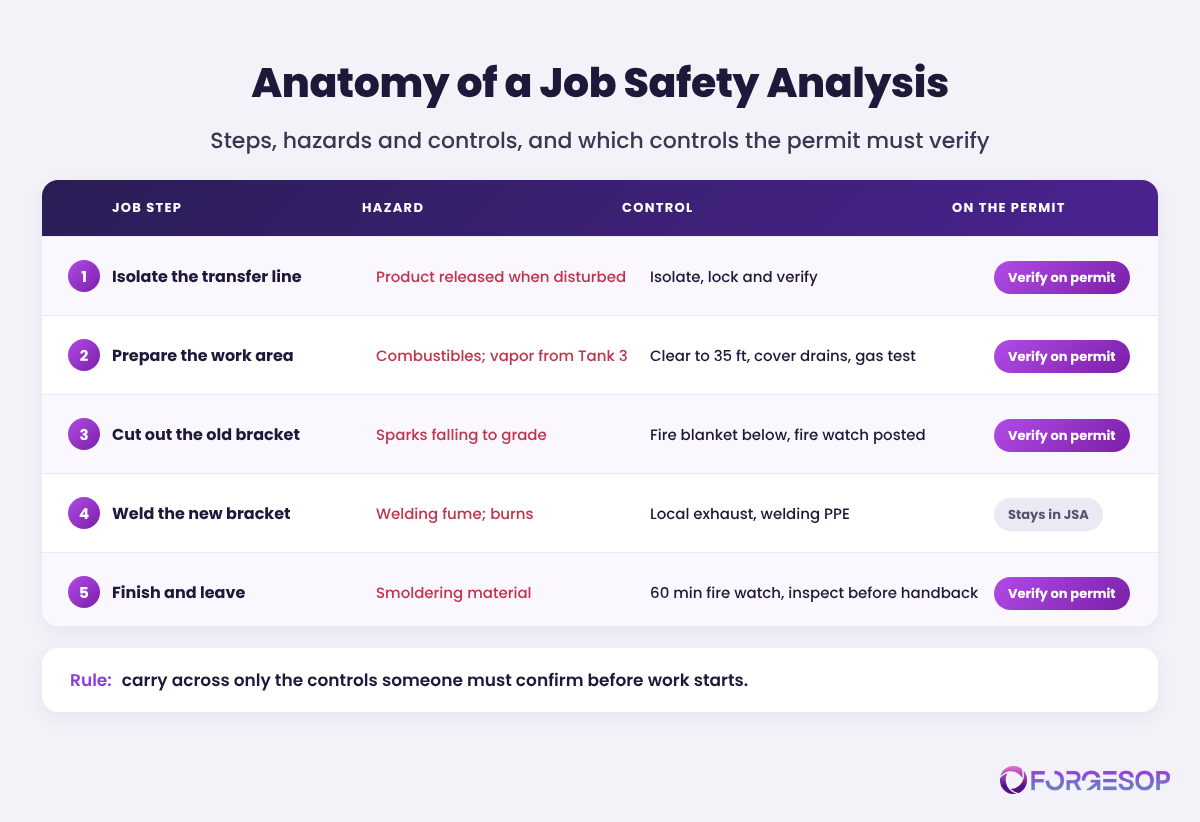
Notice that several controls in the right-hand column cannot be "done" by the JSA itself. Someone has to confirm, on the day, that the line is isolated, the air is clear and the fire watch is in place. That confirmation is the permit's job.
What is a permit to work?
A permit to work is a written authorization for a specific high-risk job, at a specific place and time, once the required controls are confirmed in place. It records the job, the location, the validity period, the hazards, the precautions, the test results and the people involved, and it is signed at issue, at any shift handover and at close-out.
The UK Health and Safety Executive (HSE) puts the limits plainly: the issue of a permit does not, by itself, make a job safe. HSE also notes that a permit is not a replacement for a risk assessment. It is how the results of that assessment are put into practice at the point of work.
In some cases, a permit is a legal requirement. OSHA requires a written entry permit for permit-required confined spaces under 29 Code of Federal Regulations (CFR) 1910.146, and a hot work permit for hot work on or near processes covered by process safety management under 29 CFR 1910.119. For general welding and cutting, OSHA expects the responsible person to designate precautions before work, preferably in a written permit.
A permit has a start and an end. When the job is done, the permit is closed, the area is handed back, and the record is filed.
Permit to work vs JSA vs SOP: the key differences
SOP | JSA | Permit to work
| |
|---|---|---|---|
Answers | How is this task done correctly? | What could go wrong on this job? | Is it safe to start this job now? |
Scope | A task, every time | A job, broken into steps | One job, one place, one time window |
Written by | Process owner, approved by management | Supervisor and crew | Issuer, on request from the work crew |
Lifespan | Until revised | Reviewed per job or per change | Hours or one shift, then closed |
Requires sign-off at the work point | No | Often, by the crew | Yes, at issue and at close-out |
Legally required? | Sometimes, as written procedures | Rarely by name; widely expected | For some work, such as confined space entry |
Example | SOP-HW-02 Hot work on site | JSA-0412 Pipe support repair | PTW-0187 Hot work, Tank Farm B |
Where do they overlap?
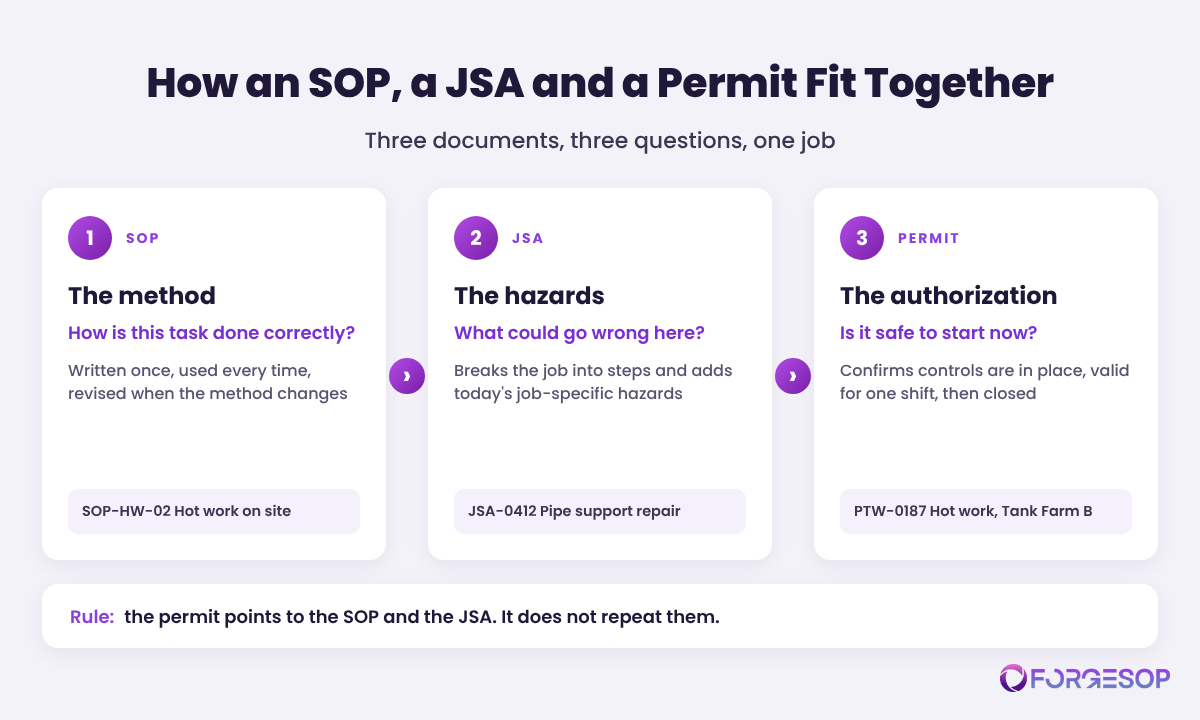
All three documents talk about hazards and controls, which is why they get confused. The difference is the level at which each one works:
The SOP states the standard controls that apply every time, such as "clear combustibles to 35 feet."
The JSA applies those controls to this job and adds what is specific to it, such as "Tank 3 still holds vapor; test inside the bund and at the drain."
The permit records that each control was actually checked, by whom and when, such as "flammable vapor 0% at 07:40, initials J.R."
In short: the SOP sets the standard, the JSA applies it, and the permit proves it.
How do they fit together?
Here is how the welding job from our opening scenario flows through all three documents.
The SOP sets the method. SOP-HW-02 says how hot work is done on site: who may weld, what equipment to use, the standard precautions, and that every hot work job outside the workshop needs a JSA and a permit.
The JSA applies it to this job. JSA-0412 breaks the pipe support repair into five steps and adds the job-specific hazards: vapor from the neighboring tank, sparks falling to grade and a transfer line that must be isolated first.
The permit confirms and authorizes. PTW-0187 lists the controls from the SOP and JSA, links to the isolation permit for the transfer line, records the gas test and the named fire watch, and authorizes the work for one shift.
Close-out feeds back. When the job ends, the permit is closed and the area handed back. Anything the crew learned, such as a hazard the JSA missed, goes back into the JSA template and, if needed, the SOP.
The permit should point to the SOP and JSA by reference, not repeat them in full. If a precaution appears in all three in different words, someone will eventually update one and not the others.
What should the permit take from the JSA?
A permit that copies the whole JSA becomes too long to check properly. A permit that ignores the JSA misses the job-specific hazards. The right balance is to carry across only the controls that must be verified on the day before work starts, such as:
isolations that must be applied and confirmed
atmospheric tests, with the reading, time and initials
named people in critical roles, such as the fire watch or confined space attendant
equipment that must be in place, such as an extinguisher, a retrieval line or a current scaffold inspection
conditions that would stop the job, such as a rising gas reading or a change in scope
Everything else, such as the general method and the protective gear for each step, stays in the SOP and JSA, where the crew can read it.
Who owns each document?
Clear ownership keeps the three documents in step. Without it, each one is updated by a different team on a different schedule, and drift is guaranteed.
Document | Typical owner | Reviewed when
|
|---|---|---|
SOP | Process or area owner, approved by management | On a set schedule, and whenever the method, equipment or regulation changes |
JSA | Supervisor and crew, with safety input | Before each permit job, and after any incident or near miss on that job |
Permit | Permit issuer, at the request of the work crew | At issue, at shift handover and at close-out |
The owners do not work in isolation. When a near miss shows a JSA missed a hazard, the supervisor updates the JSA template, the process owner checks whether the SOP needs to change, and the permit template is reviewed to see whether a new check should be verified on the day. That feedback loop is what turns three separate documents into one system.
When do you need each one?
Not every task needs three documents. Match the paperwork to the risk and to how much the job changes from one day to the next.
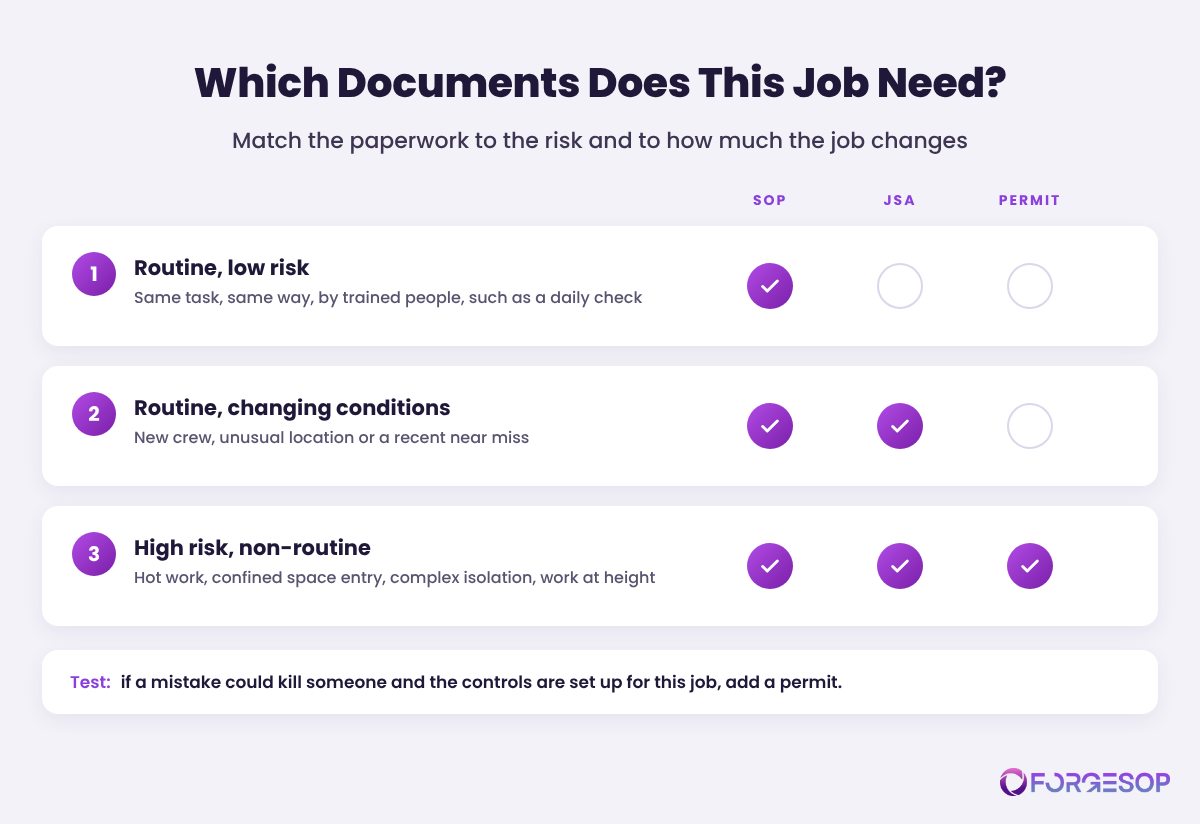
Routine, low-risk tasks done the same way every time by trained people, such as a daily equipment check, usually need only an SOP.
Routine tasks with changing conditions, a new crew, an unusual location or a recent near miss need an SOP plus a JSA reviewed for the day.
High-risk, non-routine work such as hot work, confined space entry, complex isolation and work at height needs all three, linked.
A useful test: if a mistake could kill someone, and the controls have to be set up specially for this job, the work needs a permit on top of the SOP and JSA.
Where does a risk assessment fit in?
A risk assessment is the broader process of identifying hazards, judging how likely and how serious harm would be, and deciding which controls are needed. It often covers a whole activity, area or process rather than a single job.
You can think of the four documents as a funnel:
The risk assessment decides which activities are high risk and what level of control they need.
The SOP turns those decisions into a standard method.
The JSA applies the method to one job and adds what is specific to it.
The permit confirms the controls are in place before that job starts.
When the funnel works, nothing gets lost between the boardroom decision and the work point. When one layer is missing, the gap usually shows up at the next incident investigation.
Three documents, one version of the truth
The biggest risk is not having too few documents. It is having three that disagree. Common problems include:
Duplicated precautions that drift apart. The SOP says a 60-minute fire watch, the permit template still says 30.
Generic JSAs copied from job to job without anyone looking at today's conditions.
Permits issued without a JSA, so the issuer has no hazard list to check against.
SOP revisions that never reach the permit template, so crews follow an old method on a new form.
JSAs filled in after the work starts, which turns a planning tool into a record of what already happened.
Nobody owning the links, so each document is maintained by a different team on a different schedule.
The fix is to link, not copy. Purpose-built permit to work software can tie each permit template to its SOP and JSA, so when a procedure changes, the permits built on it change too, and the issuer sees the current JSA at the moment of signing.
How to link your SOPs, JSAs and permits in 5 steps
Map which documents each job needs. List your high-risk activities and record which SOP, which JSA template and which permit type apply to each one.
Reference by ID, not by copying. Permit templates should cite the SOP and JSA by number and version, and carry only the precautions that must be verified on the day.
Review the JSA at the work point. Make the work-point review a condition for issuing the permit, so job-specific hazards are caught before the signature, not after.
Connect your change control. When an SOP is revised, trigger a review of the JSA templates and permit templates that reference it.
Audit all three together. When you audit a permit in the field, check that the SOP and JSA it references are current and that what is happening matches all three.
Related permit guides
See how the main permit types fit together in our guide to the permit to work system.
The bottom line
An SOP tells people how. A JSA tells them what could go wrong today. A permit confirms that it is safe to start. You need all three for high-risk work, and they only protect people when they agree with each other.
Pick one high-risk job on your site and lay its SOP, JSA and permit side by side. If they disagree on any control, fix the source document first, then let the others follow. That one exercise will tell you more about your permit system than a year of signed forms.
Frequently asked questions
Is a JSA the same as a permit to work?
No. A JSA identifies the hazards and controls for a job. A permit confirms those controls are in place at a specific time and authorizes work to start. A JSA often feeds the permit's list of precautions.
Is a JSA the same as a JHA?
Yes, in practice. Job safety analysis and job hazard analysis describe the same method: break the job into steps, identify the hazards at each step and set controls. OSHA's guidance uses the term job hazard analysis.
Can an SOP replace a permit to work?
No. An SOP describes how a task is done in general. It cannot confirm that today's isolations, gas tests or inspections are in place. High-risk, non-routine work needs a permit as well.
Which comes first, the JSA or the permit?
The JSA. The hazards and controls are identified first, then the permit issuer checks that those controls are in place before authorizing the work.
Does every job need a JSA?
No. Routine, low-risk tasks done the same way every time by trained people can usually rely on an SOP. Prioritize JSAs for jobs with high injury rates, potential for serious harm, new or changed jobs and any job that needs a permit.
Who should write a JSA?
The supervisor and the crew who will do the job, ideally with input from a safety professional for higher-risk work. The people closest to the task know where the hazards are, and involving them improves both the analysis and how well it is followed.
Running high-risk work across sites? ForgeSOP links every permit to the SOPs, JSAs and isolations behind it, so work is authorized against current controls and closed out on the record.
General

Forge better processes
One platform. Always audit-ready.
Bring SOPs, checklists, audits, incidents, and CAPAs into one connected system for safer, clearer, and more consistent operations.
No credit card required · Built for teams that run on process