

General
Back to Blog
General6 min read
Contractor Permit to Work: What It Is, an Example, and How to Control Contractor Risk
A specialist contractor arrives on Monday morning to repair a roof fan. The crew is skilled and experienced. They have never been to this site, they do not know the fan shares a breaker with the next unit, and the welder's insurance expired on Friday. Nobody at the gate checked.
None of that is unusual. Contractors often do the highest-risk work on a site while knowing the site least.
The numbers reflect it. The Bureau of Labor Statistics (BLS) recorded 829 contracted worker deaths in 2015, and contracted workers made up just under 60% of construction laborers killed on the job that year.
A contractor permit to work brings outside crews under the same controls as your own people, plus the extra checks that only apply to contractors. It sits inside your wider permit to work system. In this article, we cover what it is, what host employers must do, a worked example and how to control contractor permits in six steps.
Key takeaways
Contractors working on your site should work under your permit system, not their own paperwork alone.
U.S. rules give host employers specific duties to share hazards, coordinate work and exchange procedures with contractors.
Check contractor insurance, competency and site induction before any permit is issued, not after.
Give contractors access only to the areas and permits their job needs, and end it when the job ends.
What is a contractor permit to work?
A contractor permit to work is not usually a separate permit type. It is a permit issued to a contractor crew, under your site's permit system, with extra gates that confirm the contractor is approved, insured, trained and inducted for that work.
The permit itself is still a hot work, confined space, isolation or work at height permit. What changes is who holds it and what must be checked before it is issued.
What are the host employer's duties?
Several rules from the Occupational Safety and Health Administration (OSHA) give the host employer specific duties when contractors work on site:
Confined spaces: under 29 Code of Federal Regulations (CFR) 1910.146(c)(8), the host must tell the contractor about permit spaces and their hazards, share its experience and precautions, coordinate entry when both work in or near the space, and debrief the contractor afterward.
Lockout/tagout: under 29 CFR 1910.147(f)(2), the host and the contractor must inform each other of their lockout or tagout procedures.
Process safety management: 29 CFR 1910.119(h) requires the host to evaluate a contractor's safety performance, inform them of process hazards, control their entry and periodically evaluate their performance.
On multi-employer worksites, OSHA's multi-employer citation policy means more than one employer can be cited for the same hazard, including the employer that controls the site. Internationally, ISO 45001, the standard for occupational health and safety management, expects you to coordinate procurement with contractors so their hazards are identified and controlled.
In short, handing a job to a contractor does not hand over the responsibility.
Contractor permit to work example
Here is what happens when a contractor gate fails. This example is a hot work permit request that the system stops before issue.
PTW-0191: Hot work permit request, Roof Fan RF-6 (status: blocked)
Gate | Status
|
|---|---|
Contractor approved for hot work | Yes, approved vendor list |
Liability insurance certificate | Expired 3 days ago: issue blocked |
Site induction, all crew | 2 of 3 complete; third member not inducted |
Welder qualification on file | Current |
Linked isolation permit | ISO-0201 for RF-6 and shared breaker RF-7: verified |
Host area authority briefed contractor | Yes, roof hazards and fire alarm points |
Site access | Scoped to Roof A and stair tower SC-03, ends at job close |
Next step: contractor uploads current insurance and inducts the third crew member, then the request returns to the issuer.
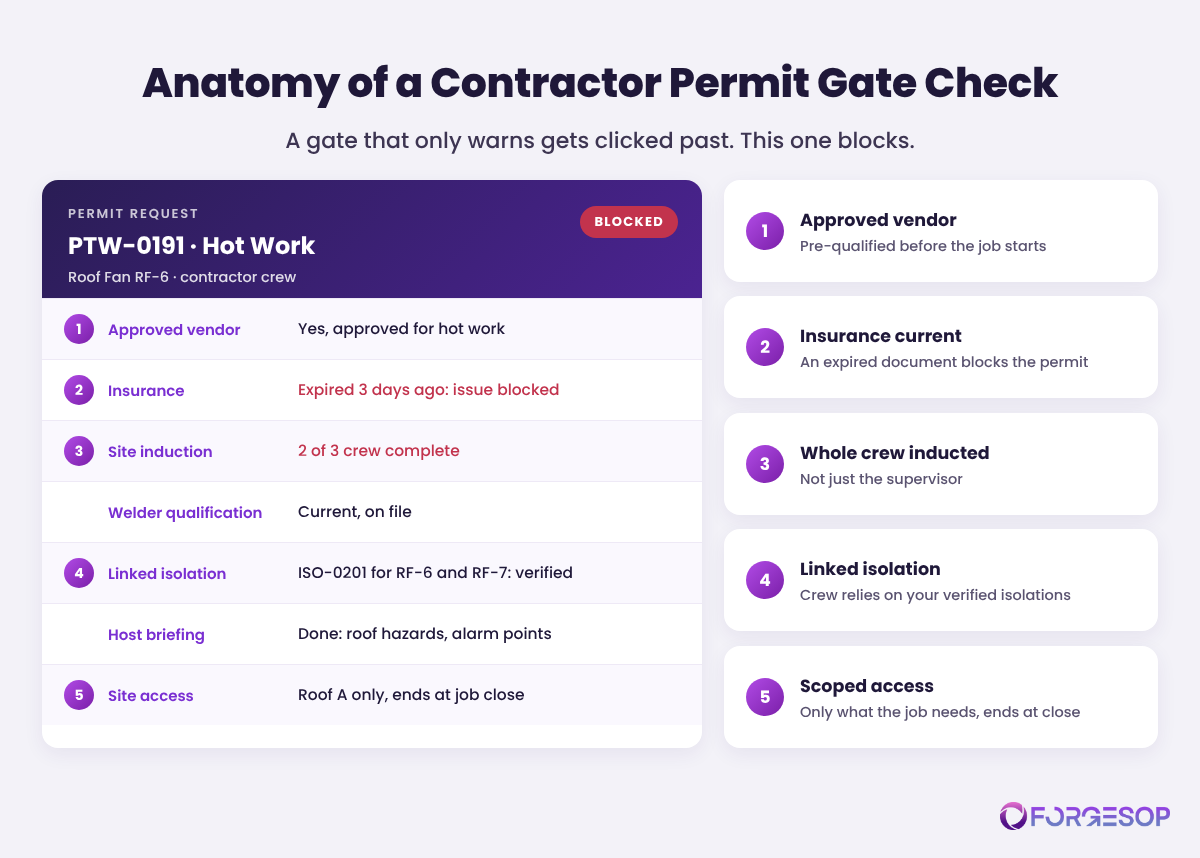
The blocked status is the point. A gate that only produces a warning gets clicked past on a busy morning.
How to control contractor permits in 6 steps
Pre-qualify before the job. Check safety performance, insurance, licenses and relevant qualifications when you select the contractor, not when they arrive.
Induct every crew member. Cover site hazards, emergency procedures, the permit system and the areas they may enter.
Brief the specific job. The area authority explains the hazards of the work location, such as shared isolations, nearby processes and other jobs in the area.
Issue permits through your system. The contractor's supervisor requests the permit. Your issuer checks the gates and authorizes it.
Scope and time-limit access. Give the crew access only to the areas and permits the job needs, and end it when the job closes.
Close out and evaluate. Inspect the area at handback, debrief the contractor, and record how they performed for the next selection decision.
Contractor gates only work if they can say no
The biggest failures in contractor permits come from checks that exist on paper but never stop anything:
Documents checked once a year. Insurance and qualifications expire between annual reviews.
Inducting the supervisor, not the crew. The person holding the welding torch is the one who needs to know where the fire alarm is.
Contractor paperwork instead of site permits. A contractor's own method statement is useful, but it does not know about your shared breaker.
Access that never expires. Badges and system logins from last year's job are a security and safety gap.
Dedicated permit to work software can block a permit when contractor insurance has lapsed or a crew member is not inducted, and give contractors site-scoped access that ends with their job.
Which permits do contractors most often need?
a hot work permit for welding, cutting and roofing
a work at height permit for roofs, scaffolds and elevated plant
an isolation permit whenever they rely on your energy isolations
For how permits, JSAs and SOPs work together, see permit to work vs JSA vs SOP, and for the full picture, our guide to the permit to work system.
The bottom line
Contractors bring skills you need and risks you cannot hand off. A contractor permit to work keeps them inside your controls, with gates that stop work when insurance, training or induction are missing.
Review the last five contractor permits on your site. If any were issued with an expired document or an uninducted crew member, your gates are warnings, not gates. Fix that before the next job.
Frequently asked questions
Should contractors use their own permit system or the host's?
On your site, contractors should work under your permit system, because your issuers know the plant, the isolations and the other work going on. A contractor's own method statements and JSAs can feed into your permit.
Who is responsible for contractor safety?
Both employers. The contractor is responsible for its own workers, and the host employer has duties to share hazards, coordinate work and control site access. Under OSHA's multi-employer policy, more than one employer can be cited for the same hazard.
What should a contractor induction cover?
At minimum: site hazards, emergency procedures and alarms, the permit to work system, restricted areas, reporting of incidents and near misses, and who to contact on site. Every crew member should complete it, not just the supervisor.
Running high-risk work across sites? ForgeSOP links every permit to the SOPs, JSAs and isolations behind it, so work is authorized against current controls and closed out on the record.
General

Forge better processes
One platform. Always audit-ready.
Bring SOPs, checklists, audits, incidents, and CAPAs into one connected system for safer, clearer, and more consistent operations.
No credit card required · Built for teams that run on process