
General
Back to Blog
General6 min read
Work at Height Permit: What It Is, an Example, and How to Issue One
A roofer is asked to replace a few broken skylight panels. It should take an hour. The scaffold at the edge was inspected last week, the harnesses are in the van, and the weather looks fine.
Halfway through, the wind picks up. He steps back to steady a panel and his foot goes through an unprotected skylight.
Falls are rarely about one missing control. They are about a job that seemed too quick to plan. According to the Bureau of Labor Statistics (BLS), 389 of the 1,034 private construction deaths in 2024 were falls, slips and trips, and 95.9% of those were falls to a lower level.
A work at height permit forces that planning to happen before anyone climbs. It is one of the core permits in any permit to work system. In this article, we cover what it is, when you need one, a worked example and how to issue one in six steps.
Key takeaways
A work at height permit authorizes elevated work only after the fall hazards, access, equipment and rescue plan have been checked.
OSHA's fall protection trigger is 6 feet in construction and 4 feet in general industry, and fall protection tops OSHA's list of most-cited standards.
Scaffolds must be inspected by a competent person before each work shift, so last week's tag is not enough.
A rescue plan is part of the permit. A worker suspended in a harness needs help fast.
What is a work at height permit?
A work at height permit is a written authorization for work where a person could fall far enough to be injured. It records the job, the location, the access method, the fall protection used, the people involved, equipment inspections, weather limits and the rescue arrangements.
Unlike hot work or confined space entry, a work at height permit is not required by name under most rules from the Occupational Safety and Health Administration (OSHA). It is a site control that helps you meet several OSHA requirements at once, including:
fall protection at 6 feet or more in construction under 29 Code of Federal Regulations (CFR) 1926.501
fall protection at 4 feet or more in general industry under 29 CFR 1910.28
scaffold inspection by a competent person before each work shift under 29 CFR 1926.451(f)(3)
prompt rescue of anyone who falls while using personal fall arrest, under 29 CFR 1926.502(d)(20)
OSHA's preliminary list for fiscal year 2026 ranks fall protection first among its most-cited standards, with scaffolding fourth and ladders fifth.
When do you need a work at height permit?
Many sites require a permit for any non-routine work above the trigger height. Common cases include:
roof work, especially near edges, skylights and fragile panels
work from scaffolds, mobile elevating work platforms or suspended platforms
work near open edges, floor openings or unguarded mezzanines
work on racking, tanks, towers or structures
any work at height by contractors
Routine work from fixed platforms with permanent guardrails usually does not need a permit.
Work at height permit example
Here is a typical permit for roof work.
PTW-0176: Work at height permit, Roof A (replace skylight panels)
Section | Entry
|
|---|---|
Job and location | Replace four skylight panels, Roof A, east section |
Valid | 07:30 to 15:30 today |
Access | Scaffold stair tower SC-03; scaffold inspected by competent person 07:10 today, tag green |
Fall hazards | Roof edge, fragile skylights, roof hatch |
Fall protection | Guardrail at east edge; skylight screens fitted to open skylights; harness and lanyard tied to rated anchor for work at skylights |
Crew competency | Two workers, fall protection training current; harnesses inspected before use |
Weather limits | Stop work in wind above the site limit, rain on the roof surface or lightning within range |
Rescue plan | Rescue kit at roof hatch; trained rescuer on crew; target to reach a suspended worker within minutes |
Exclusion zone | Area below barriered and signed |
Sign-offs | Requester; issuer; holder at completion; issuer handback |
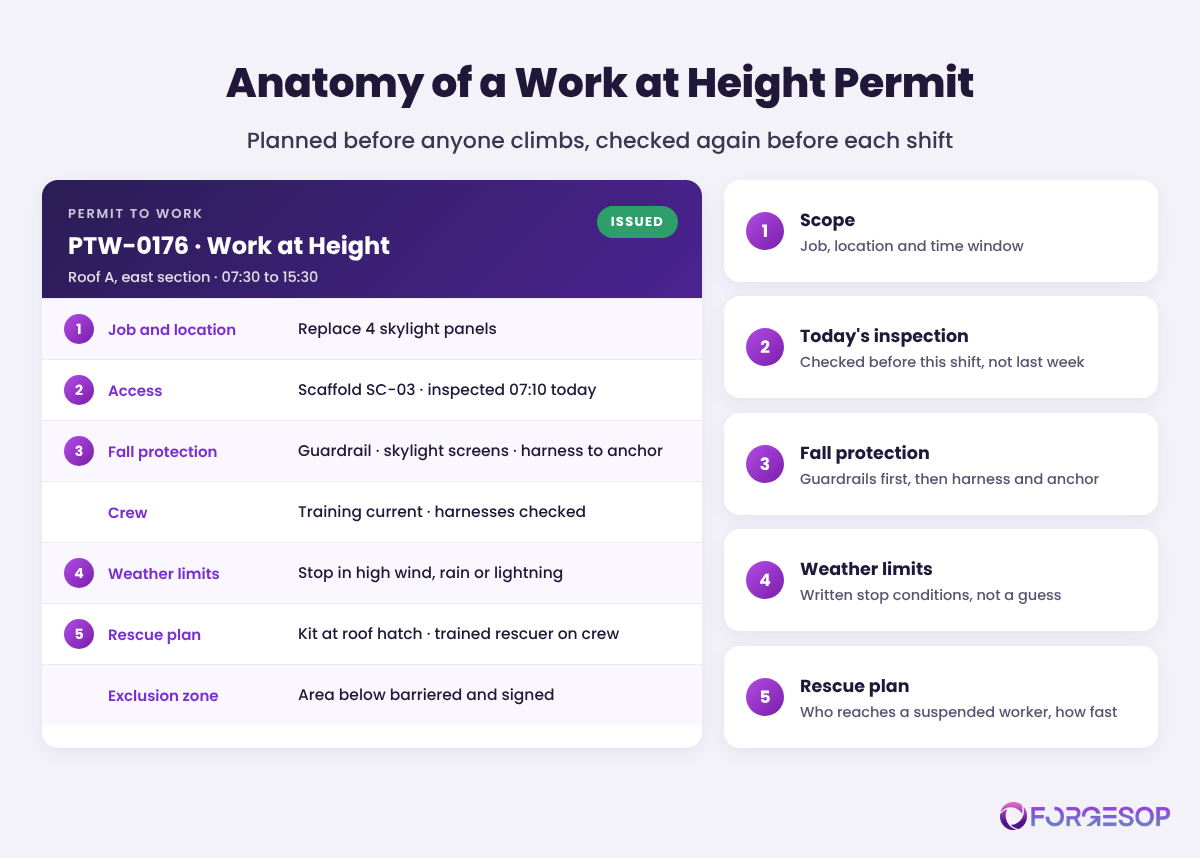
The scaffold line records today's inspection time, not the date on the tag. That one detail closes a common gap.
How to issue a work at height permit in 6 steps
Avoid the height if you can. Do the work from the ground, use extended tools or bring the item down.
Choose the right access. Prefer collective protection such as guardrails and platforms over personal fall arrest.
Confirm inspections are current. Check that the scaffold was inspected before this shift and that harnesses, lanyards and anchors are in good condition.
Check crew competency. Confirm fall protection training, and scaffold or platform training where relevant.
Plan the rescue. Name who will rescue a suspended worker, with what equipment and how quickly. "Call 911" is not a rescue plan.
Set conditions, sign and close out. Record weather limits and the exclusion zone below, issue and display the permit, and inspect the area before accepting it back.
Last week's scaffold tag is not a permit
The most common failures in work at height permits are not about missing harnesses. They are about stale checks and missing plans:
Relying on an old inspection. Scaffolds change. Ties get removed, boards get moved, and weather affects them overnight.
No rescue plan. Without a plan, the crew improvises while a worker hangs in a harness.
Ignoring fragile surfaces. Skylights and old roof sheets are among the most dangerous hazards because they look solid.
Forgetting the people below. Dropped tools and materials need an exclusion zone.
Paper permits make it easy to copy yesterday's scaffold details. Dedicated permit to work software can link the scaffold inspection to the permit and block issue when it has expired or a crew member's training has lapsed.
Which permits pair with a work at height permit?
a hot work permit for torch-on roofing or welding at height
an isolation permit when working near moving plant, roof fans or electrical equipment
a contractor permit to work, since much work at height is done by contractors
See how all the main permit types fit together in our guide to the permit to work system.
The bottom line
A work at height permit turns a quick job into a planned one. It works when the inspection is from today, the fall protection matches the hazard and someone knows exactly how to rescue a worker who falls.
Before the next roof job on your site, check one thing: can the crew tell you, in one sentence, how they would get a suspended colleague down? If not, the permit is not ready.
Frequently asked questions
At what height do you need fall protection?
Under OSHA rules, fall protection is required at 6 feet or more in construction and at 4 feet or more in general industry. Lower triggers apply in some situations, such as working over dangerous equipment.
How often must a scaffold be inspected?
OSHA requires a competent person to inspect scaffolds for visible defects before each work shift and after any event that could affect the scaffold's structural integrity.
Do you need a rescue plan for work at height?
Yes, when using personal fall arrest. OSHA requires employers to provide for prompt rescue of employees who fall, or to make sure they can rescue themselves.
Running high-risk work across sites? ForgeSOP links every permit to the SOPs, JSAs and isolations behind it, so work is authorized against current controls and closed out on the record.
General


Forge better processes
One platform. Always audit-ready.
Bring SOPs, checklists, audits, incidents, and CAPAs into one connected system for safer, clearer, and more consistent operations.
No credit card required · Built for teams that run on process