
Education
Back to Blog
Informational11 min read
Types of SOPs: Which Standard Operating Procedure Does Your Team Need?
Standard Operation Procedures (SOP) are used in every workplace. But not every SOP serves the same purpose.
Some SOPs explain how to perform a daily task. Others control safety risks, guide audits, standardize quality checks, train employees, or explain what to do during an emergency.
That is why understanding the different types of SOPs matters. The right SOP helps your team follow the correct process, reduce confusion, and keep work consistent. The wrong SOP format can make the procedure harder to use, too vague, or too detailed for the task.
This guide explains the main types of standard operating procedures, when to use each one, and how to choose the right SOP for your team.
Key Takeaways
The main types of SOPs include operational, safety, quality, compliance, administrative, HR, maintenance, emergency, IT, and customer service SOPs.
The type of SOP you need depends on the task, the risk level, the team using it, and the records you need to keep.
Some SOPs are simple step-by-step guides, while others need approvals, version control, checklists, evidence, and audit trails.
High-risk or regulated processes usually need more detailed SOPs with safety controls, responsibilities, escalation steps, and review history.
A digital SOP management system helps teams organize different SOP types, keep versions current, and make procedures easier to access.
What Are SOPs?
SOP stands for Standard Operating Procedure.
An SOP is a written set of instructions that explains how to complete a task or process in a consistent and approved way. It tells people what to do, how to do it, who is responsible, and what records or checks may be required.
SOPs are used in many industries, including manufacturing, healthcare, laboratories, construction, logistics, food production, safety, compliance, and business operations.
The main purpose of an SOP is to make work repeatable. When teams follow the same approved process, they can reduce errors, improve training, support compliance, and make operations easier to manage.
What Are the Main Types of SOPs?
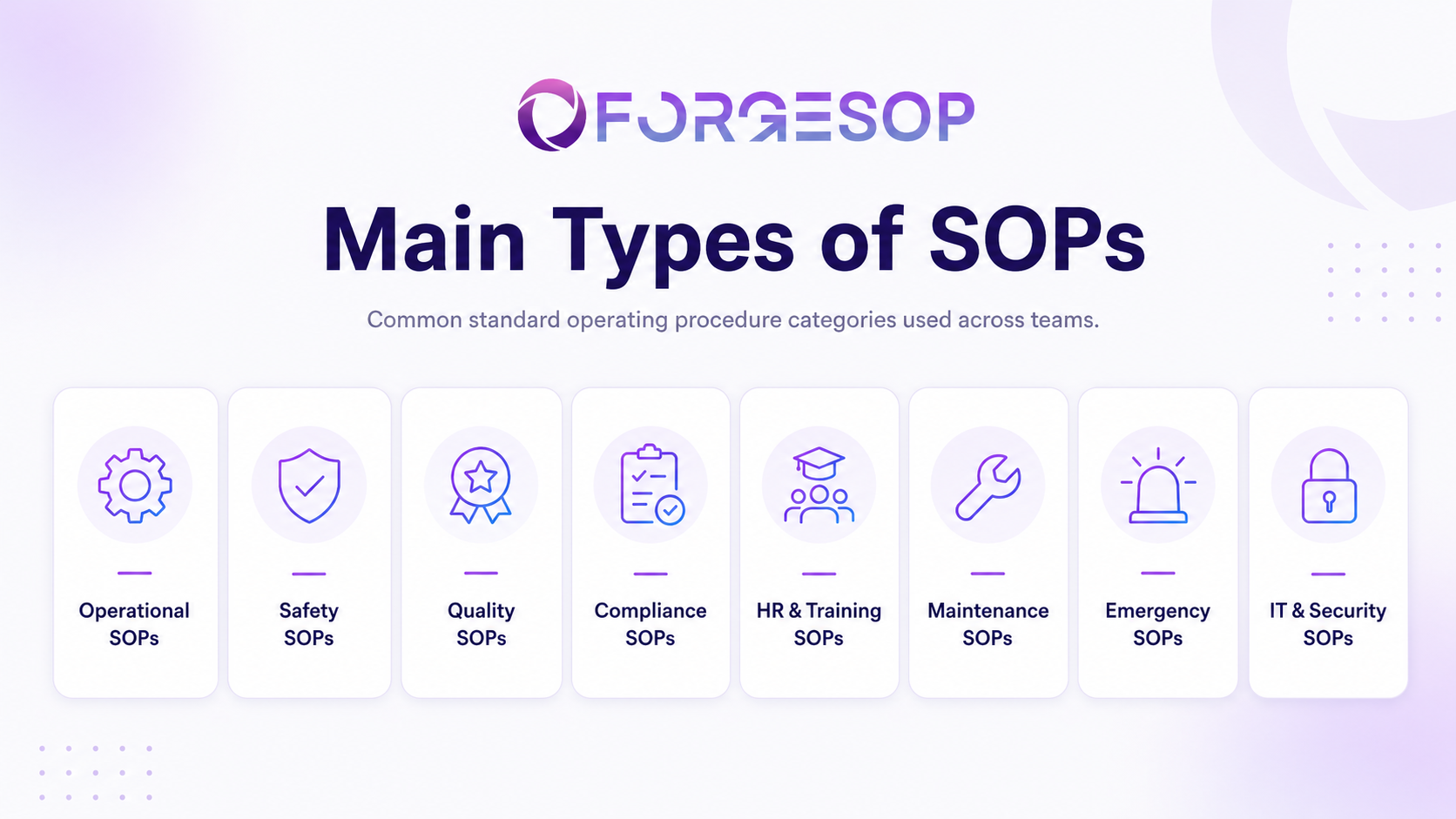
The main types of SOPs include:
SOP Type | Best Used For |
Operational SOPs | Daily work processes and routine tasks |
Safety SOPs | Hazard control, PPE, emergency steps, and safe work practices |
Quality SOPs | Inspections, checks, testing, approvals, and quality standards |
Compliance SOPs | Regulatory requirements, audits, documentation, and controls |
Administrative SOPs | Office processes, approvals, records, and internal workflows |
HR and Training SOPs | Hiring, onboarding, employee training, and role-based tasks |
Maintenance SOPs | Equipment inspection, repair, servicing, and preventive maintenance |
Emergency SOPs | Incident response, evacuation, spills, injuries, and crisis actions |
IT and Security SOPs | System access, data security, backups, and technical processes |
Customer Service SOPs | Support workflows, complaint handling, and service standards |
Each type of SOP has a different purpose. Some focus on completing a task correctly. Others focus on safety, quality, compliance, documentation, or response during unexpected situations.
1. Operational SOPs
Operational SOPs explain how routine work should be performed.
These are the procedures teams use to complete daily tasks in a consistent way. They are common in manufacturing, logistics, warehousing, service delivery, facilities management, healthcare, and general business operations.
An operational SOP may explain how to open a facility, process an order, complete a production step, handle inventory, run a daily checklist, or close a shift.
A good operational SOP should be simple, practical, and easy to follow. It should focus on the actual workflow and clearly explain each step in the order it happens.
Examples of operational SOPs include:
Daily opening and closing procedure
Inventory receiving procedure
Order processing procedure
Production line startup procedure
Cleaning and sanitation procedure
Shift handover procedure
Operational SOPs are useful when a task happens regularly and needs to be completed the same way each time.
2. Safety SOPs
Safety SOPs explain how to perform work safely.
They are used when a task involves hazards, equipment, chemicals, physical risk, environmental risk, or emergency response requirements. Safety SOPs help workers understand what controls must be followed before, during, and after the task.
A safety SOP usually includes hazards, required PPE, safe operating steps, emergency actions, reporting requirements, and stop-work conditions.
These SOPs are especially important in industries such as manufacturing, construction, laboratories, energy, logistics, chemical handling, and facilities management.
Examples of safety SOPs include:
Chemical handling procedure
Lockout/tagout procedure
Working at heights procedure
Confined space entry procedure
Forklift operation procedure
Spill response procedure
PPE selection and use procedure
Safety SOPs are useful when the main goal is to reduce risk and protect workers.
3. Quality SOPs
Quality SOPs explain how to maintain product, service, or process standards.
They are often used by quality teams, production teams, laboratories, healthcare organizations, and regulated industries. These SOPs help ensure that outputs meet required specifications and that checks are performed consistently.
A quality SOP may include inspection points, acceptance criteria, sampling methods, testing steps, approval requirements, deviation handling, and documentation rules.
Examples of quality SOPs include:
Incoming material inspection procedure
Product testing procedure
Nonconformance reporting procedure
Calibration procedure
Batch record review procedure
Quality control approval procedure
Quality SOPs are useful when consistency, accuracy, and evidence are important.
4. Compliance SOPs
Compliance SOPs explain how an organization meets regulatory, legal, client, or internal requirements.
These procedures are usually more formal because they may need to be shown during audits, inspections, or client reviews. A compliance SOP often includes document control, approval history, responsibilities, required records, references, and review schedules.
Compliance SOPs help organizations prove that important requirements are being followed, not just written down.
Examples of compliance SOPs include:
Document control procedure
Internal audit procedure
Regulatory reporting procedure
Training record management procedure
CAPA management procedure
Data retention procedure
Compliance SOPs are useful when a process needs clear ownership, evidence, and audit readiness.
5. Administrative SOPs
Administrative SOPs explain internal office, management, or support processes.
These SOPs help keep routine business workflows organized. They are often used by admin teams, finance teams, office managers, operations teams, and department heads.
Administrative SOPs may not involve high safety or compliance risk, but they still help teams avoid confusion and delays.
Examples of administrative SOPs include:
Purchase request procedure
Vendor onboarding procedure
Meeting room booking procedure
Travel approval procedure
Expense reimbursement procedure
Document filing procedure
Administrative SOPs are useful when a process involves approvals, records, repeated requests, or internal coordination.
6. HR and Training SOPs
HR and training SOPs explain employee-related processes.
These SOPs help organizations manage hiring, onboarding, role training, performance processes, policy acknowledgment, and employee exits. They are important because employee processes often involve multiple steps, different departments, and sensitive records.
A good HR SOP should clearly explain who is responsible for each step and what documentation is required.
Examples of HR and training SOPs include:
Employee onboarding procedure
New hire training procedure
Policy acknowledgment procedure
Performance review procedure
Leave request procedure
Employee exit procedure
HR SOPs are useful when teams need a consistent employee experience and clear internal accountability.
7. Maintenance SOPs
Maintenance SOPs explain how equipment, tools, facilities, or systems should be inspected, serviced, repaired, or maintained.
These procedures are common in manufacturing, facilities management, healthcare, laboratories, transportation, energy, and any workplace that depends on equipment reliability.
Maintenance SOPs often include tools required, safety steps, shutdown instructions, inspection points, service intervals, spare parts, and verification checks.
Examples of maintenance SOPs include:
Preventive maintenance procedure
Equipment inspection procedure
Machine shutdown procedure
Filter replacement procedure
Calibration maintenance procedure
Facility maintenance request procedure
Maintenance SOPs are useful when equipment condition affects safety, quality, uptime, or compliance.
8. Emergency and Incident Response SOPs
Emergency SOPs explain what to do when something goes wrong.
These SOPs are designed for situations where people need clear instructions quickly. They should be simple, direct, and easy to follow under pressure.
Emergency SOPs may cover evacuation, injuries, spills, fire response, equipment failure, security incidents, severe weather, environmental releases, or other urgent situations.
Examples of emergency SOPs include:
Fire evacuation procedure
Chemical spill response procedure
Injury reporting procedure
Emergency shutdown procedure
Incident reporting procedure
Severe weather response procedure
Emergency SOPs are useful when quick, consistent action can reduce harm, confusion, or escalation.
9. IT and Security SOPs
IT and security SOPs explain how technical systems, accounts, data, and security processes should be managed.
These SOPs are important because technical mistakes can lead to downtime, data loss, security breaches, or compliance issues. They are often used by IT teams, security teams, operations teams, and system administrators.
Examples of IT and security SOPs include:
User access request procedure
Password reset procedure
Data backup procedure
Incident response procedure
Software deployment procedure
Device management procedure
IT SOPs are useful when teams need controlled, repeatable technical processes.
10. Customer Service SOPs
Customer service SOPs explain how teams should handle customer interactions.
These SOPs help support teams respond consistently, resolve issues faster, and maintain service quality. They are useful in SaaS, healthcare, hospitality, retail, logistics, manufacturing support, and service-based businesses.
A customer service SOP may include response times, escalation rules, complaint handling steps, refund rules, documentation requirements, and communication standards.
Examples of customer service SOPs include:
Customer complaint handling procedure
Support ticket escalation procedure
Refund request procedure
Customer onboarding procedure
Service recovery procedure
Live chat response procedure
Customer service SOPs are useful when the customer experience needs to be consistent across people, channels, or locations.
How to Choose the Right Type of SOP
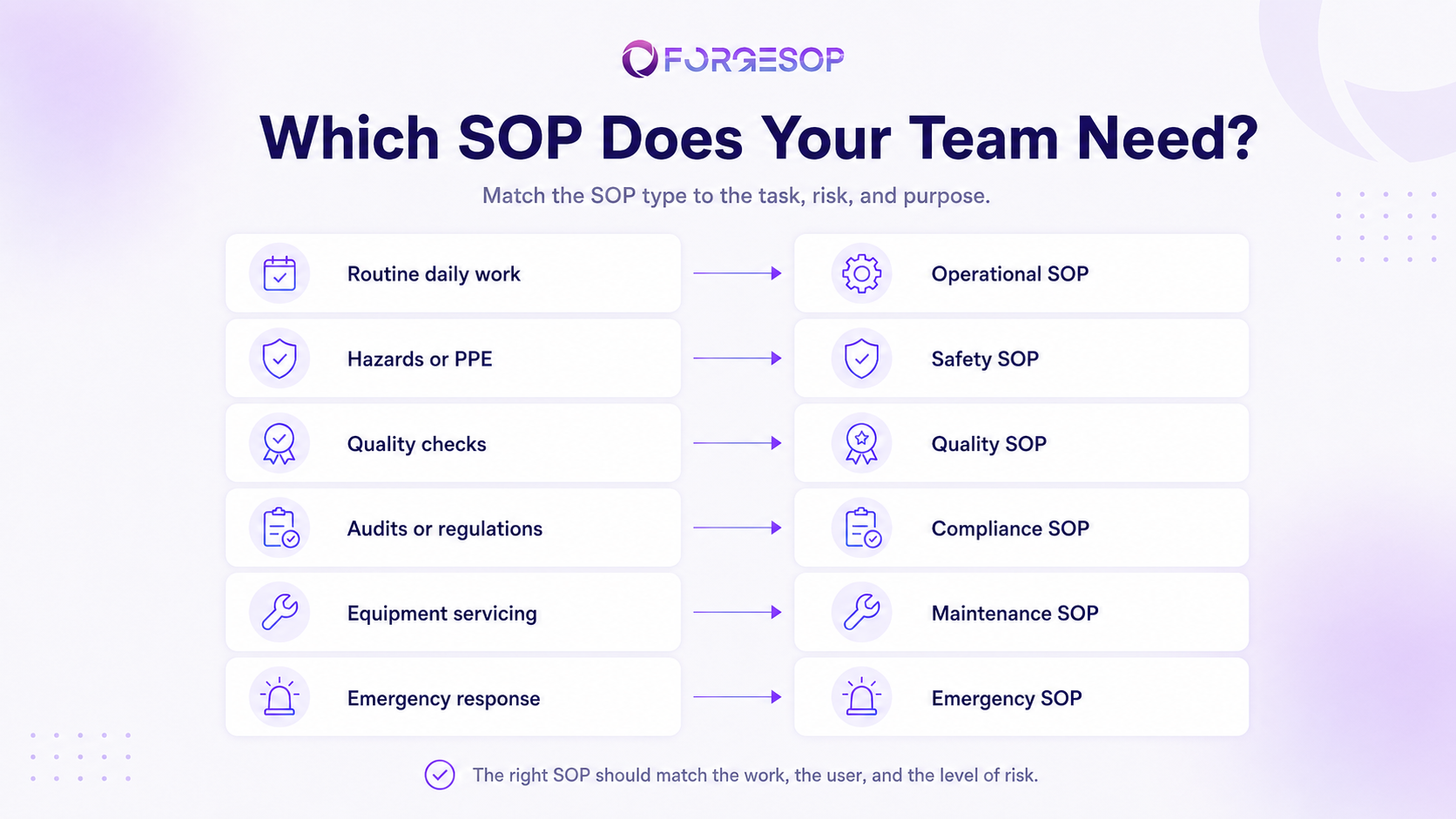
To choose the right SOP type, start with the purpose of the procedure.
Ask yourself: what is this SOP meant to control?
If the SOP explains daily work, it is likely an operational SOP. If it controls hazards, it is a safety SOP. If it defines inspections or standards, it may be a quality SOP. If it helps prove compliance, it may be a compliance SOP.
You should also consider who will use the SOP. A frontline worker may need a simple step-by-step procedure. A supervisor may need responsibilities and verification points. A compliance team may need approval history, records, and audit trails.
The level of risk also matters. A simple office process may only need a short SOP. A high-risk task involving equipment, chemicals, safety controls, or regulatory requirements may need more detail, stronger approvals, and formal review.
The right SOP should match the work, the user, and the risk.
Can One SOP Fit Multiple Categories?
Yes. Many SOPs fit more than one category.
For example, a chemical handling SOP may be both a safety SOP and a compliance SOP. A machine maintenance SOP may be both an operational SOP and a safety SOP. An incident reporting SOP may support emergency response, compliance, and CAPA management.
The category is not the most important part. What matters is that the SOP includes the right information for its purpose.
A high-risk SOP should usually include hazards, controls, responsibilities, emergency steps, records, approvals, and version history. A simple operational SOP may only need purpose, scope, responsibilities, procedure steps, and records.
Most SOPs share the same foundation: a clear purpose, defined scope, responsibilities, procedure steps, required records, and review information. What changes is the level of detail. Once you know the type of SOP your team needs, you can add the right controls, checks, approvals, or emergency steps based on how the SOP will be used.
How Digital SOP Management Helps Organize SOP Types
As teams grow, managing different types of SOPs in folders or shared drives can become difficult.
Operational SOPs, safety SOPs, quality SOPs, compliance procedures, checklists, and training records may end up scattered across different locations. This makes it harder to find the current version, track approvals, update procedures, and prove that the right people have read them.
Digital SOP management helps teams keep SOPs organized, controlled, and easier to access.
A digital SOP system can help manage:
SOP categories
Version control
Approval workflows
Review schedules
Role-based access
Training acknowledgments
Connected checklists
Audit trails
CAPA links
Searchable procedure libraries
Using Digital SOP platforms can help you manage your workflow, track work, train employees, manage deviations, and actions all under one connected platform.
ForgeSOP helps teams keep SOPs controlled with ownership, review cycles, approvals, and version history. It also connects SOPs with checklists, audits, incidents, investigations, CAPAs, resources, and operational records.
This helps organizations move beyond static documents and manage SOPs as part of everyday work.
Final Thoughts
There are many different types of SOPs, but they all serve the same basic goal: helping teams perform work clearly, consistently, and correctly.
The right SOP depends on the purpose of the process, the people using it, the level of risk involved, and the records that need to be maintained.
When SOPs are organized, current, and easy to follow, they become more than documents. They become part of how teams run safer, smoother, and more reliable operations.
Frequently Asked Questions
What are the main types of SOPs?
The main types of SOPs include operational SOPs, safety SOPs, quality SOPs, compliance SOPs, administrative SOPs, HR and training SOPs, maintenance SOPs, emergency SOPs, IT SOPs, and customer service SOPs.
What are standard operating procedure types?
Standard operating procedure types are categories of SOPs based on their purpose. For example, a safety SOP controls workplace hazards, while an operational SOP explains routine work steps.
How do I know what type of SOP I need?
Start by asking what the SOP is meant to control. If it controls daily work, use an operational SOP. If it controls hazards, use a safety SOP. If it supports audits or regulations, use a compliance SOP.
Can one SOP belong to more than one type?
Yes. Many SOPs fit multiple categories. For example, a chemical handling SOP may be both a safety SOP and a compliance SOP.
What type of SOP is used for safety?
A safety SOP is used for tasks involving hazards, PPE, emergency steps, equipment risks, chemicals, or safe work practices.
What type of SOP is used for audits?
Compliance SOPs, quality SOPs, document control SOPs, audit SOPs, CAPA SOPs, and records management SOPs are commonly used for audits.
What is the difference between an SOP and a checklist?
An SOP explains how a process should be performed. A checklist helps users confirm that required steps have been completed. In many cases, an SOP and checklist work together.
Do all SOPs need the same format?
No. The SOP format should depend on the task, risk level, industry, and user. Simple tasks may need a short SOP, while high-risk or regulated processes need more detail.
How does digital SOP management help?
Digital SOP management helps teams organize SOPs by category, manage approvals, track versions, assign access, connect checklists, and keep procedures audit-ready.
Informational

Forge better processes
One platform. Always audit-ready.
Bring SOPs, checklists, audits, incidents, and CAPAs into one connected system for safer, clearer, and more consistent operations.
No credit card required · Built for teams that run on process