
Education
Back to Blog
General13 min read
Operational SOPs: What They Are, Examples, and How to Write One
Watch two shifts run the same changeover and you will usually see two different procedures. Neither is wrong, exactly. One is faster, one is more careful, both live entirely in someone’s head, and the version your newest hire learns depends on who happens to train them.
That gap is what operational SOPs exist to close. This guide covers what an operational SOP is, how it differs from its safety and quality cousins, what these documents look like across six industries, and a seven-step method for writing procedures your team will actually follow.
Quick answer: An operational SOP (standard operating procedure) is a documented, step-by-step instruction for performing routine, day-to-day work like machine setups, changeovers, shift handovers, order processing happen the same correct way every time, regardless of who performs it. It defines the task, the steps in order, who is authorized to do them, and the records that prove the work was done.
Key takeaways
Operational SOPs document routine daily work — the tasks that keep production, logistics, and service running so output does not depend on who happens to be on shift.
They differ from safety SOPs in their center of gravity: operational SOPs standardize how work gets done; safety SOPs control how it gets done without harm. One task often needs both, in the same document.
The highest-value candidates are tasks with shift-to-shift variation, single-person dependencies, frequent handoffs, or a history of rework and downstream errors.
Write from the floor, not the office: watch the task as it is actually performed, involve the people who do it, and pilot the draft on a live shift before approving it.
An operational SOP only pays off as a living document, with a named owner, a version history, a review date, and a feedback path from the people using it.
What is an operational SOP?
An operational SOP is a standard operating procedure that documents how routine operational work should be performed: the recurring, day-to-day tasks that keep your core operation running. Where other SOP types answer “how do we stay safe” or “how do we meet spec,” the operational SOP answers the plainest question in the building: how do we do this job here, correctly, every time?
The emphasis sits on two words. Routine means the task recurs, daily, per shift, per order, or per batch which is exactly why small variations compound into big costs. Operational means the task belongs to the working core of the business: production, logistics, service delivery, and the administrative work that feeds them.
Like every SOP, an operational SOP is task-level by design. “Run the warehouse” is not an SOP; “process an inbound delivery” is. If the term SOP itself is new territory, start with our plain-language guide to what an SOP is and come back this article assumes the basics and goes deep on one category.
How are operational SOPs different from safety, quality, and compliance SOPs?
The short version: all SOP types share the same skeleton, but each type exists to control a different kind of risk. Operational SOPs protect consistency and throughput. Safety SOPs protect people. Quality SOPs protect the product or service. Compliance SOPs protect your legal and contractual standing.
SOP type | What it standardizes | The question it answers |
|---|---|---|
Operational | Routine daily work: setups, handovers, order flow | How do we do this task the same way every time? |
Safety | Hazardous work: energy isolation, PPE, emergency steps | How do we do this without anyone getting hurt? |
Quality | Product and service standards: inspection, calibration | How do we make sure the output meets spec? |
Compliance | Regulatory and contractual obligations: records, reporting | How do we prove we meet the requirement? |
In practice the boundaries blur, and that is fine. A line changeover SOP is operational at heart, but if step 4 requires isolating energy, that step carries safety content, and PPE — personal protective equipment — will appear in the header. The fix is never to write four overlapping documents. Write one SOP for the task and tag it into every category it serves, a point our types of SOPs guide covers in more depth. For tasks where hazard control is the whole point of the document, you are writing a safe operating procedure, and the structure shifts accordingly.
Consistency is an operational asset, not paperwork.
Most organizations document their hazardous tasks because regulators expect it, then leave routine work to memory and habit. The logic seems sound: nobody gets hurt if a changeover runs long or an invoice goes out late.
The reality is that undocumented routine work bleeds money quietly, in four ways.
Variation compounds. When three operators run the same setup three ways, you do not get one best cycle time — you get three different scrap rates, three different outcomes to troubleshoot, and no baseline to improve from. You cannot improve a process that runs differently every time it runs.
Knowledge walks out the door. U.S. wage and salary workers had a median tenure of just 3.9 years with their current employer in January 2024 — the lowest since 2002 according to the U.S. Bureau of Labor Statistics. If the only complete version of your receiving process lives in one veteran’s head, you are one resignation letter away from re-learning it by trial and error.
People burn time hunting for answers. Research from the McKinsey Global Institute found that interaction workers spend nearly 20 percent of the workweek searching for internal information or tracking down colleagues who can help with specific tasks. That is the daily tax of “ask Dave” as a knowledge system.
Onboarding drags. Gallup finds that only 12 percent of employees strongly agree their organization does a great job onboarding new employees. Without documented procedures, every new hire learns a folk version of the job from whoever has time that week and inherits that person’s shortcuts along with their skills.
The good news? You do not need to document everything to capture most of the value. You need to document the right tasks first.
Which tasks should get an operational SOP first?
Start where variation is already costing you. Five signals identify the tasks worth documenting now:
Two people do it two ways, and the difference shows. Different cycle times, different error rates, different results from the same task mean the process exists only as opinions.
Only one person can do it. Single-person dependencies are operational risk wearing a friendly face. If the task stops when they are on leave, it needs a document.
It crosses a handoff. Shift-to-shift handovers and department-to-department transfers are where routine work loses information. A documented handover is the cheapest coordination tool you will ever buy.
Errors surface downstream. If mistakes in this task show up later as rework, mis-shipments, credit notes, or customer complaints, the task is a control point and deserves a procedure.
Every new hire asks the same questions. When training the task takes weeks and the questions never change, the answers belong in a document, not in a supervisor’s inbox.
If losing one person would break the task, the task needs an SOP.
What does an operational SOP include?
The anatomy matches any well-built SOP but operational SOPs live or die on a specific kind of detail. The document needs:
Title and unique ID (for example, SOP-118), so versions, training records, and audits stay traceable
Purpose and scope: which task, which line or area, and what the procedure deliberately does not cover
Roles and authorization: who performs the task and what training or system access they need
Materials, equipment, and systems: tools, consumables, and the software screens involved, before step one begins
Numbered steps in sequence: one action per step, with decision points spelled out (“if the count does not match the packing slip, stop and escalate to the shift lead”)
The variation killers: exact settings, tolerances, timings, and acceptance thresholds — the specifics that separate “everyone knows how” from “everyone does it the same way”
Records: what gets logged, where, by whom, when the task is complete
Revision block: version number, author, approver, effective date, and next review date
Point 6 is where operational SOPs earn their keep. “Set the sealing temperature” is a reminder. “Set the sealing temperature to 145 °C ± 5 °C and wait for the ready light before feeding film” is a procedure.
What do operational SOPs look like in practice?
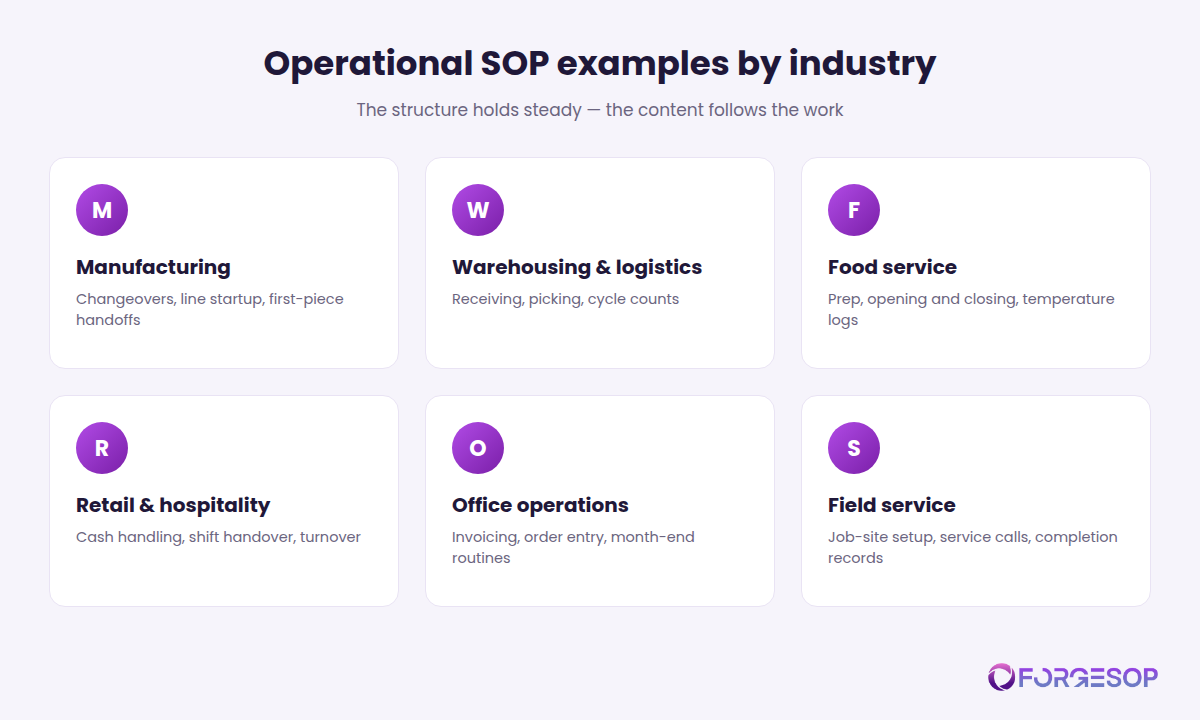
The structure holds steady across industries; the content follows the work. Typical operational SOP libraries look like this:
Manufacturing. Machine setup and changeover procedures, line startup and shutdown, first-piece verification handoffs, material staging, and end-of-shift handovers. This is where variation is most measurable, so it is usually where operational SOPs pay back fastest.
Warehousing and logistics. Receiving and putaway, picking and packing, cycle counting, loading dock scheduling, and returns processing. High turnover and seasonal staffing make documented procedures the difference between scaling up and melting down.
Food service and food production. Opening and closing routines, prep procedures, batch cooking sequences, and temperature logging. Many of these double as food-safety controls, which is exactly the multi-category tagging case described above.
Retail and hospitality. Cash handling and till reconciliation, shift handover, room or floor turnover, and stock replenishment. Consistency here is customer-facing: the procedure is the brand experience.
Office and business operations. Order entry, invoicing, customer onboarding steps, records filing, and month-end routines. Nobody bleeds when these fail, but money leaks and closing the books drags on for days.
Field service. Job-site setup, service call workflows, parts and van stock checks, and job completion records. The SOP substitutes for the supervisor who is not there to ask.
A worked example
Here is the skeleton of a real operational SOP, trimmed for space:
SOP-118: End-of-shift handover, packaging line 2 (v1.3, owner: Line Supervisor, review due: June 2027). Purpose: transfer line status to the incoming shift with no information loss. Authorized: trained line operators and shift leads. Steps: record current job number, batch count, and remaining run length on the handover board; note any stoppages over five minutes and their cause; flag open quality holds with the batch numbers affected; confirm material staged for the next two hours; walk the incoming operator through the board face to face; both operators sign the handover log. Records: signed handover log entry per shift.
Nothing in it is clever. Everything in it is checkable — and the day a batch goes wrong, that signed log is the difference between a ten-minute answer and a two-day investigation.
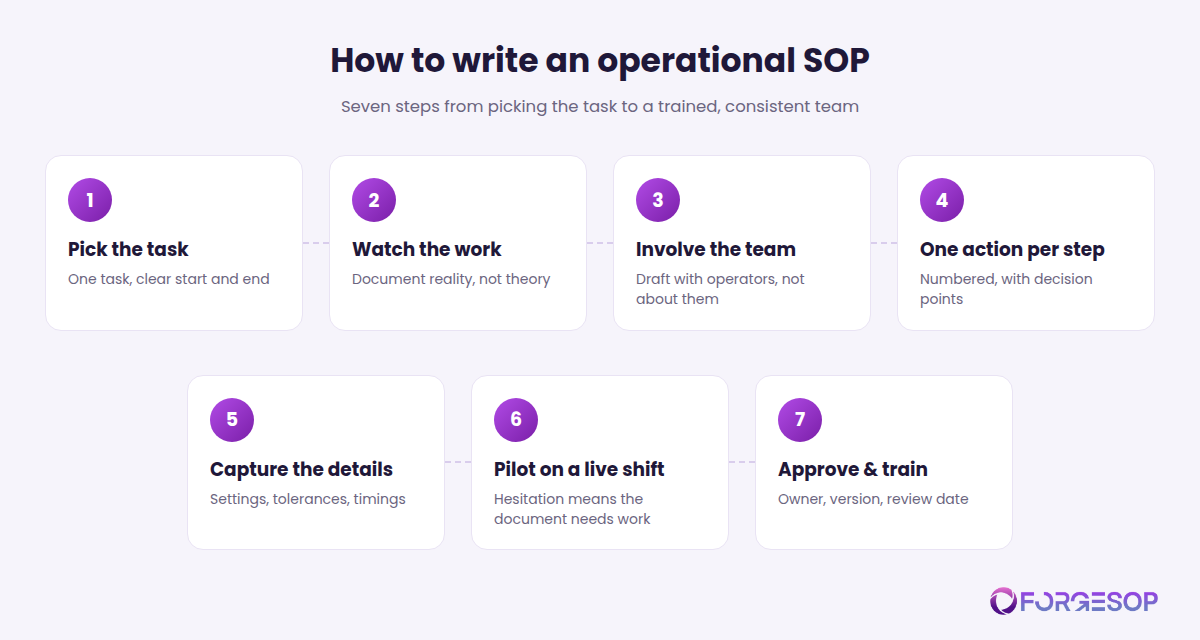
How to write an operational SOP in 7 steps
The method matters more than the template. Procedures written at a desk describe an imaginary version of the work; procedures written from the floor describe the real one. Seven steps keep you on the right side of that line:
Pick the task and set its boundaries. One task, one document. Use the five signals above to choose, and write down where the task starts and ends before drafting anything.
Watch the work as it actually happens. Observe the task live, ideally across different operators or shifts. The differences you spot are not noise — they are the reason you are writing the document.
Involve the people who do it. Draft with the operators, not about them. Procedures feel like instructions when you helped write them and like accusations when they are done to you.
Draft one action per step. Number the steps in order, keep sentences short and imperative, and spell out every decision point with its escalation path. If the task branches heavily, a flowchart format may fit better — our SOP formats breakdown shows when to switch.
Capture the details that cause variation. Settings, tolerances, timings, screen sequences, acceptance thresholds. Ask each operator what they do differently from their colleagues; the answers go in the document.
Pilot it on a live shift. Hand the draft to a competent operator who did not help write it and watch them follow it verbatim. Every place they hesitate or improvise is a defect in the document, not in the operator.
Approve, version, train, and set the review date. Give the document an owner, a version number, and a review date on day one. Train the affected team against this version, record the training, and only then call it published.
Most operational SOPs fail in the drawer, not on the floor.
The common failure is not writing bad procedures. It is writing decent ones and then letting them decay.
An operational SOP describes equipment, systems, and product mix. The three things that change most often in any business. A procedure written eighteen months ago and never revisited is a description of a line you no longer run. The first time an operator finds a step that contradicts the machine in front of them, the whole library loses credibility, not just that page.
Treat the document as a living document. That means a named owner rather than a departed author, a review date that actually triggers a review, retraining whenever the version changes, and most important a way for the people using the procedure to flag the step that no longer matches reality. The floor always notices drift first.
Where the documents live decides whether this discipline survives. Paper binders and shared drives fail quietly: versions multiply, the copy at the workstation goes stale, and nobody can say who was trained on what. Purpose-built SOP management software keeps one live version of each procedure with its history, approvals, and training records attached, so the “which version, trained when” questions answer themselves. However you solve it, solve it before your library passes a dozen documents, because retrofitting version control is far more painful than starting with it.
The bottom line
Operational SOPs are the least glamorous documents in your library and the ones your daily numbers depend on most. They will not impress an auditor the way a compliance manual does, and no regulation forces you to write them. That is exactly why the organizations that have them hold an advantage: consistent cycle times, faster onboarding, handovers that do not leak information, and processes stable enough to be worth improving.
Start with five tasks — the ones with the most variation, the most handoffs, or the most dangerous bus factor. Write them from the floor, pilot them on shift, give each one an owner and a review date, and let the library grow from proof, not from mandate. Get ahead of the variation now, while it is still a cost line and not yet a crisis.
Frequently asked questions
What is an operational SOP?
An operational SOP (standard operating procedure) is a documented, step-by-step instruction for performing routine daily work setups, changeovers, handovers, order processing consistently, regardless of who performs the task. It standardizes the operational core of the business rather than safety, quality, or compliance concerns specifically.
What is the difference between an operational SOP and a safety SOP?
An operational SOP standardizes how routine work gets done, protecting consistency and throughput. A safety SOP controls how hazardous work is performed without injury, adding hazard identification, controls, PPE requirements, and emergency steps. One task can need both kinds of content, and the best practice is one document tagged into both categories.
What is the difference between an operational SOP and a work instruction?
An operational SOP covers one complete task from start to finish for the person performing it. A work instruction zooms into a single step in finer detail, such as exact machine settings or software screens. Smaller organizations often merge the two levels into one document, which works as long as the document stays short enough to use.
Which tasks should get an operational SOP first?
Prioritize tasks with visible person-to-person variation, tasks only one employee can perform, handovers between shifts or departments, tasks whose errors surface downstream as rework or complaints, and tasks every new hire struggles to learn. These are the points where an SOP repays the writing effort fastest.
How long should an operational SOP be?
One task, one to three pages, typically ten to twenty numbered steps. If the document sprawls past that, it is usually two procedures stapled together and should be split. Detail belongs in the steps that cause variation — settings, tolerances, decision points — not in narrative padding.
How often should operational SOPs be reviewed?
Review operational SOPs at least annually, and immediately after any equipment change, system change, product change, or incident involving the task. Record the review even when nothing changes, so the revision block shows the procedure is current rather than merely old.
Who should write operational SOPs?
The people who perform the task, working with a supervisor or process owner who structures the document and checks it against requirements. Procedures written without operator input describe an imaginary version of the work and get quietly bypassed on the floor.
General

Forge better processes
One platform. Always audit-ready.
Bring SOPs, checklists, audits, incidents, and CAPAs into one connected system for safer, clearer, and more consistent operations.
No credit card required · Built for teams that run on process