General
Back to Blog
General6 min read
Hot Work Permit: What It Is, an Example, and How to Issue One
A maintenance crew is asked to weld a small bracket onto a walkway rail near a storage tank. It is a 20-minute job. The welder has done hundreds like it. Nobody tests the air, because the tank "has been empty for weeks."
The tank still holds a layer of sludge giving off flammable vapor. One spark is enough.
That pattern repeats in investigation reports. The U.S. Chemical Safety Board (CSB) has identified more than 60 deaths since 1990 from hot work explosions and fires on tanks, and in seven of the 11 accidents it reviewed, no gas testing was done before or during the work.
A hot work permit exists to stop that 20-minute job from starting until someone has checked. It is one of the core permits in any permit to work system. In this article, we cover what a hot work permit is, when you need one, a worked example and how to issue one in six steps.
Key takeaways
A hot work permit authorizes welding, cutting, grinding and other spark- or flame-producing work only after fire and explosion hazards are controlled.
OSHA requires combustibles to be moved at least 35 feet away where practicable and a fire watch for at least 30 minutes after the work; NFPA 51B now calls for at least 60 minutes.
Gas testing for flammable vapor is the control most often skipped, and the one investigators most often find missing.
The permit is not finished when the welding stops. It ends when the fire watch is complete and the area is handed back.
What is a hot work permit?
A hot work permit is a written authorization to carry out work that could ignite a fire or explosion. "Hot work" includes welding, cutting, brazing, soldering, grinding, torch work and thawing pipes with a flame.
The permit records the job, the location, the time window, the fire and explosion hazards, the precautions taken, the gas test results and the people involved, including the fire watch.
Under the welding, cutting and brazing standard from the Occupational Safety and Health Administration (OSHA), 29 Code of Federal Regulations (CFR) 1910.252, the responsible person must inspect the area and designate precautions before authorizing the work, "preferably in the form of a written permit." Under process safety management, 29 CFR 1910.119, a hot work permit is mandatory for hot work on or near covered processes.
When do you need a hot work permit?
You need a hot work permit whenever hot work happens outside a designated, permanently safe area such as a welding shop. Typical cases include:
welding or cutting in production areas, warehouses or plant rooms
any hot work on or near tanks, vessels, pipework or drains that held flammable material
grinding or cutting near stored packaging, pallets, insulation or dust
roof work involving torches or hot bitumen
hot work by contractors anywhere on site
The rule of thumb: if sparks can travel to something that burns, or vapor can travel to the sparks, the job needs a permit.
Hot work permit example
Here is a typical hot work permit for a job on a tank farm. The numbers match OSHA's rules and the 2019 and later editions of NFPA 51B, the fire prevention standard for hot work.
PTW-0187: Hot work permit (one shift only)
Section | Entry
|
|---|---|
Job and location | Weld replacement bracket on pipe support PS-14, Tank Farm B, next to Tank 3 |
Valid | 08:00 to 16:00 today |
Linked documents | SOP-HW-02 Hot work on site; JSA-0412 Pipe support repair; ISO-0098 Tank 3 transfer line isolation |
Combustibles | Cleared to 35 ft; remaining items covered with fire-resistant blankets |
Openings and drains | Drains within 35 ft covered; wall and floor openings sealed |
Gas test | Flammable vapor 0% of lower explosive limit (LEL) at 07:40, initials J.R.; retest every 2 hours and after breaks |
Fire protection | Charged extinguisher at work point; fire alarm call point located |
Fire watch | Named person during work and for at least 60 minutes after |
Sign-offs | Requester; issuer; fire watch accepted; holder at completion; issuer handback |
Stop work if: the gas reading rises above the site limit, the scope changes, or the fire watch has to leave.
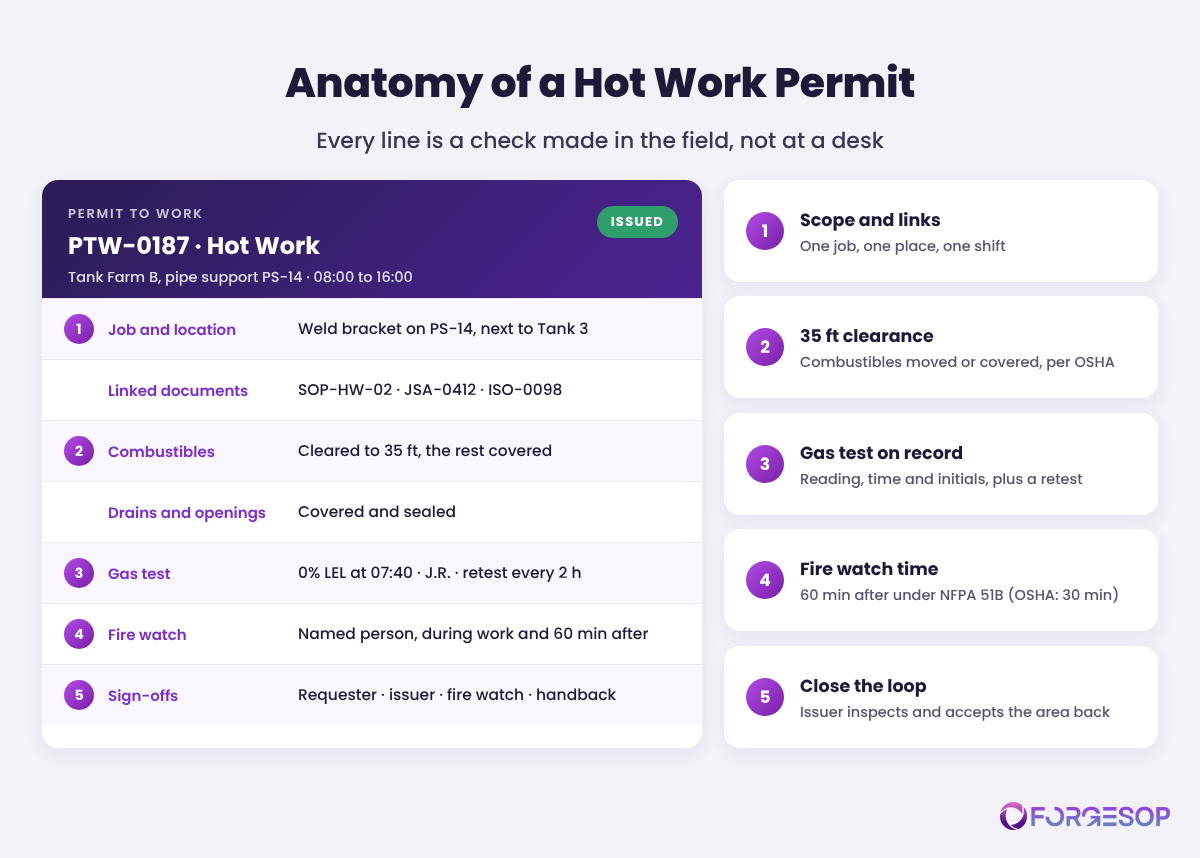
Every line on the permit is a check someone has to make in the field, not a box to tick at a desk.
How to issue a hot work permit in 6 steps
Ask whether hot work is necessary. The CSB's first lesson is to use alternatives where possible, such as cold cutting, mechanical joining or moving the part to a welding shop.
Inspect the area in person. Look for combustibles, openings, drains, conveyors and anything on the other side of walls and floors. Sparks travel further than most people expect.
Clear or protect combustibles. Move them at least 35 feet away where practicable. Where you cannot, cover them with fire-resistant blankets or shield them with metal guards.
Test the atmosphere. Use a calibrated gas detector where flammable vapor could be present, including inside nearby tanks and drains. Record the reading, the time and who took it, and set a retest interval.
Assign a fire watch. Brief them, give them an extinguisher, and make sure they have no other duties. They stay during the work and for at least 60 minutes after under current NFPA 51B.
Sign, display and close out. Issue the permit, display it at the work point and, when the fire watch ends, inspect the area again before accepting it back.
Hot work permits fail in the last hour
Most hot work fires do not start while the torch is lit. They start afterward, when a spark has lodged in insulation, behind a wall panel or in a gap in the floor and smolders unseen. That is why the fire watch time keeps getting longer, and why it is the first control to be cut short.
Other common mistakes:
Testing once and never again. Conditions change during a shift. A tank that read zero at 7 a.m. can read differently at noon.
Testing in the wrong place. Test where vapor can collect: inside connected tanks, drains and low points, not just the open air at the work point.
Fire watches with other jobs. A fire watch who is also fetching tools is not a fire watch.
Blanket permits. A permit covering "all welding in Building 4 this week" means nobody checks today's conditions.
Paper permits make these shortcuts easy, because nothing stops a permit from being signed without a gas reading. Dedicated permit to work software can require the gas test before issue, time the fire watch, and keep the record on file.
Which permits pair with a hot work permit?
Hot work rarely happens alone. You will often need:
an isolation permit to isolate lines feeding the equipment
a confined space entry permit if the welding happens inside a tank or vessel
a work at height permit if the work is on a roof or scaffold
See how all the main permit types fit together in our guide to the permit to work system.
The bottom line
A hot work permit is a short document guarding against a fast, unforgiving hazard. It works when someone actually walks the area, tests the air, posts a dedicated fire watch and stays until the risk of smoldering has passed.
Pick your next routine hot work job and walk it with your permit in hand. If any line on the permit cannot be checked in the field, fix the permit before the next spark.
Frequently asked questions
What counts as hot work?
Hot work is any job that produces sparks, flame or enough heat to ignite materials. It includes welding, cutting, brazing, soldering, grinding, torch-applied roofing and thawing pipes with a flame.
How long must a fire watch last after hot work?
OSHA requires at least 30 minutes after welding or cutting ends. NFPA 51B, from its 2019 edition onward, requires at least one hour and allows additional fire monitoring afterward. Many sites and insurers follow the longer NFPA period.
Who can issue a hot work permit?
A trained person authorized by the employer, sometimes called the permit authorizing individual. They must inspect the area, confirm the precautions and should not be the person doing the hot work.
Running high-risk work across sites? ForgeSOP links every permit to the SOPs, JSAs and isolations behind it, so work is authorized against current controls and closed out on the record.
General

Forge better processes
One platform. Always audit-ready.
Bring SOPs, checklists, audits, incidents, and CAPAs into one connected system for safer, clearer, and more consistent operations.
No credit card required · Built for teams that run on process