

General
Back to Blog
General6 min read
Isolation Permit and LOTO: What They Are, an Example, and How They Work Together
A filler on a bottling line jams. A mechanic hits the stop button, reaches in to clear it, and a colleague at the control panel, seeing the line stopped, restarts it.
The machine was stopped. It was never isolated.
That gap between "off" and "safe" is what lockout/tagout (LOTO) and isolation permits are built to close. The Occupational Safety and Health Administration (OSHA) estimates that compliance with its lockout/tagout standard prevents about 120 deaths and 50,000 injuries a year, yet the standard still ranks third on OSHA's preliminary list of most-cited standards for fiscal year 2026.
An isolation permit is one of the core permits in any permit to work system. In this article, we explain how it differs from LOTO, when you need one, a worked example and how to run one in six steps.
Key takeaways
LOTO is the physical method of isolating energy. An isolation permit is the record that coordinates and authorizes it for a specific job.
OSHA's lockout/tagout standard sets six steps for applying energy control, ending with verification that the equipment is actually isolated.
Use an isolation permit when a job involves several isolation points, several crews, shift changes or contractors.
Isolations must come off in a controlled order, with everyone clear, before energy is restored.
What is an isolation permit, and how is it different from LOTO?
Lockout/tagout is the practice of shutting off and locking energy sources so equipment cannot start up or release stored energy during servicing. OSHA's 29 Code of Federal Regulations (CFR) 1910.147 covers electrical, mechanical, hydraulic, pneumatic, chemical, thermal and other forms of energy.
An isolation permit, sometimes called an isolation certificate, is the document that lists every isolation point for one job, records who applied and verified each one, and controls when the isolations are removed.
In short: LOTO is the lock on the valve. The isolation permit is the record that says which valves, in what order, verified by whom, and released when.
For a simple job on a single machine with one energy source, the machine's written energy control procedure may be enough. As jobs get more complex, the permit becomes the only reliable way to keep track.
When do you need an isolation permit?
Use an isolation permit when any of these apply:
the job involves more than one isolation point or energy type
several crews or trades work on the same equipment
the job runs across a shift change
contractors apply or rely on isolations
isolation involves process lines, such as blinding or double block and bleed
other permits, such as hot work or confined space entry, depend on the isolation
OSHA's standard expects this kind of coordination. It requires a group lockout procedure that gives each worker the same protection as a personal lock, an orderly transfer of protection at shift changes, and an exchange of lockout procedures between the host employer and any outside contractor.
Isolation permit example
Here is an isolation permit for a filler repair. The steps follow the sequence in OSHA's standard.
ISO-0183: Isolation permit, Filler 2 (replace drive coupling)
# | Isolation point | Method | Applied by | Verified by
|
|---|---|---|---|---|
1 | Main electrical disconnect MCC-4/12 | Open, lock, tag | T. Nguyen | S. Ford |
2 | Compressed air supply valve AV-21 | Close, lock, bleed downstream | T. Nguyen | S. Ford |
3 | Product infeed valve PV-07 | Close, lock | T. Nguyen | S. Ford |
4 | Capper drive (stored spring energy) | Block mechanically | T. Nguyen | S. Ford |
Verification: start button tested with no movement; air gauge reads zero; voltage tested absent at motor terminals.
Group lockout: each crew member adds a personal lock to the group lock box and removes it when they finish.
Linked permits: none. Valid: until work complete; transfer at shift change by signed handover.
Release order: reverse of application, after the holder confirms all tools removed, guards replaced and personnel clear.
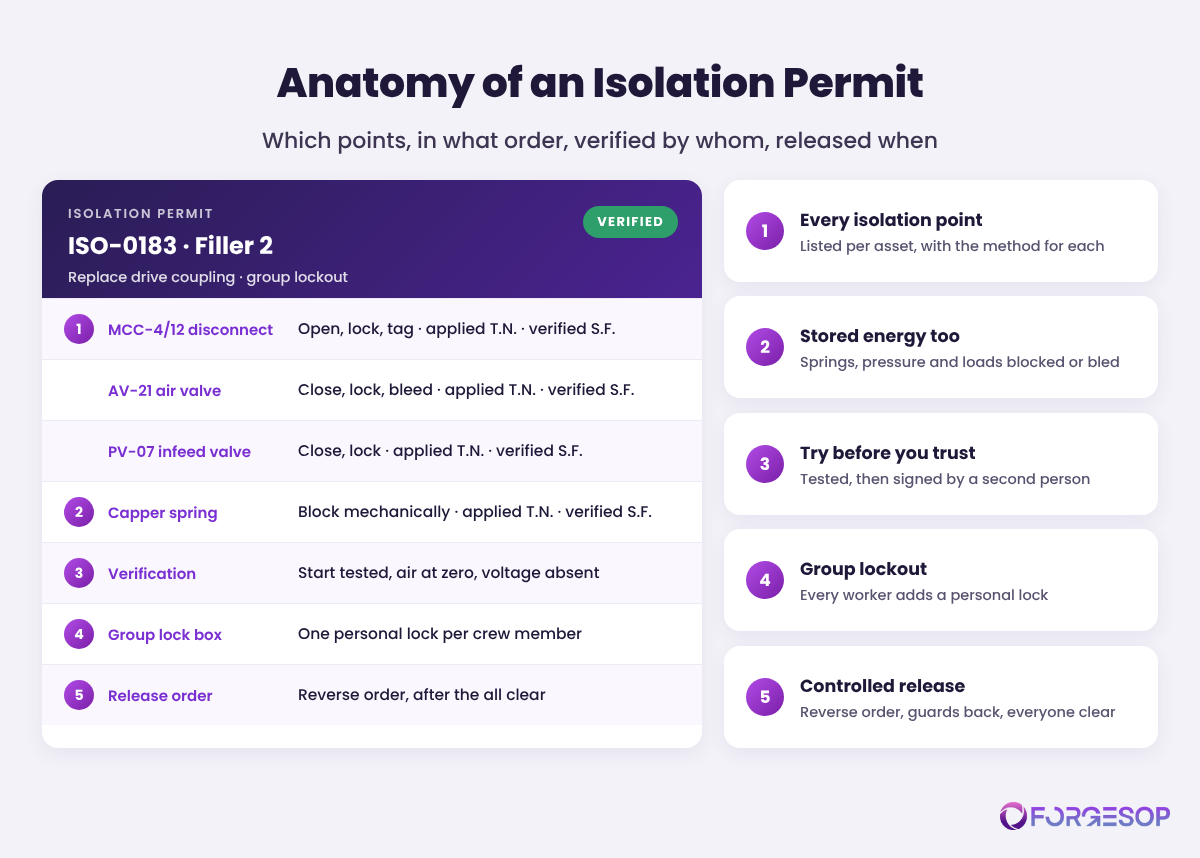
The two-name rule on every line is deliberate. Second-person verification catches the isolation that was applied to the wrong valve.
How to run an isolation permit in 6 steps
These follow the six application steps in 1910.147(d), with the permit wrapped around them.
Prepare for shutdown. Identify every energy source from the equipment's energy control procedure and list each isolation point on the permit.
Shut down the equipment. Use the normal stop sequence and tell everyone affected.
Isolate each source. Open disconnects, close and lock valves, and blind lines where needed. Record who did each one.
Apply locks and tags. Every lock identifies the person who applied it. For group work, use a group lock box with personal locks.
Release stored energy. Bleed air and hydraulic pressure, block springs and gravity loads, and discharge capacitors.
Verify isolation. Try the start controls, check gauges and test for voltage. A second person confirms and signs.
When the work is done, reverse the process in a controlled order, confirm everyone is clear, and only then restore energy.
Stopped is not isolated
Most isolation incidents come from a small set of shortcuts:
Skipping verification. Applying a lock to the wrong disconnect looks exactly like applying it to the right one until someone presses start.
Forgetting stored energy. Pressure trapped in a line or a raised load can move after every switch is off.
Leaving locks on a supervisor's key ring. At shift change, a lock with no owner is either cut off or left forever.
Removing isolations out of order. Restoring air before checking guards are back on reintroduces the hazard.
Paper isolation lists make these gaps hard to see. Dedicated permit to work software can list isolation points per asset, block a hot work or entry permit until the linked isolation is verified, and enforce the release order.
Which permits pair with an isolation permit?
a hot work permit when welding on isolated pipework
a confined space entry permit for entry into isolated tanks and vessels
a contractor permit to work when outside crews rely on your isolations
See how all the main permit types fit together in our guide to the permit to work system.
The bottom line
LOTO puts locks on energy sources. An isolation permit makes sure the right locks are on the right points, verified by a second person, handed over at shift change and removed in the right order.
Pick one complex isolation on your site this month and walk it with the permit in hand. If you cannot name who verified each point, you have found your next fix.
Frequently asked questions
Is an isolation permit required by OSHA?
Not by name. OSHA requires written energy control procedures, training, periodic inspections at least once a year and specific steps for applying and releasing lockout. Many sites use an isolation permit to meet those requirements on complex jobs.
What is the difference between lockout and tagout?
Lockout uses a lock to physically hold an energy-isolating device in a safe position. Tagout uses a warning tag. OSHA expects lockout wherever the equipment can be locked, because a tag does not physically prevent operation.
Who removes a lockout device?
Generally, the person who applied it. OSHA allows removal by someone else only under specific procedures, such as verifying the employee is not at the facility, making every reasonable effort to contact them and informing them before they return.
Running high-risk work across sites? ForgeSOP links every permit to the SOPs, JSAs and isolations behind it, so work is authorized against current controls and closed out on the record.
General


Forge better processes
One platform. Always audit-ready.
Bring SOPs, checklists, audits, incidents, and CAPAs into one connected system for safer, clearer, and more consistent operations.
No credit card required · Built for teams that run on process