

General
Back to Blog
General17 min read
Permit to Work System: What It Is, How It Works, and How to Build One
On the evening of 6 July 1988, the night shift on the Piper Alpha oil platform in the North Sea needed to restart a standby condensate pump. Nobody in the control room knew that the pump's pressure safety valve had been removed for maintenance that day and replaced with a blind flange. The paperwork for that job existed. It just never reached the people who needed it.
Gas leaked from the flange and ignited. 167 men died.
The public inquiry led by Lord Cullen exposed the gaps. A later review by the Institution of Chemical Engineers (IChemE) summed up its findings as severe and numerous defects in the permit-to-work system, along with poor transfer of information between shifts. Nearly four decades later, the lesson applies to every plant, warehouse, utility and construction site that does high-risk work: a permit is only as good as the information it carries and the controls it enforces.
In this article, we break down what a permit to work system is, which jobs need one, how a permit moves from request to close-out, and how to build a system your crews will actually use.
Quick answer: A permit to work (PTW) system is a formal, written process for authorizing high-risk, non-routine work such as hot work, confined space entry, isolation of hazardous energy and work at height. Each permit states what work will be done, where and when, the hazards, the controls that must be in place before work starts, who authorized it, and how the area is handed back afterward.
Key takeaways
A permit to work system controls high-risk, non-routine jobs by requiring a competent person to confirm and sign that the controls are in place before work begins.
The permit does not make the job safe. The isolations, gas tests, fire watches and rescue plans it calls for do.
Most permits move through five stages: request, assess, authorize, work and close out.
The four most common permit types are hot work, confined space entry, isolation and work at height, and each has its own regulatory triggers.
Most permit failures happen at the edges: shift handover, overlapping jobs, contractors and close-out.
A permit, a job safety analysis (JSA) and a standard operating procedure (SOP) do different jobs, and a strong system links all three.
What is a permit to work system?
A permit to work system is a documented process for controlling work that could cause serious harm if done without specific precautions. The UK Health and Safety Executive (HSE) describes a permit as a formal system "stating exactly what work is to be done and when, and which parts are safe".
In practice, a permit is a written authorization tied to one job, one location and one time window. It brings together:
the scope of work and the equipment involved
the hazards identified for that job
the precautions required, such as isolations, gas tests and barriers
the people involved and their roles
the validity period of the permit
the sign-offs at issue, shift handover and close-out
The "system" part matters as much as the form. A permit to work system includes the rules for which jobs need a permit, who can issue one, how permits are displayed and tracked, how conflicting jobs are spotted, and how the whole process is audited.
A permit is not the safety measure
HSE puts it plainly: the issue of a permit does not, by itself, make a job safe. A signature on a form has never stopped a flash fire.
The value of a permit is that it forces a pause. Someone competent has to look at the job, confirm the controls are physically in place, and accept responsibility in writing before anyone strikes an arc or opens a hatch.
That is also why a permit does not replace a risk assessment. HSE describes the permit as the way to put the risk assessment into practice at the point of work.
The reality is that many sites treat the permit as paperwork to complete rather than a control to verify. When that happens, the form gets filled in at a desk, the checks get ticked from memory, and the permit stops doing its job.
Which jobs need a permit to work?
A job needs a permit when it is high risk, not routine, and depends on precautions that must be set up for that specific job. HSE lists hot work, vessel entry, cutting into pipework that carries hazardous substances, and work that needs electrical or mechanical isolation as typical examples.
In the United States, several standards from the Occupational Safety and Health Administration (OSHA) require a permit or point strongly toward one:
Permit-required confined spaces: 29 Code of Federal Regulations (CFR) 1910.146 requires a written entry permit before anyone enters.
Welding, cutting and brazing: 29 CFR 1910.252 requires the responsible person to inspect the area and designate precautions before authorizing work, preferably in a written permit.
Process safety management: 29 CFR 1910.119 requires a hot work permit for hot work on or near covered processes, plus safe work practices for lockout, confined space entry, opening process equipment and controlling entry to the facility.
Lockout/tagout: 29 CFR 1910.147 does not require a permit by name, but it requires written energy control procedures, and many sites manage complex isolations under an isolation permit.
Fall protection in construction: 29 CFR 1926 Subpart M sets the trigger height at 6 feet, and many sites use a work at height permit for roofs, scaffolds and unprotected edges.
Outside the United States, the same logic appears in HSE's guidance on permit-to-work systems (HSG250) and in ISO 45001, the international standard for occupational health and safety management, which expects you to plan and control high-risk operations and contractor work.
A simple test works on most sites: if a mistake on this job could kill someone, and the controls have to be set up specially for it, put it under a permit.
What are the main types of work permits?
Most sites run four core permit types, plus a handful of specialist permits for their own high-risk activities.
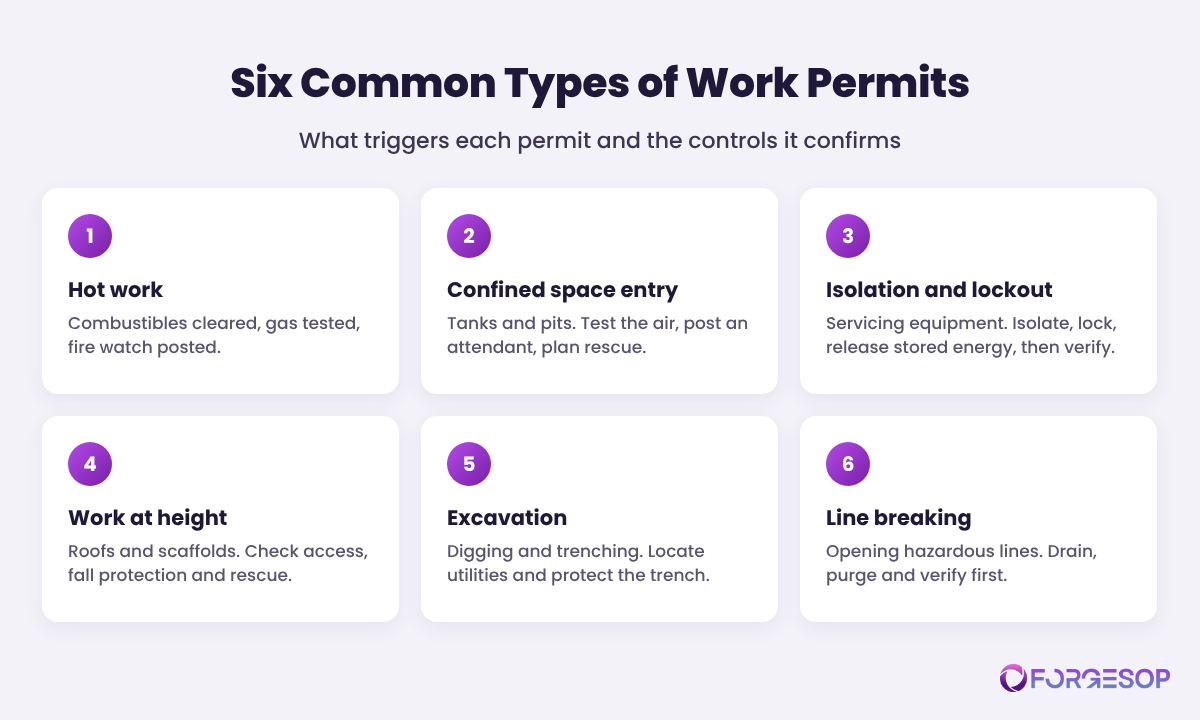
Hot Work Permit
A hot work permit covers welding, cutting, grinding, brazing and any other job that produces sparks, flame or enough heat to ignite something. Typical controls include clearing combustibles, gas testing for flammable vapor, protecting openings and drains, and posting a fire watch.
OSHA requires combustibles to be relocated at least 35 feet from the work where practicable, and a fire watch to stay for at least half an hour after the work ends. NFPA 51B, the fire prevention standard for hot work, extended that to at least one hour in its 2019 edition. The U.S. Chemical Safety Board (CSB) has identified more than 60 deaths since 1990 from hot work explosions and fires on tanks.
Read the full guide: Hot Work Permit: What It Covers and How to Issue One
Confined Space Entry Permit
A confined space entry permit controls entry into tanks, vessels, pits, silos, sewers and other spaces with limited ways in and out and a serious hazard inside. OSHA lists 15 things the permit must document, including the space, the purpose of entry, authorized entrants, the attendant, test results, isolations and rescue arrangements.
Atmospheric testing has a set order: oxygen first, then combustible gases, then toxic gases. The stakes are high for anyone who goes in after a collapsed worker. The National Institute for Occupational Safety and Health (NIOSH) found that about 60% of confined space deaths involved would-be rescuers.
Read the full guide: Confined Space Entry Permit: Example and Checklist
Isolation and Lockout/Tagout Permit
An isolation permit controls work on equipment that could start up, energize or release stored energy. It lists every isolation point, the order in which isolations are applied and verified, who holds the locks, and the order in which they come off.
Lockout/tagout (LOTO) is the physical method, and the permit is the coordination layer on top. OSHA estimates that compliance with its lockout/tagout standard prevents about 120 deaths and 50,000 injuries a year, and the standard still ranks third on OSHA's preliminary list of most-cited standards for fiscal year 2026.
Read the full guide: Isolation Permit and LOTO: How They Work Together
Work at Height Permit
A work at height permit covers jobs where someone could fall far enough to be hurt: roofs, scaffolds, elevated platforms, open edges and floor openings. Typical controls include a current scaffold inspection, edge protection or fall arrest, crew competency checks, weather limits and a rescue plan.
Falls remain the deadliest hazard in construction. According to the Bureau of Labor Statistics (BLS), 389 of the 1,034 private construction deaths in 2024 were falls, slips and trips, and 95.9% of those were falls to a lower level.
Read the full guide: Work at Height Permit: Example and How to Issue One
Other permits you may need
Depending on your operations, you may also need permits for:
excavation and ground disturbance, where buried utilities and trench collapse are the main risks
line breaking, which means opening pipework or vessels that held hazardous material
electrical work on or near exposed energized parts
heavy or critical lifts, radiography, roof access and diving
How do the main permit types compare?
Permit type | Typical trigger | Key controls | Main US reference
|
|---|---|---|---|
Hot work | Welding, cutting or grinding near anything that can burn | Clear combustibles to 35 ft, gas test, fire watch after the job | 29 CFR 1910.252, NFPA 51B |
Confined space entry | Entering a permit-required confined space | Test the atmosphere in order, attendant outside, rescue plan | 29 CFR 1910.146 |
Isolation | Servicing equipment that could start up or release energy | Isolate, lock, release stored energy, verify before work | 29 CFR 1910.147 |
Work at height | Work at 6 ft or more in construction (4 ft in general industry) | Scaffold inspection, edge protection or fall arrest, rescue plan | 29 CFR 1926 Subpart M, 1910.28 |
Excavation | Digging, trenching or ground disturbance | Utility locate, protective system, daily competent person inspection | 29 CFR 1926 Subpart P |
How does a permit to work system work?
Whatever the permit type, a well-run system moves every job through the same five stages.
Request. The person responsible for the work raises the permit. They name the job, the asset, the location, the permit type, the time window and the crew.
Assess. The hazards and required precautions come from the permit template and the JSA for the job. Someone confirms them at the work point, not at a desk: gas readings are taken, isolations are walked, barriers are checked.
Authorize. The issuer checks that every precondition is met, such as isolations in place, crew competency current and no conflicting permits on the same equipment. Only then do they sign and issue the permit, and a copy is displayed at the work point.
Work. The permit stays live until the job ends or the validity period runs out. If the scope changes, conditions change or a gas alarm sounds, work stops and the permit is reassessed. Unfinished work at the end of a shift is left safe and formally handed over. If work pauses for a longer period, the permit is suspended, and it is only revalidated after someone rechecks the conditions at the work point.
Close out. The crew confirms the job is complete and the area is safe. Isolations come off in the right order, the issuer accepts the area back, and the permit record is filed.
The fifth stage is the one most often rushed. HSE's guidance calls for a clear process for handing plant back when work is complete, because a job that is "done" with an isolation still in place, or a guard still off, is a hazard for the next person.
Who does what in a permit system?
Clear roles stop jobs from falling into gaps. HSE warns against gaps or overlaps in responsibility, and most systems use some version of these roles:
Permit requester or holder: the person in charge of the work crew, who requests the permit and makes sure the crew follows it.
Permit issuer: the competent person who checks the controls and authorizes the work. For high-risk jobs, the issuer should not be the same person who does the work.
Area authority: the person responsible for the plant or area, who knows what else is happening there.
Isolating authority: the person who applies, verifies and removes isolations.
Specialist roles: gas testers, fire watches, confined space attendants and entry supervisors, each named on the permit.
What should a permit include?
The best way to see what belongs on a permit is to look at one. Here is the skeleton of a typical hot work permit.
PTW-0187: Hot work, Tank Farm B, pipe support repair
Scope: weld a replacement bracket on pipe support PS-14, next to Tank 3
Valid: 08:00 to 16:00, one shift only
Linked documents: SOP-HW-02 Hot work on site, JSA-0412 Pipe support repair, ISO-0098 Isolation of the Tank 3 transfer line
Hazards: flammable vapor from Tank 3, combustible material at grade, sparks falling below the work
Precautions: Tank 3 transfer line isolated and locked under ISO-0098; combustibles cleared to 35 feet; drains covered; fire-resistant blanket under the work; extinguisher at the work point
Gas test: flammable vapor reading recorded before work, repeated every two hours and after every break, with time and tester's initials
Fire watch: named person during work and for at least 60 minutes after it ends
Sign-offs: requester, issuer, fire watch, shift handover (if used), holder at completion, issuer accepting handback
Every line answers a question an investigator would ask after an incident. What was the job? What was isolated? Who checked the air, and when? Who accepted the area back?
Most permit failures happen at the edges, not on the form
A permit form can be perfect and the system can still fail. In incident after incident, the breakdown happens where the job meets something else.
Shift handover. Piper Alpha is the defining example. A permit that lives on a clipboard in one person's hand does not tell the next shift what is open, isolated or half-finished.
Overlapping jobs. Two permits on the same line, issued by different people, can cancel each other's controls. HSE recommends that related and simultaneous permits be linked and displayed so anyone can see the status of the equipment at a glance.
Contractors. Contractors often do the highest-risk work on a site while knowing the site least. BLS data show that 829 contracted workers died on the job in 2015, and they made up just under 60% of construction laborers killed that year. Our guide to the contractor permit to work covers the gates that matter.
Permit overload. When dozens of permits are requested at the start of a shift, issuers rush. HSE suggests spreading permit demand through planning or adding authorizers at busy times.
Copy-paste precautions. Reusing last month's permit for "the same job" skips the step where someone looks at today's conditions.
How do you know if your permit system is working?
Most sites judge their permit system by lagging indicators: if nobody got hurt, the system must be fine. That is a dangerous assumption. Permit failures often sit quietly for months before conditions line up for an incident.
Leading indicators tell you much earlier. Track a handful of them every month:
Field audit results. Walk to a sample of live permits and compare the paper with reality. Is the isolation actually applied? Is the fire watch actually there?
Missing or late test records. Count permits where a gas test, scaffold inspection or competency check was not recorded before issue.
Overdue close-outs. Permits left open after the work ended are a sign that handback is being skipped.
Handover quality. Check how many multi-shift jobs have a signed handover entry, not just a verbal one.
Permit-related near misses. Encourage crews to report near misses involving permits, such as work starting before issue or two crews on the same equipment, and treat each one as free information.
Issuer workload. If one person signs 40 permits before 7 a.m., the checks are not happening.
The takeaway: a permit system that is never audited in the field is a permit system you are trusting on faith.
How is a permit different from a JSA or an SOP?
These three documents are often confused, but each answers a different question:
An SOP explains how a task is done correctly every time.
A JSA breaks one job into steps and identifies the hazards and controls for each step.
A permit confirms that the controls are actually in place, right now, for this job, and authorizes the work to start.
A strong system links them: the permit points to the SOP and the JSA, and the JSA feeds the permit's list of precautions. See our full comparison of the permit to work vs JSA vs SOP.
How do you build a permit to work system in 7 steps?
Whether you are starting from scratch or fixing a system nobody trusts, these steps cover the essentials.
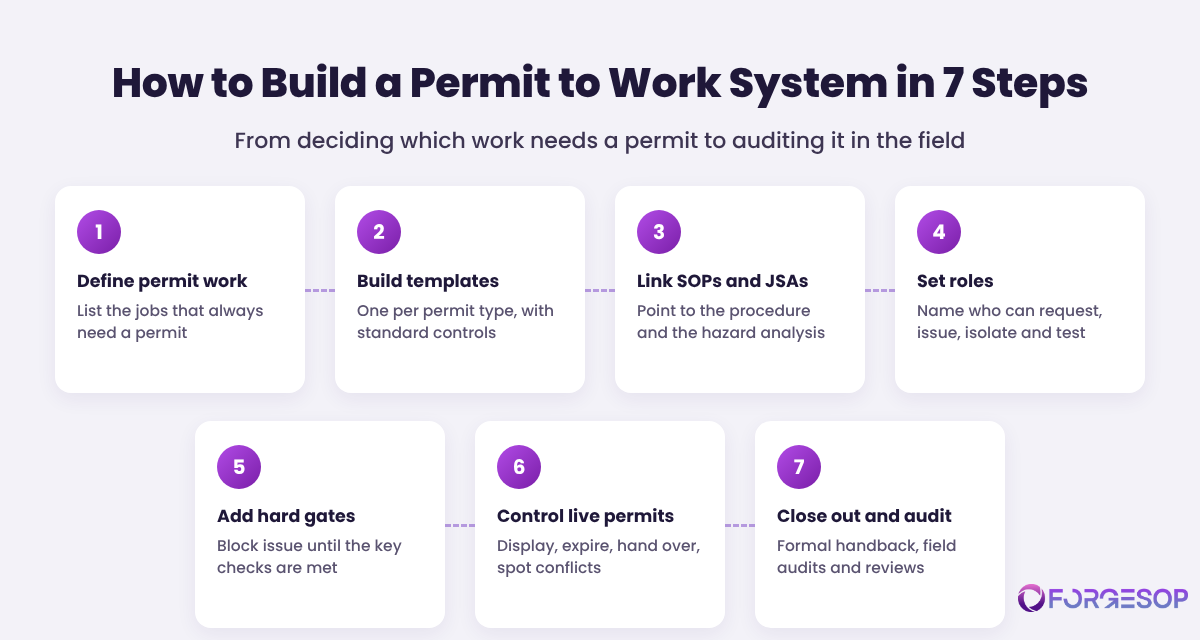
Define which work needs a permit. Write down the activities that always require one, such as hot work outside designated areas, confined space entry and complex isolations, and who decides in borderline cases.
Build one template per permit type. Each template carries its standard hazards, precautions, tests and sign-offs, so nobody starts from a blank page.
Link each template to its SOP and JSA. The permit should point to the procedure for the task and the hazard analysis for the job, not repeat them.
Define roles and competency. Name who can request, issue, isolate and test, and keep a record of who is trained and authorized for each role.
Set hard gates before issue. Decide what must be true before a permit can be issued: isolations verified, gas test in range, scaffold inspection current, contractor documents valid.
Control the live permit. Display permits at the work point and in a central place, set expiry times, require formal handover at shift change, and check for conflicting jobs on the same equipment.
Close out, audit and review. Require formal handback, audit a sample of permits against what is happening in the field, and review the system when incidents or near misses point to a weakness. HSG250 includes a monitoring checklist you can adapt.
A paper permit trusts people to check. A better system makes skipping impossible.
Paper permits rely on memory and goodwill. The issuer has to remember that the scaffold tag expired yesterday, that a contractor's insurance lapsed last week, or that another crew holds a permit on the same pump.
Under pressure, people forget. That is not a character flaw. It is a design flaw.
The fix is to move the checks from people's heads into the system. Purpose-built permit to work software can block a permit from being issued until isolations are confirmed, competencies are current and contractor documents are valid. It can show every open and expiring permit across sites on one live board, and keep a time-stamped record of who signed what. Whatever tools you use, the goal is the same: make the safe path the only path.
If you move from paper to an electronic system, plan the changeover like any other change. HSE advises risk-assessing the switch and making sure training covers the permit process itself, not just which buttons to press. A digital form that people do not understand is no safer than a paper one.
The bottom line
A permit to work system is one of the oldest controls in industrial safety, and still one of the most important. It works when it forces a real pause before high-risk work, connects the people who need to know, and closes the loop when the job ends.
Start by listing the jobs on your site that need a permit, then test your current system against the five stages. The weak points will show up at handover, at close-out and wherever contractors are involved. Fix those before they become an incident.
Frequently asked questions
What is a permit to work system?
A permit to work system is a formal, written process for authorizing high-risk, non-routine work. Each permit states the job, location, time window, hazards and required controls, and records who authorized the work and who accepted the area back when it ended.
Is a permit to work a legal requirement?
It depends on the work and the jurisdiction. In the United States, OSHA requires written entry permits for permit-required confined spaces and hot work permits under process safety management, and it expects written authorization for welding and cutting. Other high-risk work is commonly put under permit as good practice.
Who can issue a permit to work?
Only people the employer has trained and formally authorized for that permit type and area. The issuer must understand the hazards, be able to verify the controls, and, for high-risk work, should not be the same person who carries out the job.
How long is a permit to work valid?
As long as the job needs and no longer. OSHA states that a confined space entry permit cannot exceed the time required to complete the task. Many sites limit permits to one shift and require formal handover or revalidation if the work continues.
What is the difference between a permit to work and a risk assessment?
A risk assessment identifies hazards and decides which controls are needed. A permit to work confirms those controls are in place for a specific job at a specific time, and authorizes the work. The permit puts the risk assessment into practice at the work point.
Can one permit cover several jobs?
Generally no. A permit should cover one defined scope of work at one location. If several jobs affect the same equipment, issue separate permits, link them, and make sure the issuer can see all of them before authorizing any.
How long should you keep permit records?
OSHA requires employers to keep each canceled confined space entry permit for at least one year. Many organizations keep all permits longer to support audits, incident investigations and trend reviews, so set a retention period in your written procedure.
Running high-risk work across sites? ForgeSOP links every permit to the SOPs, JSAs and isolations behind it, so work is authorized against current controls and closed out on the record.
General


Forge better processes
One platform. Always audit-ready.
Bring SOPs, checklists, audits, incidents, and CAPAs into one connected system for safer, clearer, and more consistent operations.
No credit card required · Built for teams that run on process