
General
Back to Blog
General8 min read
Process Orientation: What It Is and How to Build It Into Your Operation
Ask who knows how hazardous chemicals are received and logged at your site, and you will probably hear one name. Maybe it's a warehouse lead who checks every label against the current safety data sheet (SDS) and knows which supplier still ships an old revision. None of that is written down. It lives in her head and a binder nobody else opens.
Then she takes four weeks of leave.
That is what a missing process looks like: not chaos, just quiet dependence on the right person being in the room. Process orientation removes that dependence. In this article, we break down what it means, what it costs to work without it, why documents alone don't fix it, and seven steps to start this quarter.
Quick answer: Process orientation is a way of running an organization around the end-to-end flows of work that deliver results, rather than around departments or job titles. Each critical process has a named owner, a visible map, one agreed way of working, and a routine for measuring and improving it. It is a management habit, not a one-time documentation project.
Key takeaways
Process orientation organizes work around flows, not org charts. Responsibility follows the work from trigger to result, including the handoffs between teams.
The warning signs are familiar: know-how locked in one person, unclear ownership, everyone doing it their own way, and leaders deciding on gut feel.
Documents support processes; they don't replace them. A manual nobody can navigate is not a process.
Standards already think this way. ISO 9001 is built on a "process approach," and lockout/tagout rules require a documented, owned, and inspected process.
Start small. One mapped process with a named owner and a review date beats a company-wide map nobody maintains.
What is process orientation?
Process orientation means treating your organization as a set of connected processes that deliver value (to customers, to workers, and to regulators) rather than as a collection of departments that each optimize their own piece.
A process has a trigger, a result, and the steps, people, and records in between. "Receive a hazardous chemical" starts when a delivery arrives and ends when the container is logged, labeled, stored, and its SDS is available to users. That one flow crosses purchasing, the warehouse, the safety team, and production.
When you work in a process-oriented way, someone owns that whole flow from start to finish. The method is standardized, the map is visible, and improvement happens on purpose rather than by accident.
A process is not a department.
Departments are how you organize people. Processes are how work actually moves. Most failures happen in the gaps between them, like the purchase order that never told the warehouse a new chemical was coming. Process orientation puts an owner on those gaps.
It is also not a project. Many organizations map their processes once, file the diagrams, and move on. The reality is that process orientation is a management model you sustain for years.
What does it cost to work without clear processes?
If your processes aren't defined, the cost rarely shows up as one line item. It shows up as friction, rework, and risk. Four patterns come up again and again.
A key person leaves, and the know-how leaves too. The U.S. Bureau of Labor Statistics (BLS) reported that median tenure with a current employer was 4.1 years in January 2026. Every few years, you should expect the person who "just knows" to move on.
Nobody owns the handoff. When responsibility is unclear, work stalls between teams. Corrective actions sit open, customers wait, and follow-up quietly stops.
Everyone does it their own way. Three shifts, three methods, three quality levels. Variation can work for a while, but you can't improve a process you can't describe.
Leadership can't see how work really gets done. Without visible processes, decisions rest on gut feel and the loudest anecdote rather than evidence.
There is also a daily search tax. The McKinsey Global Institute estimated in 2012 that knowledge workers spend nearly 20% of their workweek searching for and gathering information. In safety-critical work, the cost goes further: a skipped step in an energy isolation is how a near miss becomes an incident.
Your binder is not your process.
Many organizations have plenty of documentation and still lack good processes, because documents and processes do different jobs. A document is static: it has to be found, read, and interpreted. A process shows, at a glance, who does what, in what order, with which handoffs. Documents still matter, especially the standard operating procedures (SOPs) that tell people exactly how to perform a step. But they should hang off the process, not stand in for it.
Document-centric | Process-oriented | |
|---|---|---|
Unit of work | A department or a file | An end-to-end flow, from trigger to result |
Ownership | Whoever wrote the document | A named process owner and deputy |
Finding the method | Search folders and ask around | Start at the process map, drill into the SOP |
Handoffs | Implied or undocumented | Shown on the map, with a named receiver |
Making a change | Edit a file and hope people notice | Revise, approve, train, confirm acknowledgment |
What an auditor sees | A stack of documents | How work flows, who is accountable, and proof it is followed |
When someone leaves | The knowledge walks out | The process, and the reasoning behind it, stays |
The takeaway: let the process come first, and let documents support it.
What does process orientation look like in practice?
A well-documented example comes from car manufacturing. In 1984, two automakers reopened a shuttered assembly plant in Fremont, California, as a joint venture with much of the original workforce. What changed was the system: standardized work, clear responsibility, and continuous improvement. In a 2010 MIT Sloan Management Review article, John Shook, who helped lead the transition, wrote that absenteeism of 20% or more fell to a steady 2%. One plant, one era, but a clear signal.
You may already run a process-oriented system without calling it one. The lockout/tagout (LOTO) standard from the Occupational Safety and Health Administration (OSHA), 29 CFR (Code of Federal Regulations) 1910.147, requires documented energy control procedures, training for the people who use them, and an inspection of each procedure at least once a year. That is process orientation in regulatory form, and it is hard to sustain: lockout/tagout ranked third on OSHA's preliminary list of most frequently cited standards for fiscal year 2026 (see our guide to safety SOPs). ISO 9001, the international quality management standard (revised in September 2026), and ISO 45001, its occupational health and safety counterpart, are built the same way, around defined processes with clear responsibilities.
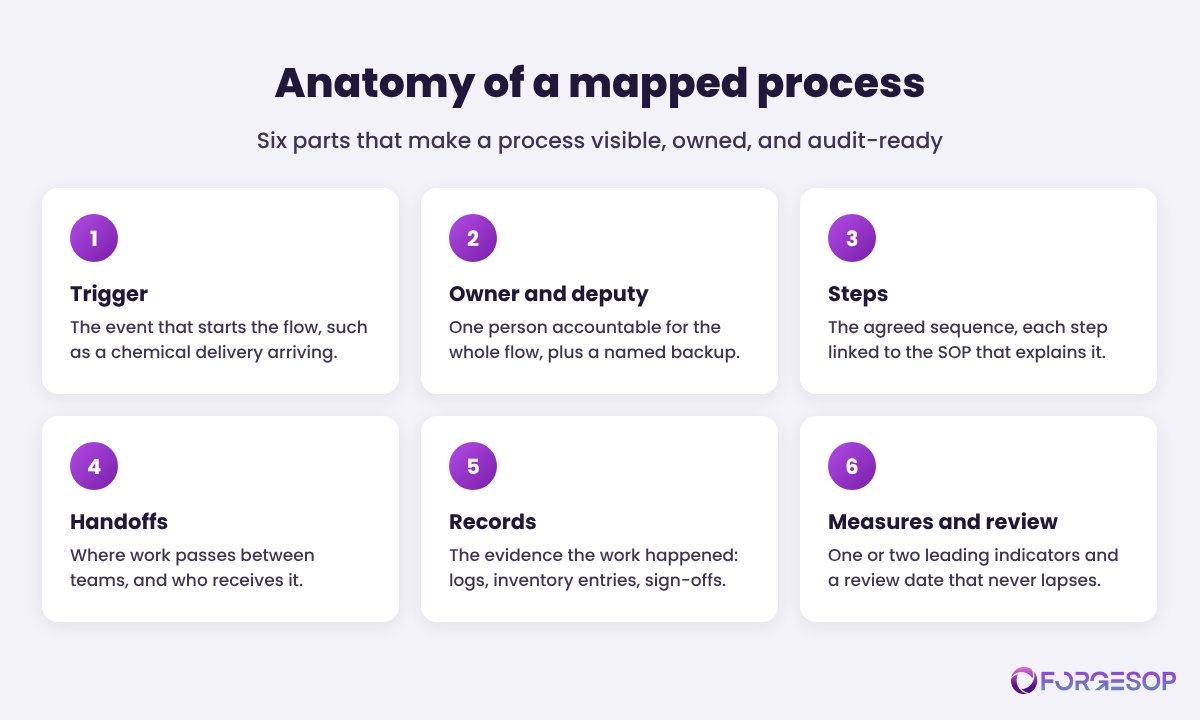
Here is the skeleton of a typical mapped process, using chemical receiving:
Trigger: a delivery containing a hazardous chemical arrives.
Owner: the warehouse supervisor (deputy: the shift lead).
Steps: check the order, match the label to the current SDS, log it in the chemical inventory, store by compatibility, share the SDS.
Handoffs: purchasing (approved list), safety team (new chemical review), production.
Records: receiving log, inventory entry, SDS revision date.
Measures: containers received without a current SDS; days from receipt to inventory entry.
Review: annually, and after any incident, near miss, or supplier change.
It fits on one page. That's the point.
How to get started with process orientation in 7 steps
Process orientation needs four things to stick: management commitment, clear ownership, maps people actually use, and continuous improvement. These steps build all four, one process at a time.
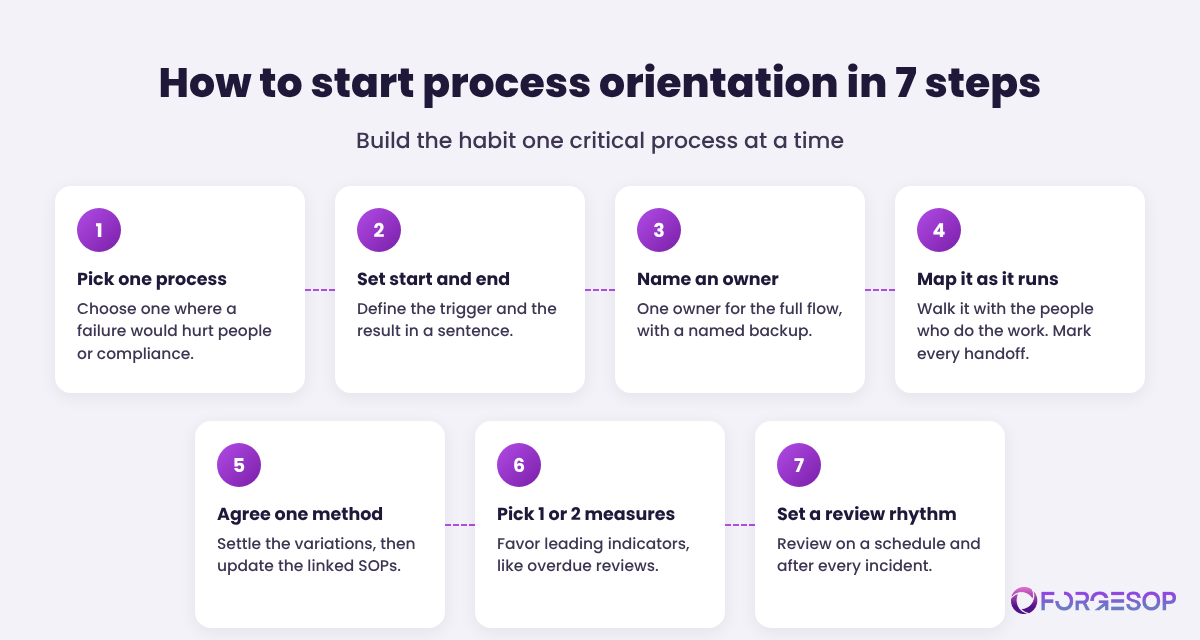
Pick one critical process. Choose one where a failure would hurt people, quality, or compliance, or one that depends on a single person.
Define where it starts and ends. Write the trigger and the result in one sentence each.
Name an owner and a deputy. The owner is accountable for the whole flow, handoffs included, not just their department's slice.
Map it as it really runs. Walk it with the people who do the work. Mark every handoff, decision, and record, and note where people improvise.
Agree on one way of working. Settle the variations, then write or update the SOPs the map points to.
Choose one or two measures. Favor leading indicators, such as overdue reviews or skipped steps, over lagging ones like injuries.
Set a review rhythm. Review on a schedule and after any incident, near miss, audit finding, or change, and feed what you find into your corrective action process.
Then pick the next process.
The process you mapped last year has already drifted.
Process orientation rarely fails at the mapping stage. It fails a year later, when the map says one thing, the SOP says another, and the floor does a third. We looked at what that costs in the hidden cost of uncontrolled SOPs.
The fix is control: one current version of each process and procedure, a named owner, acknowledgments tracked by name, and review dates that prompt the owner before they lapse. Purpose-built SOP management software makes that structural rather than heroic.
In short, a process is only as good as its last review.
The bottom line
Process orientation isn't about more paperwork. It's about making the way work flows visible, owned, and improving, so it no longer depends on one person's memory.
You don't need to change everything at once. Take one critical process and ask: Is ownership clear? Is the flow visible? Does everyone do it the same way? Do you know where it breaks? The honest answers show you where to start.
The sooner you start, the sooner you get ahead of risk, before it becomes an incident.
Frequently asked questions
What is process orientation in simple terms?
Process orientation means organizing work around the flows that produce results, such as receiving a chemical or closing a corrective action, instead of around departments. Each flow has an owner, a visible map, one agreed method, and a regular review.
Is process orientation the same as process mapping?
No. Process mapping is one tool: drawing how a process runs. Process orientation is the management model around it: ownership, standardized work, measurement, and improvement. A map without an owner goes stale quickly.
What does a process owner do?
A process owner is accountable for a process from trigger to result, including handoffs between teams. They keep the map and linked SOPs current, track a few measures, lead reviews, and approve changes.
How long does it take to become process-oriented?
You can map and own one critical process within a few weeks. Making it how the whole organization works usually takes years, because it depends on management commitment and culture, not documentation.
Want every process, SOP, and owner in one place? ForgeSOP keeps your procedures versioned, acknowledged, and reviewed on schedule, so the way work is mapped matches the way work is done.
General

Forge better processes
One platform. Always audit-ready.
Bring SOPs, checklists, audits, incidents, and CAPAs into one connected system for safer, clearer, and more consistent operations.
No credit card required · Built for teams that run on process