
General
Back to Blog
General23 min read
Customer Service SOPs: What They Are, Examples, and How to Write One
The first call came in on a Tuesday. A customer said the plug on her new space heater had gotten hot enough to soften the outlet cover. Nobody was hurt. The agent apologized, shipped a replacement, and closed the ticket as resolved in under six minutes. Over the next five weeks, ten more customers described the same thing to ten different agents, through the phone line, the chat window, a retailer's returns desk, and one angry review. Every ticket was handled politely. Every ticket was closed as resolved.
Every customer was served well. The company still failed.
By the time someone in quality noticed the pattern, a harder question was already on the table: when should the company have told federal regulators about a possible hazard, and why did nobody inside the business connect the dots?
Most organizations have customer service scripts, a help desk system, and a satisfaction score on a dashboard. Far fewer have customer service procedures: the step-by-step instructions that tell an agent what to ask, what to decide, what they may promise, where a complaint goes next, and what record proves it happened. The script covers what to say. The procedure covers what to do.
Customer service SOPs close that gap. This guide, the tenth and final article in our series on the types of SOPs, covers what a customer service SOP is, how it differs from a script and from the other SOP types, which procedures to write first, what belongs inside each one, and a seven-step method for writing procedures that turn complaints into fixes rather than fines.
Quick answer: A customer service SOP (standard operating procedure) is a written, step-by-step instruction for a recurring customer interaction: answering inquiries, taking and changing orders, handling complaints, processing returns and refunds, and responding to safety or quality reports. It names who does each step, what they may decide, where each issue is routed, and the record that proves it.
Key takeaways
Customer service SOPs turn service promises into repeatable steps: intake, triage, escalation, returns and refunds, document requests, and account changes.
A script is not a procedure. Scripts tell agents what to say; procedures tell them what to ask, decide, record, and route.
Complaints are early warnings. A customer service team is often the first part of a business to hear about a product defect, an injury, or a quality failure, and some of those reports start legal clocks.
The stakes are measurable. The Consumer Product Safety Commission (CPSC) expects a reportable hazard to be reported within 24 hours, and in 2026 a fitness equipment company agreed to a $16.875 million penalty after failing to promptly report a hazard it had received hundreds of reports about.
Most unhappy customers never complain at all. Qualtrics XM Institute found that fewer than one in three consumers give feedback after a bad experience, so every complaint you receive stands for others you never hear.
Customer service procedures drift fast, through new products, new channels, help desk macros, and chatbots. Keep one controlled version and review it every time any of those change.
What is a customer service SOP?
A customer service SOP is a standard operating procedure for a recurring interaction between your organization and the people who buy from it. It takes a commitment you make to customers (complaints are answered within one business day, refunds follow a fair rule, injury reports reach the safety team the same day) and converts it into named roles, ordered steps, decision rules, time targets, and the record that proves each step happened.
The scope is wider than the contact center. Customers raise issues with sales reps, field technicians, distributors, retail partners, and the chat window as often as they call the support line. Anyone who hears from a customer is running a customer service procedure, written or not.
If the term SOP itself is new ground, start with our plain-language guide to what an SOP is and come back; this article assumes the basics and goes deep on one category.
A script is not a procedure.
A script tells the agent what to say: the greeting, the empathy statement, the closing line. It is useful, and most service teams have plenty of them.
A procedure tells the agent what to do. When a customer reports that a product overheated, ask the safety questions first, record the model and lot number, ask the customer to stop using it and keep it, flag the ticket for the product safety officer within two hours, and hold the replacement until quality agrees. None of that is about wording. All of it decides what happens next.
Scripts break the moment a customer says something unexpected. A procedure with clear decision rules still works when that happens, which is when it counts.
Every complaint is information someone else needs.
A complaint is rarely only a customer service problem. A damaged delivery may be a packaging problem, an early failure a quality problem, and a product that hurt someone a safety problem, and possibly a regulatory one.
The standards treat it that way. ISO 9001, the international standard for quality management systems, lists customer communication, including customer feedback and complaints, as a requirement in clause 8.2.1. ISO 10002, the international guideline for complaints handling, sets out how an organization should receive, track, respond to, and learn from complaints about its products and services.
In regulated industries the expectation becomes a rule. U.S. drug manufacturers must establish and follow written procedures for handling all written and oral complaints under Food and Drug Administration (FDA) rules in Title 21 of the Code of Federal Regulations (21 CFR 211.198), including a review of whether each complaint describes a serious and unexpected adverse drug experience that must be reported. Medical device makers face the same expectation through the FDA's Quality Management System Regulation (QMSR), which took effect on February 2, 2026 and incorporates ISO 13485, the medical device quality standard that requires documented procedures for timely complaint handling.
If your customers include businesses that use your chemicals, even a routine document request carries a duty. Under the Hazard Communication Standard (HazCom) of the Occupational Safety and Health Administration (OSHA), chemical manufacturers, importers, and distributors must provide a safety data sheet (SDS) with the initial shipment and with the first shipment after an SDS is updated, and retail distributors must provide one to commercial customers on request. A customer asking for the current SDS is not asking for a favor.
How are customer service SOPs different from other SOP types?
Every SOP type shares the same skeleton: numbered steps, named roles, a revision block. What changes is the risk each type controls. An operational SOP keeps your core work consistent, a quality SOP protects the product, a safety SOP prevents harm during planned work, and a compliance SOP proves the rules were followed. A customer service SOP protects the relationship with the people who buy from you, and makes sure the information they give you reaches the people who need it.
Operational SOPs | Quality SOPs | Customer Service SOPs | |
|---|---|---|---|
Primary job | Running core work the same way every time | Making sure the product or service meets its specification | Resolving what customers raise, and routing the signals inside it |
Who runs them | Operators, technicians, and supervisors | Inspectors, quality assurance, and production | Service agents, plus sales reps, field technicians, distributors, and chatbots |
Typical trigger for writing one | A new process, a wave of new hires, inconsistent output | A new specification, a nonconformance, an audit finding | A new product or channel, a complaint trend, a missed escalation, a reporting duty |
Core content | Steps, tools, settings, handoffs | Specifications, acceptance criteria, inspection records | Intake fields, triage questions, authority limits, response targets, approved language |
Cost of failure | Waste, rework, inconsistent output | Defects, rework, recalls, failed audits | Lost customers, missed safety reports, regulatory penalties, refund leakage |
Review cadence | With process changes, and at least annually | Every specification change and corrective action, and at least annually | Every product launch, policy, or channel change, every complaint trend, and at least annually |
Sign-off | Operations manager | Quality lead | Customer service lead, with the quality and safety leads for triage rules |
The column on the right has a property no other column shares: the other person in the procedure works somewhere else. They never read your SOP, they may be frustrated or frightened, and they will describe a defect in their own words rather than yours. Every design choice follows from that: capture what they said in full, ask the screening questions every time, and give agents clear limits so that empathy produces the same decision on every shift.
In practice the categories overlap, and that is fine. A complaint that reveals a defect becomes an investigation under your quality SOPs and, when the root cause is confirmed, your corrective and preventive action (CAPA) process. A recall is an emergency and incident response event as much as a service one. Verifying a caller before you change their account or bank details belongs equally to your IT and security SOPs. Refunds run through the payment controls in your administrative SOPs, agent onboarding belongs with your HR and training SOPs, and field technicians who hear complaints on site follow your maintenance SOPs too. Write one SOP for the task and tag it into every category it touches, a point our types of SOPs guide makes across all ten types.
The complaint you closed may be the report you missed.
Most of the customer service failures that end up in the news are not failures of courtesy. They are failures of routing.
In August 2026, the CPSC announced that a fitness equipment company had agreed to pay a $16.875 million civil penalty for failing to immediately report a fall hazard with its treadmills. According to the agency, the company received at least 874 reports of the treadmills unexpectedly accelerating, stopping, or changing speed between March 2018 and October 2022, including at least 71 reports of injury. Reports like those usually reach a company the way any complaint does: through a phone line, an inbox, a warranty claim, or a retailer.
The rules explain why the routing matters so much. Under Section 15(b) of the Consumer Product Safety Act, a company that obtains information reasonably supporting the conclusion that a product has a defect that could create a substantial product hazard, or creates an unreasonable risk of serious injury or death, must report it immediately, which the CPSC defines as within 24 hours. The CPSC also treats information held by any employee who could reasonably be expected to appreciate its significance as known to the company, and says five days should ordinarily be the most it takes for that information to reach the person responsible for reporting.
Read that again with your service desk in mind. The agent who took the call may be the moment the company "knew."
The clocks customer service starts.
Product safety is not the only deadline that can start at the front line. Depending on what you sell, a customer contact can trigger several:
Medical devices: manufacturers must report information suggesting a device may have caused or contributed to a death or serious injury, or malfunctioned in a way that could, within 30 calendar days of becoming aware of it, and within five work days when remedial action is needed to prevent an unreasonable risk of substantial harm.
Drug products: every written and oral complaint must be recorded and reviewed, with the record kept at least one year past the product's expiration date.
Delayed orders: under the Federal Trade Commission (FTC) Mail, Internet, or Telephone Order Merchandise Rule, if you cannot ship when promised (or within 30 days when you promised nothing), you must offer the customer the choice to accept the delay or cancel for a prompt refund, generally within seven working days.
Privacy requests: under California Consumer Privacy Act (CCPA) regulations, a request to know, delete, or correct personal information must be acknowledged within 10 business days and answered within 45 calendar days. The European Union's General Data Protection Regulation (GDPR) allows one month for similar requests.
None of these clocks waits for the ticket to be escalated. A procedure that names which contacts start a clock, and who must hear about them by when, keeps a service conversation from becoming a compliance failure.
Most unhappy customers never tell you.
The commercial cost is just as real, and mostly invisible. The Qualtrics XM Institute's 2026 consumer trends research, a survey of 20,001 consumers in 14 countries, estimates that bad experiences put nearly $3 trillion in global sales at risk. It found that 34% of consumers reduce their spending after a negative experience and 13% stop spending with the company entirely. Yet fewer than one in three consumers give the company any feedback, an all-time low for the study.
That makes every complaint more valuable than it looks: a free report from a customer who could have simply left, probably speaking for others who did.
Why do customer service procedures stay unwritten?
Because the people turn over. The U.S. Bureau of Labor Statistics (BLS) counts about 2.67 million customer service representative jobs and projects about 289,500 openings a year through 2035, all of them to replace workers who move to other occupations or leave the labor force, even as total employment is expected to shrink. Knowledge that lives in a senior agent's head walks out the door on a regular schedule.
Because the tools feel like procedures. Help desk macros and knowledge base articles look like documentation, but they rarely say who decides, what the limits are, or where a safety report goes.
Because the metrics reward speed. When agents are measured on handle time and tickets closed, a step that slows them down, such as a screening question, is the first to disappear unless the procedure requires it.
And because automation hides the gaps. Chatbots and AI (artificial intelligence) assistants answer from whatever content they were given, with no sense of when to stop. Customers notice: in a Gartner survey of 5,728 customers, 64% said they would prefer companies did not use AI for customer service, and their top concern was that it would make it harder to reach a person. A written path from the bot to a human is a procedure, not a feature.
Which customer service SOPs should you write first?
No team needs fifty service procedures by the end of the quarter. Across industries, the highest-value customer service SOPs cluster into six families.
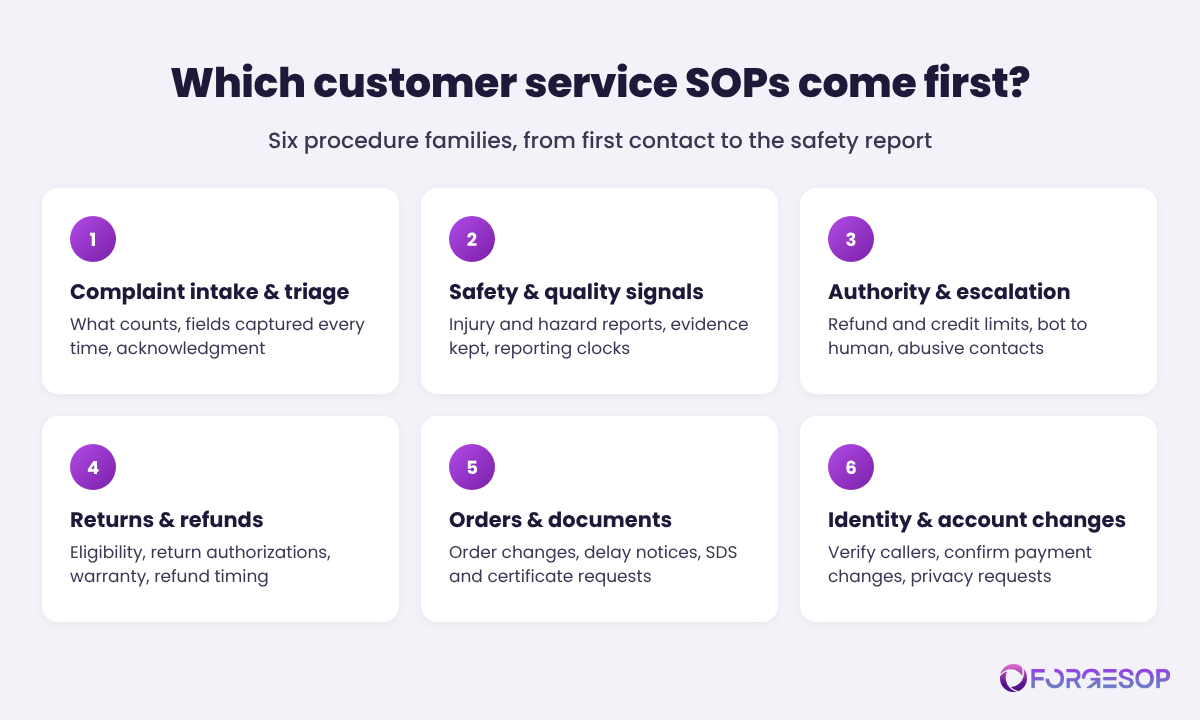
Complaint intake and triage. What counts as a complaint, the information captured every time, how complaints are categorized, and how they are acknowledged. Start here: every other family depends on complaints being captured completely, whatever the channel.
Safety, quality, and regulatory signals. The screening questions asked on every product complaint, what happens when a customer reports an injury, fire, chemical exposure, or adverse reaction, how evidence is preserved, and who decides whether to report. This family has the highest stakes and the shortest clocks.
Escalation and authority limits. Who may approve a refund, credit, replacement, or exception, and up to what value; how a ticket moves from agent to team lead to manager; how a customer reaches a person from a chatbot; and how to handle abusive or threatening contacts safely.
Returns, refunds, and warranty claims. Eligibility rules, return authorizations, inspection of returned goods, refund timing, and warranty decisions. Inconsistency here is where refund leakage and favoritism hide.
Orders, delays, and document requests. Order changes and cancellations, delay notices, backorders, and requests for documents such as safety data sheets, certificates of analysis, and compliance declarations. Many of these carry their own deadlines.
Customer identity, data, and account changes. How a caller's identity is verified before account details are disclosed or changed, how payment or delivery changes are confirmed, and how privacy requests are routed. It shares its verification steps with your IT and security procedures.
Two rules set the order inside the families. Follow the harm: procedures for contacts that could involve injury, a regulated product, or a legal deadline come first. Follow the volume: after that, write the procedures behind your most common contact reasons, which a quick export from your help desk system will show you in an afternoon.
What does a customer service SOP include?
Most SOPs share the same foundation, covered in our guide to what an SOP should include. For customer service procedures, the content comes down to ten building blocks:
Title, unique ID, and one task per document, such as SOP-1004 Product Complaint Intake and Triage, not a sixty-page "customer service manual"
Purpose, scope, and channels in scope: phone, email, chat, web forms, social media, sales reps, field staff, distributors, and retail partners
Roles and authority limits: who receives, who reviews, who decides, and the value limits for refunds, credits, and exceptions at each level
Definitions: complaint versus inquiry, safety complaint, and severity levels, with every acronym spelled out, such as customer relationship management (CRM) and return merchandise authorization (RMA)
Triggers and required information: what starts the procedure and the fields captured every time, such as product, lot or serial number, and the customer's own description
The triage screen: the short list of questions asked on every complaint to catch safety, quality, and regulatory signals, and what each answer triggers
Ordered steps with time targets: imperative and numbered, with acknowledgment, response, handoff, and resolution targets written in
Approved language and what not to say: key phrases for difficult moments, and clear limits on statements about cause, fault, safety, and liability
Records, closure, and trend review: what the closed record contains, how long it is kept, and how often complaints are reviewed for patterns
Revision block, review triggers, and training: version, owner, approver, effective date, the events that reopen it, and how agents are trained on it
Two of these blocks do the heavy lifting, and they are the two most often missing.
The triage screen turns a ticket into a signal. Most service workflows are built to resolve the issue and close the ticket. The triage screen adds a second question: does anyone else need to know? Was anyone hurt? Was there heat, smoke, fire, a chemical exposure, or property damage? Did the product break or move in a way it should not have? Is a child involved? A yes to any of them changes the path: the ticket stays open, the safety or quality owner is told within a set time, and the product is preserved. The screen takes thirty seconds, and it is the difference between eleven resolved tickets and one recognized pattern.
Authority limits turn empathy into consistent decisions. Without written limits, the same complaint gets a full refund from one agent, a partial credit from another, and a polite no from a third, depending on who answered. Write down what each level may approve, up to what value, and what always needs a second person. Then write down what nobody in customer service decides alone: the cause of a failure, whether a product is safe, and whether the company is at fault. Kindness stays with the agent. Judgment calls with legal or safety consequences go to the people who own them.
What does a customer service SOP look like in practice?
Here is the skeleton of a typical one, trimmed for space.
SOP-1004: Product complaint intake and triage
Version 3.0 · Owner: Customer Service Manager · Review due: at the next product launch or March 2027, whichever comes first
Purpose: Capture every product complaint completely, screen it for safety and quality signals, and route it to the right owner on time.
Scope: Every product sold under the company’s brands, through every channel, including sales reps, field technicians, distributors, and retailers.
Trigger: Any contact in which a customer expresses dissatisfaction with a product, whether or not they use the word “complaint.”
Roles:
The receiving agent captures and screens.
The team lead reviews flagged complaints.
The quality engineer investigates.
The product safety officer decides on regulatory reporting.
The Customer Service Manager verifies.
Capture: Contact details, product, model, lot or serial number, date and place of purchase, what happened in the customer’s own words, and photos where possible.
Safety screen (asked on every product complaint):
Was anyone hurt or did anyone need medical attention?
Was there heat, smoke, fire, sparking, a chemical exposure, or property damage?
Did the product break, fall, or move in a way it should not?
Is a child or vulnerable person involved?
If any answer is yes:
Flag the ticket as a safety complaint and keep it open.
Notify the product safety officer within two hours, using the after-hours number outside business hours.
Ask the customer to stop using the product and keep it, and arrange a prepaid return.
No replacement or disposal until quality agrees.
Language: Acknowledge, apologize for the experience, and explain next steps. Make no statement about the cause, fault, or whether the product is safe.
Response: Acknowledge within one business day, and tell the customer who will contact them and when.
Exception: A report of death or hospitalization goes to the product safety officer and the legal lead immediately, by phone.
Records: Every complaint, flagged or not, stays in the complaint file with its lot or serial number and outcome. Quality reviews all complaints weekly for trends, including the ones closed as resolved.
Verification: The Customer Service Manager samples ten closed complaints a month to confirm the screen was asked and recorded.
Nothing in it is complicated, and that is the point. The agent still gets to be warm and helpful. But eleven reports of a hot plug are no longer eleven separate good deeds. They are one pattern, visible in the first week, with the product in hand and a record of exactly when the company knew and what it did.
How to write a customer service SOP in 7 steps
The method matters more than the template, and for customer service procedures the method starts with your own contact data and ends with calibration.
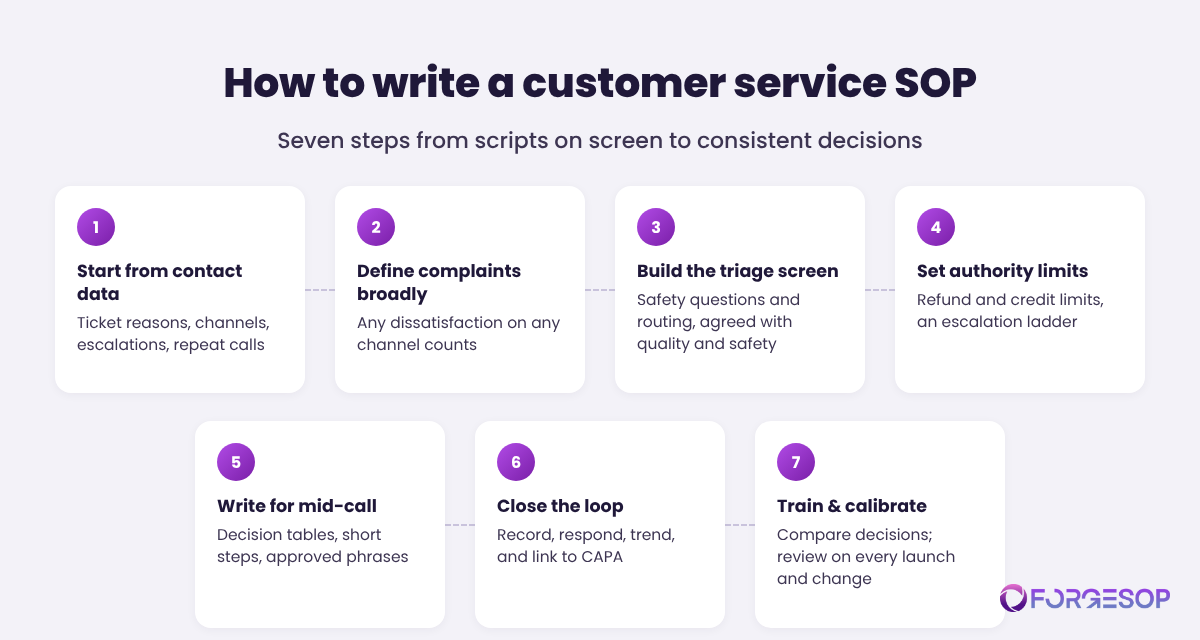
Start from your contact data, not from a template. Export three to six months of tickets, calls, and chats and sort them by reason, channel, and outcome. Note where escalations happened, where customers called back, and where the same issue was resolved differently.
Define what counts as a complaint, and make it broad. ISO 10002 treats a complaint as any expression of dissatisfaction where a response is expected, whether or not the customer uses the word. Apply that definition across every channel. A narrow definition is how serious reports end up filed as general inquiries.
Build the triage screen with your quality and safety leads. Agree on the screening questions, what each answer triggers, who is notified, and how fast. The safety and quality leads should sign off the screen, because it commits their teams, and whoever owns regulatory reporting should confirm the routing against your actual obligations.
Set authority limits and an escalation ladder. Write the value limits for refunds, credits, and replacements at each level, what always needs approval, and the topics agents never decide alone. Add the path from chatbot to person, and a separate path for abusive or threatening contacts that protects your staff.
Write for the moment the agent is in. The person running this procedure is mid-conversation, often with a frustrated customer on the line. Use decision tables, short steps, and approved phrases for difficult moments. If an agent has to scroll through three pages to find the next step, the procedure will be skipped.
Close the loop: record, respond, and trend. Define what a closed record must contain and what the customer is told at closure. Then connect service to the rest of the business: a weekly or monthly complaint review with quality, links into incident reporting, audits, and corrective actions, and CAPA for recurring causes. A complaint that is resolved but never trended teaches the company nothing.
Train, calibrate, and set the review triggers. Train agents on the procedure, not only the scripts, and run calibration sessions where team leads review the same contacts and compare decisions. Then tie reviews to events as well as the calendar: any product launch or change, any recall, any new channel or chatbot update, any policy or regulatory change, any missed escalation or complaint trend, and at least annually.
The procedure that fails is the one the knowledge base forgot.
Customer service procedures rarely fail because they were badly written. They fail because the version agents actually use drifted away from the approved one. The refund limit changed in the policy but not in the help desk macro. The outsourced overflow team still works from a binder printed two years ago. The chatbot learned last spring's return policy and keeps promising something the company no longer offers.
Drift is more dangerous here than in most SOP families, because the procedure is copied into more places than almost any other: macros, knowledge articles, chatbot content, partner portals, and printed quick-reference cards. We dissected what documentation drift costs in the hidden cost of uncontrolled SOPs, and customer service procedures multiply that cost by every copy.
The countermeasures are familiar, applied with more discipline. Every customer service SOP gets one named owner and a deputy. Every macro, knowledge article, and chatbot answer points back to the controlled procedure it came from, and changes start there. Every revision is acknowledged by the people who run it, including outsourced and partner teams. Purpose-built SOP management software makes this structural rather than heroic: one current version, acknowledgments tracked by name, and review dates that remind the owner. However you solve it, the newest agent on the overflow team and the chatbot should be reading the same rules as your most experienced lead.
In short, a customer service procedure is only as current as its oldest copy.
The bottom line
Customer service SOPs are where your promises to customers stop being slogans and start being habits. They decide whether a complaint is captured completely, whether an injury report reaches the safety team the same day, whether two customers with the same problem get the same answer, and whether the business learns anything from what its customers tell it.
Start with six families: complaint intake, safety and quality signals, escalation and authority limits, returns and refunds, orders and document requests, and customer identity and account changes. Write them for the agent mid-conversation, put the triage screen before the resolution, set clear limits on what anyone decides alone, and trend every complaint, including the ones closed as resolved.
This article closes our series on the ten types of SOPs, and it is a fitting place to end. Customer service is where every other procedure eventually meets the outside world. When customers tell you something went wrong, a good procedure makes sure the right people hear it, before it becomes an incident.
Frequently asked questions
What is a customer service SOP?
A customer service SOP (standard operating procedure) is a written, step-by-step document for a recurring customer interaction, such as answering inquiries, changing orders, handling complaints, processing returns and refunds, and handling reports of product safety or quality problems. It names who does each step, what they may decide, where each issue is routed, the time targets, and the record that proves it was done.
What is the difference between a customer service script and an SOP?
A script tells an agent what to say, such as the greeting, empathy statements, and closing lines. An SOP tells the agent what to do: which questions to ask, what information to record, what they may approve, when to escalate, who must be notified, and by when. Scripts help with tone; SOPs make sure the right decisions and handoffs happen, especially when a conversation goes off the script.
What are examples of customer service SOPs?
Common examples include complaint intake and triage, handling a reported injury, escalation and refund approval limits, returns and warranty claims, order changes and shipping delay notices, safety data sheet requests, caller identity verification before account changes, privacy requests, chatbot to human handoff, and handling abusive contacts. Any recurring customer interaction with a decision or a handoff in it is a candidate.
Are customer service SOPs required?
Often, yes, depending on your industry and certifications. ISO 9001 requires communication with customers to include obtaining their feedback, including complaints. FDA rules require drug manufacturers to have written procedures for handling all written and oral complaints, and the FDA's Quality Management System Regulation requires medical device makers to have documented complaint handling procedures. Companies that sell consumer products must report qualifying hazards to the Consumer Product Safety Commission within 24 hours, which is hard to do reliably without a procedure that routes customer reports. Where no rule names them, auditors and major customers increasingly expect them anyway.
What should customer service do when a customer reports an injury?
Follow a written procedure that puts safety first: make sure the customer is safe and has sought medical help if needed, record what happened in their own words with the product and lot or serial number, ask them to stop using the product and keep it, and notify the person responsible for product safety within a set time, usually the same day. Agents should express concern and explain next steps, but not speculate about the cause, admit fault, or say whether the product is safe.
How often should customer service SOPs be reviewed?
At least annually, and immediately after any event that changes how the task is done: a new or changed product, a recall, a new channel or chatbot update, a policy or regulatory change, a missed escalation, or a complaint trend. Because these procedures are copied into macros, knowledge articles, and chatbot content, every review should also check that those copies match the approved version.
Who should write customer service SOPs?
The customer service lead owns them, but each one should be drafted with the agents who run it and approved by the teams it commits: the quality and safety leads for complaint triage, finance for refund and credit limits, IT and security for identity verification, and legal or regulatory affairs for anything that could start a reporting duty. Experienced agents know what really happens on calls; new agents are the best test of whether the procedure is clear.
Want every agent, partner, and chatbot working from the same procedure? ForgeSOP keeps every customer service SOP versioned, acknowledged, and easy to find, so the rules on the front line match the rules you approved.
General

Forge better processes
One platform. Always audit-ready.
Bring SOPs, checklists, audits, incidents, and CAPAs into one connected system for safer, clearer, and more consistent operations.
No credit card required · Built for teams that run on process