

General
Back to Blog
General6 min read
Confined Space Entry Permit: What It Is, an Example, and How to Issue One
A worker climbs into a pit to clear a blocked pump and collapses within seconds. A colleague sees him fall and goes in after him. Then a second colleague follows.
This is the most familiar story in confined space safety, and the most avoidable. The National Institute for Occupational Safety and Health (NIOSH) found that about 60% of confined space deaths involved would-be rescuers, people who went in to help without testing the air or having a rescue plan.
A confined space entry permit exists so that nobody goes in, first or second, until the space has been tested, isolated and made ready for rescue. It is one of the core permits in any permit to work system. In this article, we cover what an entry permit is, what it must contain, a worked example and how to issue one in six steps.
Key takeaways
A confined space entry permit authorizes entry into a permit-required confined space only after hazards are controlled and acceptable entry conditions are confirmed.
OSHA lists 15 items an entry permit must document, from the space and purpose of entry to rescue services and communication.
Test the atmosphere in a fixed order: oxygen first, then combustible gases, then toxic gases.
Keep canceled entry permits for at least one year, and review them for problems.
What is a confined space entry permit?
A confined space entry permit is the written document that allows and controls entry into a permit-required confined space. Under the confined spaces standard from the Occupational Safety and Health Administration (OSHA), 29 Code of Federal Regulations (CFR) 1910.146, that is a space large enough to enter, with limited means of entry or exit, not designed for continuous occupancy, and with at least one serious hazard, such as:
a hazardous atmosphere, or the potential for one
material that could engulf an entrant
an inwardly converging or sloping shape that could trap someone
any other recognized serious hazard, such as moving parts or exposed wiring
Tanks, vessels, silos, pits, vaults, sewers, boilers and some ducts commonly qualify.
The permit is signed by the entry supervisor and posted at the entrance. It stays in force only for the time needed to finish the job, and it must be canceled when the work ends or a condition the permit does not allow arises.
What must an entry permit include?
OSHA lists 15 items in 1910.146(f). In plain terms, the permit must record:
the space to be entered
the purpose of entry
the date and authorized duration
the authorized entrants
the attendants
the entry supervisor, plus the signature or initials of whoever authorized entry
the hazards of the space
the measures used to isolate the space and control hazards
the acceptable entry conditions
initial and periodic test results, with tester initials and times
the rescue and emergency services, and how to call them
how entrants and attendants will communicate
the equipment required, such as protective equipment, testing gear, alarms and rescue equipment
any other information needed for safety
any additional permits, such as a hot work permit
Confined space entry permit example
Here is an example for a tank entry. The atmospheric limits come straight from OSHA's definition of a hazardous atmosphere.
PTW-0179: Confined space entry permit, Tank 3 (inspection and cleaning)
Section | Entry
|
|---|---|
Space and purpose | Tank 3, internal inspection and sludge removal |
Valid | 07:00 to 15:00 today; cancel when work ends |
People | Entrants: A. Diaz, K. Lee. Attendant: M. Okafor. Entry supervisor: R. Patel |
Isolation | Inlet and outlet lines blinded; agitator locked out under ISO-0102 |
Acceptable conditions | Oxygen 19.5% to 23.5%; flammable gas below 10% of the lower flammable limit (LFL); toxic gases below exposure limits |
Tests (in order) | Oxygen, then combustible gas, then toxic gas; before entry and every 30 minutes, with time and initials |
Ventilation | Forced air running throughout entry |
Rescue | Tripod and retrieval line at manway; site rescue team on standby, call by radio channel 2 |
Communication | Radio check every 15 minutes; voice contact maintained |
Other permits | Hot work: none allowed under this permit |
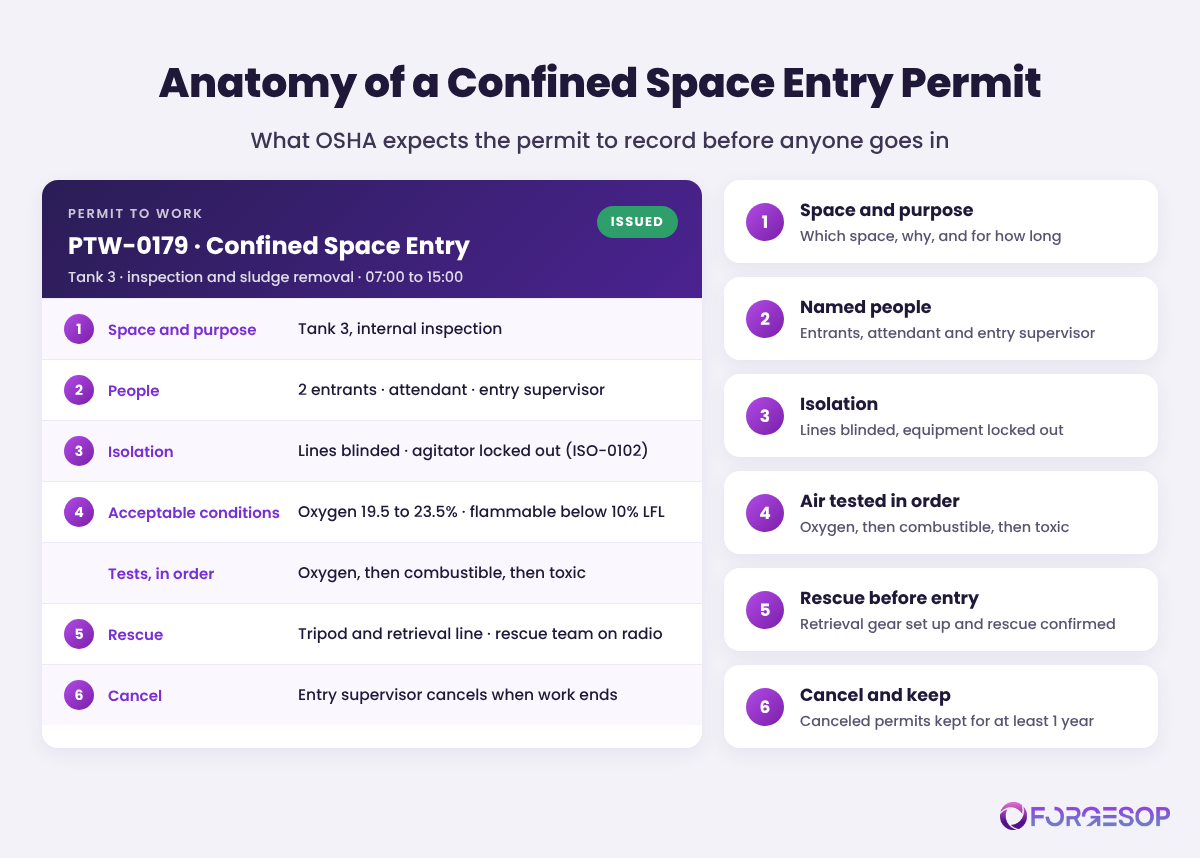
Notice the rescue line. OSHA requires retrieval systems whenever an authorized entrant enters a permit space, unless the equipment would increase the overall risk or would not help a rescue.
How to issue a confined space entry permit in 6 steps
Confirm the space and the purpose. Check the space is on your confined space inventory and that entry is truly necessary. Work from outside where possible.
Isolate the space. Blind, blank or disconnect lines, and lock out mechanical and electrical equipment. Use an isolation permit for anything complex.
Ventilate and test. Test oxygen first, then combustible gases, then toxic gases, at several depths. Record results, times and initials.
Name everyone. List entrants, the attendant and the entry supervisor on the permit, and confirm their training is current.
Set up rescue before anyone enters. Put retrieval equipment in place, confirm the rescue service is available, and test communication.
Sign, post and cancel. The entry supervisor signs, the permit is posted at the entrance, and it is canceled when work ends or conditions change.
The attendant is the most important person on the job
The attendant stays outside, keeps an accurate count of who is inside, stays in contact with entrants, orders evacuation when conditions change and calls rescue. Under OSHA rules, the attendant must not take on duties that interfere with monitoring entrants.
In practice, the attendant is often the first role to be compromised. Common failures:
The attendant is also fetching tools or watching two spaces at once.
The attendant enters to help. That is how one death becomes two.
Tests are done once. Atmospheres change as sludge is disturbed or work begins.
Rescue means "call 911." Public emergency services may take too long or lack confined space training. Confirm your rescue service can respond in time.
Paper permits cannot stop a supervisor from signing without a test result. Dedicated permit to work software can block issue until test results are recorded and the attendant and rescue plan are named.
Which permits pair with a confined space entry permit?
an isolation permit for the lines and equipment connected to the space
a hot work permit for any welding or cutting inside the space
a contractor permit to work when an outside firm does the entry
See how all the main permit types fit together in our guide to the permit to work system.
The bottom line
A confined space entry permit is a short form that protects people from hazards they often cannot see or smell. It works when the space is isolated, tested in the right order, staffed by a dedicated attendant and backed by a rescue plan that exists before anyone goes in.
Pull your last ten canceled entry permits and check them against the 15 required items. Any gaps you find are the ones to fix first.
Frequently asked questions
What is the difference between a confined space and a permit-required confined space?
A confined space is large enough to enter, has limited entry or exit and is not designed for continuous occupancy. It becomes permit-required when it also has a serious hazard, such as a hazardous atmosphere, engulfment risk or a shape that could trap someone.
What order should confined space air testing follow?
Test for oxygen first, then combustible gases and vapors, then toxic gases and vapors. Oxygen comes first because many combustible gas sensors need enough oxygen to read accurately.
How long do you keep confined space entry permits?
OSHA requires employers to keep each canceled entry permit for at least one year and to note any problems found during entry, so the program can be reviewed.
Running high-risk work across sites? ForgeSOP links every permit to the SOPs, JSAs and isolations behind it, so work is authorized against current controls and closed out on the record.
General


Forge better processes
One platform. Always audit-ready.
Bring SOPs, checklists, audits, incidents, and CAPAs into one connected system for safer, clearer, and more consistent operations.
No credit card required · Built for teams that run on process