
General
Back to Blog
General5 min read
Flowchart SOP Format: What It Is, an Example, and How to Write One
A drum of solvent tips over in the warehouse. Two people arrive at the same time. One grabs the spill kit. The other starts clearing the area and reaches for the phone. Both are following the same written procedure.
The procedure had the right steps. It just buried the first decision in the middle of a paragraph.
The flowchart format brings decisions like that into the open. It is one of the eight types of SOP formats, and the best fit for any task where the next step depends on an answer. In this article, we cover what a flowchart SOP is, when to use one, a worked example and how to write one in six steps.
Key takeaways
A flowchart SOP draws a procedure as boxes joined by arrows, with a diamond wherever someone has to make a decision.
Use it when a task involves several decisions, whatever its length.
Write every decision as a yes or no question and label both branches.
Keep the chart to one page and move detail into linked text procedures or tables.
What is the flowchart SOP format?
A flowchart SOP is a standard operating procedure (SOP) drawn as a diagram. Each reader starts at the top and follows only the path that applies to them, which is why flowcharts are so fast to use.
Most SOP flowcharts need just four symbols:
an oval for the start and the end
a rectangle for an action
a diamond for a decision, with one arrow out for each answer
an arrow to show what comes next
These conventions are old and stable. The International Organization for Standardization (ISO) set out flowchart symbols in ISO 5807 back in 1985, and the standard was last reviewed and confirmed in 2019. The US Environmental Protection Agency (EPA) also recommends flowcharts in its SOP guidance, both to illustrate the process and to break up long sections of text.
When should you use the flowchart format?
The writing guide Penn State published for dairy farm businesses in 2001 puts it simply: if a task involves many decisions, use a flowchart, whether it has five steps or fifty.
Flowcharts suit tasks like:
incident and complaint triage
equipment fault finding
chemical spill response
handling a nonconformance, meaning a product or process that fails a requirement
deciding who to notify and when
Choose something else when the task is a straight line, because a flowchart of a straight line adds nothing that simple steps don't already say. When the work crosses several teams, use the swimlane format instead.
Flowchart SOP example
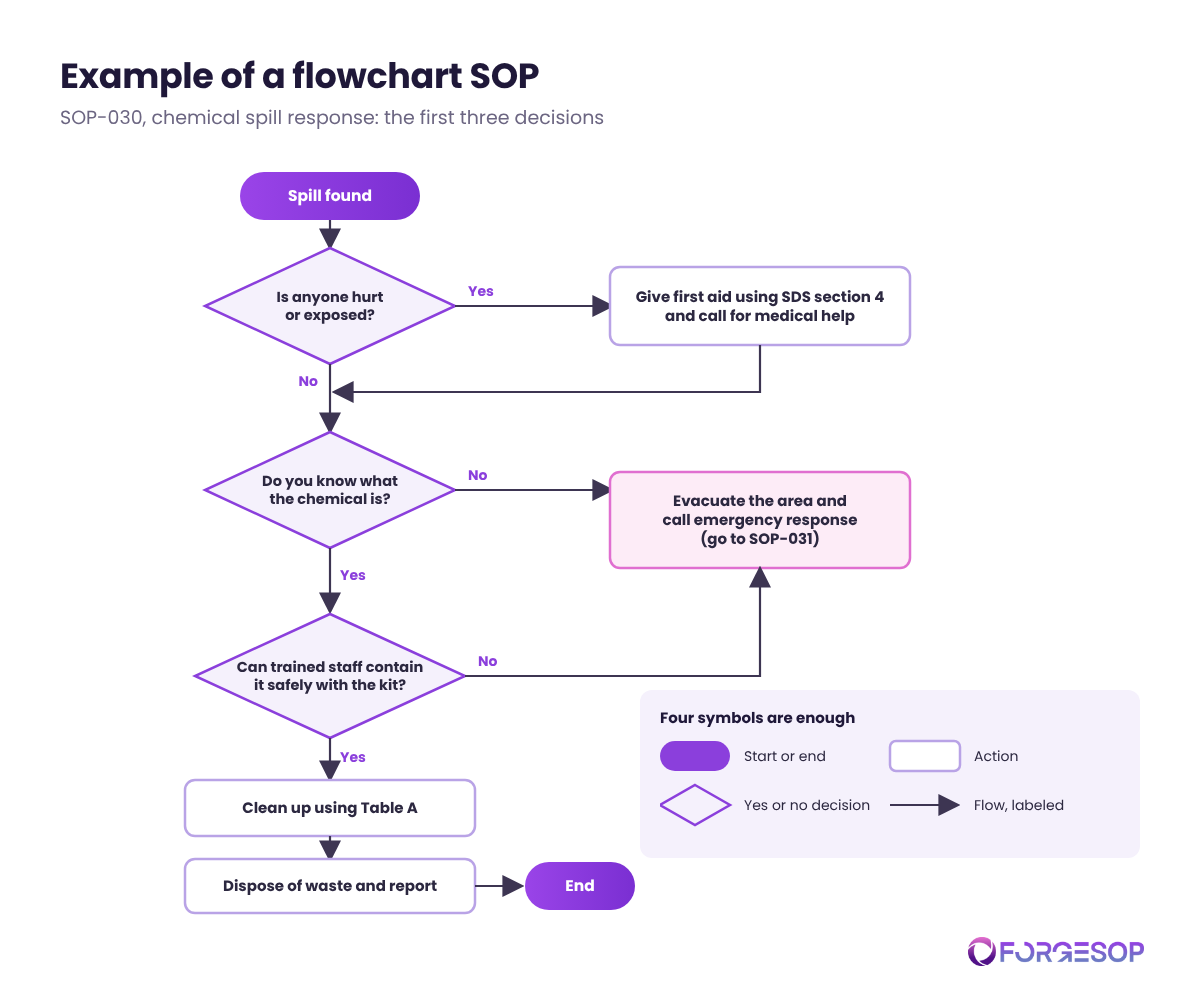
Here are the first decisions in a chemical spill procedure, written as a flowchart.
SOP-030: Chemical Spill Response, First Decisions
Start: a spill is found.
Decision: Is anyone hurt or exposed? If yes, give first aid using section 4 of the safety data sheet (SDS) and call for medical help, then continue. If no, continue.
Decision: Do you know what the chemical is? If no, evacuate the area and call emergency response. If yes, continue.
Decision: Can trained staff in the area contain it safely with the spill kit? If no, evacuate the area and call emergency response. If yes, continue.
Action: Clean up using Table A, personal protective equipment (PPE) and absorbent by chemical type.
Action: Dispose of the waste and report the spill.
End.
The third diamond is the one that matters most. It mirrors a line drawn in the hazardous waste operations and emergency response (HAZWOPER) standard from the Occupational Safety and Health Administration (OSHA), which does not treat incidental releases that employees in the immediate area can absorb, neutralize or otherwise control at the time of release as emergency response. Everything bigger needs the emergency path. Our guide to emergency and incident response SOPs covers that side.
How to write a flowchart SOP in 6 steps
List the decisions first. Ask the people who do the job where they have to stop and think. Those are your diamonds.
Phrase each decision as a yes or no question. "Is anyone hurt?" works. "What kind of chemical is it?" belongs in a table.
Draw the main path first. Lay out the most common route from start to end, top to bottom.
Add the branches. Label every arrow out of a diamond, and make sure every branch ends in an action or an end point. No dead ends.
Keep it to one page. When a branch needs detail, point to a linked text procedure or table rather than squeezing it onto the chart.
Walk every branch with the doers. Test each path against a real scenario before you approve the chart.
If it needs a magnifying glass, it has failed
Flowcharts go wrong in a few familiar ways:
Unlabeled arrows. A diamond with two unmarked arrows forces the reader to guess.
Dead ends. A branch that just stops leaves someone standing in a spill with no next step.
Questions that aren't yes or no. Multiple-choice questions belong in a table.
Too much on one page. If people have to zoom in to read it, split it into a main chart and sub-charts.
An image with no source file. Flowcharts are often saved as pictures, so nobody can edit them when the process changes.
Keep the editable source with the approved version, under the same owner and review date. Purpose-built SOP management software holds both in one place, with a version history behind them.
Which formats pair well with flowcharts?
A table holds the lookups a flowchart points to, such as PPE by chemical type.
A swimlane takes over when the decisions are spread across several roles.
For the full set, see our guide to types of SOP formats.
The bottom line
A flowchart puts decisions where everyone can see them. That matters most in the moments when people are stressed and have no time to read.
Pick the procedure your team argues about most, list its decisions, and draw it on a single page.
Frequently asked questions
What symbols are used in an SOP flowchart?
Most SOP flowcharts use four: an oval for start and end, a rectangle for an action, a diamond for a decision and arrows for the flow. Standard symbols are set out in ISO 5807.
When should an SOP be a flowchart instead of a list?
When the task involves several decisions, so the next step depends on an answer. If the task runs the same way every time, a numbered list is clearer.
Can a flowchart replace a written SOP?
For simple decision tasks, yes. For complex tasks, the flowchart works best as the front page, with linked text procedures or tables carrying the detail.
Want every SOP in one place, whatever its format? ForgeSOP keeps your procedures versioned, acknowledged, and reviewed on schedule, so the steps people follow are always the current ones.
General
Forge better processes
One platform. Always audit-ready.
Bring SOPs, checklists, audits, incidents, and CAPAs into one connected system for safer, clearer, and more consistent operations.
No credit card required · Built for teams that run on process