
General
Back to Blog
General6 min read
Simple Steps SOP Format: What It Is, an Example, and How to Write One
A new hire is asked to receive the morning chemical delivery. The procedure fits on one page, but it is written as three dense paragraphs. Halfway through the second one sits the line about checking each label against the current safety data sheet (SDS). It gets missed.
Nothing in that procedure was wrong. It was just hard to follow.
The simple steps format fixes that problem for short, routine tasks. It is the most basic of the eight types of SOP formats, and the one most teams should reach for first. In this article, we cover what the format is, when it fits, a worked example, and how to write one in six steps.
Key takeaways
A simple steps SOP is a short numbered list in which each line holds one action, written in the order the work is done.
Use it for tasks with about ten steps or fewer and no decisions along the way.
Start every step with a verb, keep one action per line, and put any warning before the step it applies to.
If the list keeps growing or starts to branch, move to hierarchical steps or a flowchart.
What is the simple steps SOP format?
The simple steps format is a standard operating procedure (SOP) laid out as a numbered list. Each number is one action. The steps run top to bottom in the same order the work runs on the floor, so the reader never has to jump back or skip ahead.
It is the format most people picture when they hear the word SOP, and there is a reason it is so common. A numbered list is quick to write, easy to scan and simple to update when the task changes. Editing one line takes a minute.
The format still needs the usual frame around it: a title, a purpose, a scope, an owner and a revision number. The simple part is how the steps are laid out, not whether the document is controlled.
When should you use the simple steps format?
A useful rule of thumb comes from a writing guide Penn State published for dairy farm businesses in 2001: if a task has no decisions and ten steps or fewer, simple steps are the best fit. The rule works just as well in a warehouse, a lab or an office.
Use the simple steps format when:
The task is routine. It runs the same way every time, such as opening a site or logging a delivery.
There are no branches. Nobody has to stop and choose between two paths.
The list is short. Roughly ten steps or fewer, so it fits on one screen or one laminated card.
The reader already knows the job. The SOP is a reminder of order and key points, not a training manual.
Choose something else when the task has many steps that need detail (use hierarchical steps) or when the next step depends on an answer (use a flowchart).
Routine tasks are also where written procedures are least likely to be opened. In a 1998 survey of nearly 400 petrochemical operators and managers, presented to the Institution of Chemical Engineers (IChemE), only 10% said they used procedures for routine tasks, compared with 75% for safety-critical ones.
A short, plain list gives a routine procedure its best chance of being read.
Simple steps SOP example
Here is the procedure from the opening scenario, rewritten as simple steps.
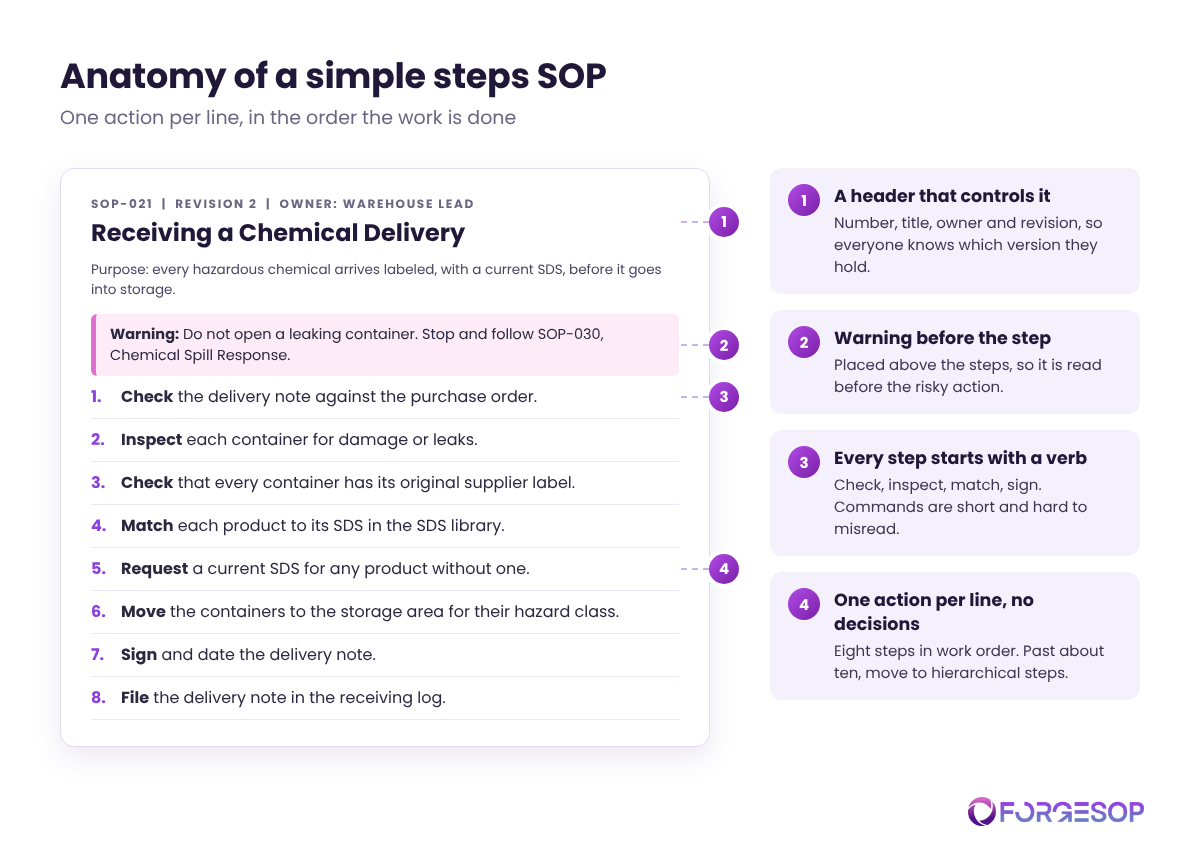
SOP-021: Receiving a Chemical Delivery
Purpose: Make sure every hazardous chemical arrives labeled, with a current SDS, before it goes into storage. Scope: All chemical deliveries to the main warehouse. Owner: Warehouse Lead. Revision 2.
Warning: Do not open a leaking container. Stop and follow SOP-030, Chemical Spill Response.
Check the delivery note against the purchase order.
Inspect each container for damage or leaks.
Check that every container has its original supplier label.
Match each product to its SDS in the SDS library.
Request a current SDS from the supplier for any product without one.
Move the containers to the storage area for their hazard class.
Sign and date the delivery note.
File the delivery note in the receiving log.
Eight steps, one verb at the start of each, and no branches. The warning sits above the list, before the reader reaches the step where it matters.
How to write a simple steps SOP in 6 steps
Watch the task being done. Walk it with the person who does it most often and write down each action in order. Writing from memory at a desk misses steps.
Cut it to one action per line. If a step contains "and then", it is usually two steps.
Start every step with a verb. Check, move, sign. Commands are shorter and harder to misread than descriptions.
Use "must" for requirements. The Office of the Federal Register advises writers to use "must" to impose an obligation, because "shall" can read like a prediction.
Put warnings before the step. A caution that comes after the action arrives too late.
Test it with someone new. Hand it to a person who has never done the task and watch where they hesitate. Every pause points to a line that needs fixing.
Short does not mean careless
The biggest risk with simple steps is that they look finished when they are not. Watch for these mistakes:
Hiding a decision inside a step. "Store the drum in the right place" assumes the reader knows the right place. Name it, or point to the table that does.
Letting the list grow. Fifteen steps is no longer simple. Group them into main steps with sub-steps instead.
Mixing why with what. Background belongs in the purpose section. The steps should be actions only.
Skipping the review date. A short list goes stale as quickly as a long one, so it needs an owner and a review cycle like any other controlled document.
Keeping dozens of short SOPs current is where a shared folder starts to struggle. Purpose-built SOP management software keeps one approved version of each, a named owner and a reminder when the review date comes round.
Which formats pair well with simple steps?
Simple steps rarely cover a whole site on their own. They often sit alongside:
a checklist that pulls the critical points of the same task onto one page for sign-off
hierarchical steps for the longer, rarer tasks in the same area
a table for lookups the steps refer to, such as storage areas by hazard class
For a side-by-side view of all eight, see our guide to types of SOP formats.
The bottom line
The simple steps format is the default for good reason. It is fast to write, fast to read and easy to keep current. If your SOP library is full of paragraphs, rewriting your most-used routine procedures as numbered steps is one of the quickest wins available.
Start with one task this week: watch it, list it, test it and publish it.
Frequently asked questions
How many steps should a simple steps SOP have?
About ten or fewer. Past that point, readers lose their place and the list becomes hard to scan. Group longer tasks into main steps with sub-steps instead.
Can a simple steps SOP include warnings?
Yes. Place each warning or caution directly before the step it applies to and keep it to one or two lines. A warning is not a decision, so it does not break the format.
What is the difference between simple steps and a checklist?
Simple steps teach the order of a task. A checklist confirms that critical steps were done, usually by someone who already knows the task. Many teams use both for the same job.
Want every SOP in one place, whatever its format? ForgeSOP keeps your procedures versioned, acknowledged, and reviewed on schedule, so the steps people follow are always the current ones.
General


Forge better processes
One platform. Always audit-ready.
Bring SOPs, checklists, audits, incidents, and CAPAs into one connected system for safer, clearer, and more consistent operations.
No credit card required · Built for teams that run on process