
Education
Back to Blog
General18 min read
Compliance SOPs: What They Are, Examples, and How to Write One
At some point in the past year, a rule that applies to your operation changed. A reporting threshold moved, a permit condition was rewritten, a retention period stretched, a form gained a mandatory field. The agency announced it in a notice nobody on your team had time to read, and your written procedures kept saying exactly what they said on the day they were approved.
Most compliance findings are born in that quiet gap between the rule as it stands and the procedure as written. Not from recklessness, but from drift.
Compliance SOPs exist to close that gap and keep it closed. This guide covers what a compliance SOP is, how it differs from its operational, safety, and quality SOPS, which procedures to write first, what belongs inside each one, and a seven-step method for writing compliance procedures that survive both the audit and the next rule change.
Quick answer: A compliance SOP (standard operating procedure) is a written, step-by-step instruction for the recurring tasks that keep an organization meeting regulatory, legal, and contractual requirements: regulatory reporting, document control, permit renewals, training records, audits, and data retention. Each one names the requirement it satisfies, who does what by when, and the record that proves it happened.
Key takeaways
Compliance SOPs are the procedures that translate external requirements (regulations, permits, standards, client contracts) into named tasks with owners, deadlines, and records.
Their defining feature is the requirement reference. Every compliance SOP should cite the exact rule, clause, or permit condition it satisfies; a procedure that cannot name its requirement cannot prove its purpose.
Regulators cite missing paperwork more often than missing hardware. Three of OSHA's five most cited standards in FY2025 (hazard communication, lockout/tagout, respiratory protection) are built on a written-program requirement.
Compliance SOPs fail on the calendar, not the shop floor. Deadlines, renewal dates, and rule changes are their native hazards, so triggers, clocks, and escalation paths belong inside the document.
Reactive compliance is the expensive kind. Ponemon Institute research puts the cost of non-compliance at 2.71 times the cost of staying compliant.
Treat every compliance SOP as a living document tied to the current version of its requirement. When the rule changes and the procedure does not, the finding writes itself.
What is a compliance SOP?
A compliance SOP is a standard operating procedure that documents how your organization meets a specific requirement imposed from outside the task itself: a regulation, a permit condition, a standard clause, a contract term, or a corporate policy. It takes one obligation (file this report, keep this record, renew this permit, run this audit) and turns it into a named task with an owner, a method, a deadline, and a record that proves completion.
Compliance SOPs come in two flavors, and if you read the quality installment of this series, the split will feel familiar. Performing procedures carry out obligations directly: submitting the annual injury summary, filing the chemical inventory report, renewing the wastewater permit. Governing procedures keep the compliance system itself working: document control, internal audits, regulatory change monitoring, management of change. The first kind satisfies the regulator this quarter. The second kind makes sure the first kind still works next year.
Within the documentation stack, compliance SOPs sit between policy and proof. The policy says "we comply with all applicable regulations," which commits you to everything and instructs nobody. The records prove what happened after the fact. Compliance SOPs are the layer in between, where "all applicable regulations" becomes a list of specific duties with names and dates attached. If the term SOP itself is new ground, start with our plain-language guide to what an SOP is and come back; this article assumes the basics and goes deep on one category.
How are compliance SOPs different from safety and quality SOPs?
Every SOP type shares the same skeleton: numbered steps, named roles, a revision block. What changes is the risk each type exists to control. An operational SOP protects consistency and throughput. A safety SOP protects the person doing the work. A quality SOP protects the product. A compliance SOP protects the organization itself: its permits, its certifications, its contracts, and its standing with the agencies that can stop the line without touching it.
Safety SOPs | Quality SOPs | Compliance SOPs | |
|---|---|---|---|
Primary job | Preventing injury and illness | Keeping output inside specification | Meeting external requirements and proving it |
Typical trigger for writing one | Risk assessment, regulation, incidents | Defects, complaints, customer specs | A regulation, permit, standard, or contract clause |
Core content | Hazards, controls, PPE, emergency actions | Method, sampling, acceptance criteria | Requirement reference, duties, deadlines, records |
Cost of failure | Injury, enforcement, liability | Escapes, recalls, lost customers | Citations, fines, lost permits and contracts |
Review cadence | At least annual, plus after every incident | Annual, plus every spec or method change | Annual, plus every rule or permit change |
Sign-off | Safety lead plus operations | Quality lead | Compliance owner, often with legal review |
One difference deserves special attention, because it reshapes how the documents are written. In most SOP types, the record is a by-product of the work: you run the changeover, and the log entry proves you did. In a compliance SOP, the record frequently is the work. The filed report, the posted summary, the retained exposure record: the deliverable and the evidence are the same object. That is why compliance procedures obsess over confirmation numbers, filing receipts, and retention periods in a way that would look fussy anywhere else.
In practice the categories overlap, and that is fine. A lockout/tagout procedure is a safety SOP through and through, and it also satisfies a federal standard that explicitly requires documented energy control procedures, which makes it compliance content too. The fix is never to write two overlapping documents.
Write one SOP for the task and tag it into both categories. The question that matters day to day is simpler: when the reason a document exists is an external requirement, and the evidence trail is the point, the rules in this article apply.
Regulators cite missing paperwork more often than missing hardware.
That sounds like an excuse to buy binders, so here is the evidence.
Every fiscal year, the Occupational Safety and Health Administration (OSHA) publishes its ten most cited standards. In the FY2025 list, hazard communication sits at number two with 2,546 citations, lockout/tagout at number four with 2,177, and respiratory protection at number five with 1,953. Look up what those standards actually demand and a pattern appears: each one is anchored to a written document. Hazard communication requires a written program. Lockout/tagout requires documented energy control procedures. Respiratory protection requires a written program with worksite-specific procedures. When inspectors cite these standards, they are very often citing paper that does not exist, does not match the site, or was never shown to the people it covers.
The same pattern holds in regulated manufacturing. The most cited observation in FDA drug inspections in FY2025, at 243 citations, was quality unit procedures "not in writing or not fully followed." Not fraud, not contamination: procedures.
The reality is that inspectors rarely discover organizations doing malicious things. They discover organizations that cannot produce the program, the procedure, or the record, and enforcement treats the two almost identically.
Why does the gap persist?
Because compliance work is quiet work. The report filed on time produces silence; the permit renewed early produces silence; and silence is easy to deprioritize when production is loud. Obligations end up living in one experienced person's head and personal calendar, which works right up until that person leaves. The U.S. Bureau of Labor Statistics puts median employee tenure at 3.9 years as of January 2024. Your permit cycle, your retention periods, and your regulators will all outlast the person who currently remembers them.
Compliance knowledge that is not written down is not institutional. It is on loan.
What does non-compliance actually cost?
Start with the sticker prices. Under OSHA's 2026 penalty levels, a serious violation runs up to $16,550 and a willful or repeated violation up to $165,514. Those are per-violation figures, and violations multiply: each missing written program, each untrained employee, each unposted summary can count separately, which is how a single inspection turns into a six-figure citation package.
Environmental enforcement sets a similar tone. In its FY2025 annual results, the U.S. Environmental Protection Agency (EPA) reported 2,127 concluded civil enforcement cases, the most in nine years, over $1.2 billion assessed in civil penalties and criminal fines, and 156 criminal defendants charged, the most since 2016, on the back of nearly 8,300 inspections.
Then there is the asymmetry that matters for budgeting. A Ponemon Institute study of 53 multinational organizations, conducted with Globalscape, found that meeting data protection requirements cost an average of $5.47 million a year while non-compliance cost $14.82 million, a factor of 2.71. The study looked at data protection specifically, but anyone who has lived through a consent order will recognize the shape: fines are the visible slice, and business disruption, remediation, and rebuilt trust are the rest of the bill.
The good news? The control that prevents most of this is a document. A written procedure with an owner and a deadline costs an afternoon to produce, and it is the difference between an obligation your organization holds and an obligation one employee happens to remember.
Which compliance SOPs should you write first?
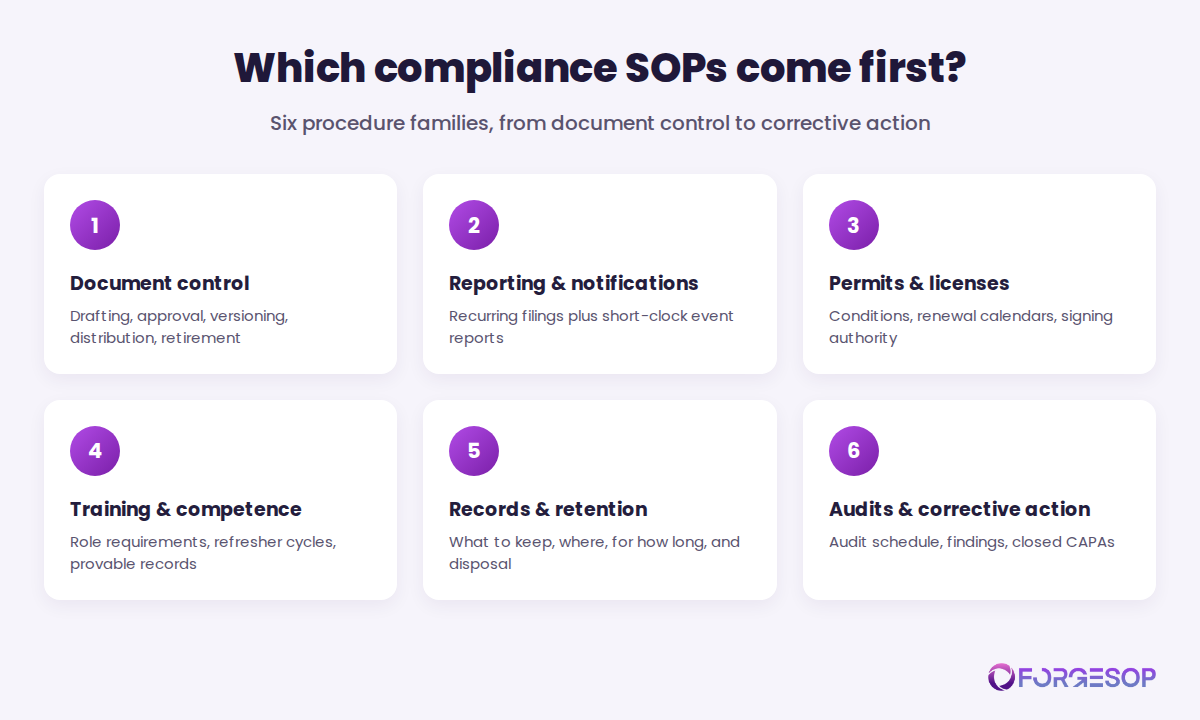
Not all obligations carry equal risk, and no team writes forty procedures in a quarter. Across industries, the highest-value compliance SOPs cluster into six families. Start where your deadlines and your last audit already point.
Document control. The SOP for your SOPs: how procedures are drafted, approved, versioned, distributed, and retired, and how superseded copies leave circulation. Nearly every external framework audits this first, because if document control is broken, no other procedure can be trusted. Write it before the library grows, not after.
Regulatory reporting and notifications. The recurring filings (injury and illness summaries, chemical inventories, discharge monitoring reports) plus the event-driven notifications that run on short clocks, such as reporting a work-related fatality to OSHA within 8 hours or an in-patient hospitalization within 24. This SOP owns the calendar and the stopwatch.
Permit, license, and registration management. What you hold, which conditions each one imposes on daily operations, renewal lead times, and who has signing authority. An expired permit can stop work faster than most incidents, and renewal windows are unforgiving of vacation schedules.
Training and competence records. Which roles require which training under which rule, refresher cycles, and records that connect person, course, date, and document version. Untrained or unverifiable-trained employees are a citation multiplier across many standards.
Records retention and data handling. What to keep, in what form, where, for how long, and how records are protected and eventually destroyed. Retention periods vary wildly (OSHA injury logs: five years; employee exposure records: thirty), and if you handle personal data, privacy rules add their own schedule.
Internal audits and corrective action. The audit schedule, the method, and the path that turns findings into owned, verified fixes. We cover the mechanics in our guides to audit-ready operations and the CAPA investigation process; the compliance SOP is what makes those loops mandatory rather than aspirational.
Two rules set the order inside the families. Follow the deadlines: anything with a filing date, posting window, or renewal date gets documented first, because calendar failures are both the most common and the most defensible to prevent. And follow the findings: whatever your last audit, inspection, or near-miss with a regulator flagged is, by definition, the gap someone else has already noticed.
What does a compliance SOP include?
Format matters less than completeness, but strong compliance SOPs share ten building blocks:
Title and unique ID, such as SOP-041, so training records, audits, and revisions stay traceable
Purpose and scope: the obligation covered, the sites and roles it applies to, and what the document deliberately excludes
Requirement reference: the exact regulation, clause, permit condition, or contract term the procedure satisfies, cited by number and effective date
Roles and responsibilities: who performs each task, who reviews or signs, and who answers to the regulator, with a named deputy for each critical role
Definitions: the acronyms and terms of art spelled out once, so the next owner does not have to guess what the last one meant
Triggers and deadlines: what starts the task (a calendar date, an event, a threshold crossed) and every clock that follows
Numbered steps in sequence: one action per step, including the systems used, the forms completed, and the sign-offs collected
The record: exactly what proves completion (confirmation number, certified receipt, signed form), where it is filed, and its retention period
Escalation and exception path: what happens when a deadline is at risk, a requirement cannot be met, or the rule is ambiguous, including when legal counsel gets a call
Revision block and review triggers: version, author, approver, effective date, next review date, and the change events that reopen the document early
Two of these blocks separate real compliance SOPs from routine procedures wearing a compliance label.
The requirement reference is the defining block. A procedure that cannot name its requirement is an orphan: when the rule changes, nobody knows this document is affected, and when an auditor asks why you do this, the answer is folklore. The reference works in the other direction too. Knowing exactly what the clause demands tells you what you can stop doing; plenty of compliance workload is accumulated habit that no current rule actually requires.
Triggers, deadlines, and the exception path earn their keep under pressure. A 24-hour hospitalization report does not wait for the safety manager to return from leave, which is why the deputy is named in the document rather than decided in the moment. Give every deadline an internal early-warning version ("renewal packet complete 60 days before expiry; if not, escalate to the site director") so the procedure fails loudly while there is still time to recover.
What does a compliance SOP look like in practice?
Here is the skeleton of a real one, trimmed for space.
SOP-041: Injury and illness recordkeeping and reporting (v2.1, owner: EHS Manager, review due: August 2027). Purpose: meet OSHA injury and illness recordkeeping and reporting obligations for the Dayton site.
Requirement references: 29 CFR Part 1904 (recording criteria, forms, retention) and 29 CFR 1904.39 (fatality and severe injury reporting). Roles: supervisors report any work-related injury or illness to the EHS Manager the same shift; the EHS Manager determines recordability and updates the OSHA 300 log within 7 calendar days; HR maintains privacy-case files; the site director certifies the annual summary.
Triggers and deadlines: recordability decided within 7 days of learning of a case; Form 300A certified and posted February 1 through April 30; electronic submission completed by March 2; any work-related fatality reported to OSHA within 8 hours and any in-patient hospitalization, amputation, or loss of an eye within 24 hours.
Steps cover the incident intake form, the recordability decision tree, log entry, annual summary preparation, and the submission portal workflow, with screenshots.
Records: 300 logs, 301 incident reports, and 300A summaries retained five years and producible on request.
Escalation: any potential 8-hour or 24-hour report triggers an immediate phone call to the EHS Manager and site director, with the corporate legal contact listed by name and number.
Nothing in it is clever. Everything in it is dated, owned, and checkable, and when an inspector opens with "show me your logs and who certifies them," the answer takes minutes.
How to write a compliance SOP in 7 steps
The method matters more than the template, and for compliance procedures the method starts one step further back than most guides admit: before you can document the task, you have to read the rule that created it.
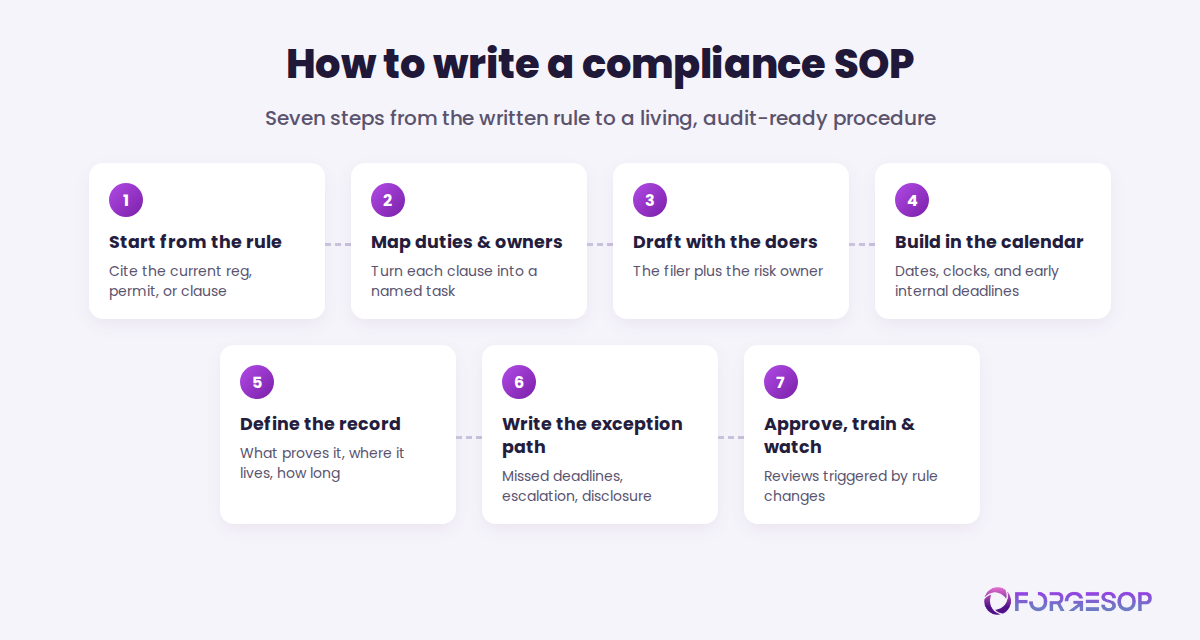
Start from the requirement, not the task. Pull the current text of the regulation, permit, standard, or contract clause, and cite it in the reference block by number and effective date. A surprising number of findings trace back to procedures built on a summary of a rule, or a consultant's memory of one, rather than the rule itself.
Translate the requirement into duties, owners, and dates. Walk the text clause by clause and ask three questions: what must exist, what must happen, and what must be kept? The output is a duty list with a named role and a deadline against each line. Write the procedure from the duty list, not from how things happen to work today.
Draft with the person who files, and the person who owns the risk. The coordinator who uses the submission portal knows the quirks the regulation never mentions; the compliance or EHS lead knows what the regulator expects between the lines. Where interpretation is involved, get legal eyes on the draft once, in writing, so the interpretation survives staff changes.
Build the calendar into the document. Every date, clock, and threshold from step 2 goes into the procedure itself, each with an internal deadline set ahead of the legal one. A report that is submission-ready five business days early turns a portal outage from an emergency into an anecdote.
Define the record before the first execution. Decide what proves completion, where it is filed, who can retrieve it, and how long it is retained. If the proof is a confirmation number, the step that captures it belongs in the procedure; screenshots taken in a panic two years later are not a retention strategy.
Write the exception path while nobody needs it. A missed deadline, a system outage on filing day, a requirement you discover you cannot meet, a potential violation surfaced mid-task: name who decides, who is informed, and whether self-disclosure options apply. These calls are hard enough with a procedure and reckless without one.
Approve, train, version, and watch the rule. Route the document for signature including the compliance owner, train every affected role against that version, and record the training. Then tie reviews to events, not just the calendar: a regulatory change alert, a permit renewal, a reorganization, or an audit finding each reopens the document automatically.
A compliance SOP is only as current as the rule it cites.
Here is the trait that makes this SOP type unusual: every other procedure in your library decays when your operation changes. Compliance SOPs also decay when someone else's text changes, in an agency office, a standards committee, or a client's legal department, and nobody sends you a calendar invite when it happens.
The recent example every regulated manufacturer knows: the FDA's Quality Management System Regulation (QMSR) took effect on February 2, 2026, retiring a framework device makers had cited in their procedures for decades in favor of ISO 13485 alignment. Teams that kept a requirement map, with each procedure tied to the clauses it satisfies, could list every affected document in an afternoon. Teams that did not spent weeks doing archaeology in their own library.
So treat regulatory change as an operational input with an owner. Someone specific monitors the sources (agency mailing lists, register notices, permit correspondence, standard revisions), and the requirement reference block turns each alert into a lookup: which SOPs cite this rule, and who owns them? This is also where version control stops being an administrative nicety. A stale printout taped inside a control room cabinet is how a site follows a superseded rule for eleven months, a failure mode we dissected in the hidden cost of uncontrolled SOPs. Purpose-built compliance management software closes that gap structurally, keeping each procedure tied to its requirement with versions, approvals, and evidence attached, so a rule change surfaces every affected document in minutes instead of weeks. However you solve it, solve it before the library grows past a dozen documents; retrofitting traceability during an enforcement response is the most expensive way to buy it.
In short, most compliance teams do not have a writing problem. They have a watching problem, and watching is a system you build, not a virtue you hire.
The bottom line
Compliance SOPs are where "we follow the rules" stops being a belief and becomes a set of tasks that specific people own on specific dates. Regulators read them first, auditors sample them first, and on the day something goes wrong, they are the difference between demonstrating a managed system and narrating a scramble.
Start with five documents: document control, the reporting obligation with the nearest deadline, permit renewals, training records, and records retention. Cite the current rule in every one, build the calendar and the exception path into the text, and give each document an owner plus review triggers tied to the rule itself. Then keep them pointed at today's requirements, because a procedure citing a current rule is a control, and a procedure citing a superseded rule is a finding that has not been written up yet.
Get ahead of the requirements while they are still calendar entries, and not yet citations.
Frequently Asked Questions
What is a compliance SOP?
A compliance SOP (standard operating procedure) is a written, task-level document explaining how your organization meets a specific regulatory, legal, contractual, or internal requirement. It cites the requirement it satisfies, assigns each duty to a named role, sets the triggers and deadlines, defines the escalation path, and specifies the record that proves the obligation was met.
What are examples of compliance SOPs?
Common examples include document control, injury and illness recordkeeping and reporting, environmental and chemical inventory reporting, permit and license renewal management, training record management, records retention and destruction, internal audit scheduling and execution, and corrective and preventive action (CAPA) management. Any recurring task that exists because a rule, permit, standard, or contract demands it is a candidate.
What is the difference between a compliance SOP and a quality SOP?
A quality SOP keeps output inside specification: it is built around methods, sampling, and measurable acceptance criteria. A compliance SOP keeps the organization meeting external requirements: it is built around a requirement reference, deadlines, responsibilities, and evidence. The two overlap often, since many quality procedures satisfy regulatory clauses, and the best practice is one document tagged into both categories rather than two overlapping ones.
Does OSHA require SOPs?
OSHA rarely uses the term SOP, but many of its standards require written programs or documented procedures, including hazard communication, lockout/tagout energy control procedures, respiratory protection, process safety management operating procedures, and emergency action plans. In practice, missing or inadequate written documents are among the most commonly cited failures under these standards, so written procedures are effectively mandatory wherever those rules apply.
How often should compliance SOPs be reviewed?
Review each compliance SOP at least annually, and immediately whenever its underlying requirement changes, a permit is renewed or modified, the organization restructures, or an audit or inspection produces a related finding. Because the requirement can change without any internal trigger, assign someone to monitor regulatory sources and map each SOP to the rules it cites, so external changes reopen the right documents automatically.
Who should own compliance SOPs?
Give each document a single named owner: the role closest to performing the obligation, such as the EHS manager for injury reporting or the document controller for document control. A compliance or legal function should review and co-approve, and every critical duty needs a named deputy, because regulatory deadlines do not pause for vacancies or vacations. Ownership by "the compliance department" as a whole reliably means ownership by nobody.
Can one SOP be both a safety SOP and a compliance SOP?
Yes, and it often should be. A lockout/tagout procedure protects the worker and simultaneously satisfies a standard that requires documented energy control procedures. Write one procedure for the task and tag or index it under both categories, so each audience finds it. Writing two parallel documents guarantees they will disagree eventually, and an auditor will find the disagreement before you do.
Building your compliance SOP library one requirement at a time? ForgeSOP keeps every procedure tied to its requirement, its owner, and its evidence, so the proof exists before anyone asks for it.
General
Forge better processes
One platform. Always audit-ready.
Bring SOPs, checklists, audits, incidents, and CAPAs into one connected system for safer, clearer, and more consistent operations.
No credit card required · Built for teams that run on process